
Translated material
About the symbolism of the hare among the Slavs
About the symbolism of the hare among the Slavs [1]
In the modern mass consciousness, the image of the hare is present primarily as the personification of cowardice and as a character of folk tales, in which he appears as a defenseless creature. In this regard, the expression is cowardly as a hare, to tremble like a hare, a hare of heart, a hare soul, to run (drape) as a hare, proverbs “a frightened hare and a bush is afraid”, “a thief that a hare: and is afraid of his shadows”. Well known in Europe, including the Slavs, the fairy -tale plot "Who is the cowardly of the hare?" The Belarusian legend explains the fearfulness of the hare by the fact that he has too little heart. When God sculpted the hare of clay, he made him too long ears, and there was not enough clay on his heart. Then he tore off part of the clay from the tail and made a small hare from it. In Bosnia and Bulgaria, pregnant women did not eat hare from fear that the born child would be shy. Nowadays, it was precisely such a symbolism of the hare that has gained particular popularity in urban culture. The word of the hare appeared the meaning of the “stow passenger”, and the shy, but even and even impudent and even impudent, boasting with his fearlessness, the hare became the comic hero of jokes, fables, comics and cartoons.
Meanwhile, in the traditional culture, the image of a cowardly hare is by no means the main one, but rather even peripheral, here completely different symbolic meanings are foreseen for him. In folklore texts, he acts as a male character everywhere. In game songs, they turn to him as a “Zayushka-father”, “Zhashushka Stepanushka”. In Bulgaria, Zaeshka is a game (dance with jumps) is exclusively men. In the Ukrainian fairy tale, the gardener shares with his wife a wonderful apple brought by a hare, which is why they are born a son named Zanan. And the Bulgarian has a male name Zayko.
The loving-brown symbolism of the hare is clearly manifested in folklore. In the wedding majestic songs of the groom, they call "Bellenky Zayushka, a harsh ermine." At the Russian Prikamye, they dressed up bunnies on the second day of the wedding. In round dance games of the central provinces of Russia “Zainka” is a groom who chooses a bride. He becomes in a circle, and he is asked to bake, to whip, to skip a wreath, to kiss the girl. The image of a wreath and the motive of the kiss are associated with the topic of marriage. In the Belarusian children's chorus, the old woman is advised to marry a hare. The motive for the marriage of the hare on the Kunitsa, on the Owl, on the fox is reflected in Belarusian and Ukrainian fairy tales and comic songs. The wedding is portended by the Russian cubic song about the hare that fell into a trap, which symbolizes the loss of bachelor freedom. About a girl who is not successful, the Ukrainians of Polesie said that she would get married when she caught a hare in the forest.
As an animal known for its fertility, the hare personifies the fruiting power, as, for example, in the Belarusian fairy tale about Sevchik. Pan, in order to exercise the field, buys Sevchik from a man, which turns out to be a hare that escaped from the bag. In the Serbs, hare blood served as a means of infertility, and the female organs were lubricated by the hare fat to facilitate childbirth. In Belarusians and Bulgarians, the hats were given to the chickens so that they would rush better. The Ukrainians and Kashubs were explained to children that the hare brought them. And the Luzhitshens believed that if the hare would run to the newlywed during their first time after the wedding of departure from the house, then their marriage would be happy with children.
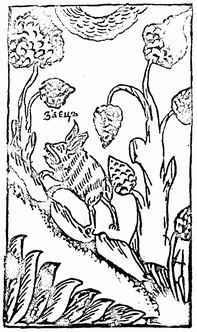 The “lust” of the hare underlies the erotic and phallic symbols of this animal. The Ukrainians and Belarusians Polesie, as well as the Macedonians, believes that if a woman dreams of a hare of her, then she will become pregnant or give birth to her son. Manuscript and Ukrainian print dream books interpret dreams about the hare as the upcoming marriage, fornication or "sin with his wife."
The symbolism of Koitus is reflected by Serbian erotic jokes about the hare jumping here and here; Moravian expression on the vain exile of hares from a hole (Marne Vyhdnelz Diry Zajice); The motives of skipping a bunny into a hole in the Belarusian round dance song, a hare bite - in Polish wedding and lyrical songs, crumbling a hare of cabbage - in Eastern Slavic song texts, etc. In the Russian mystery, snow covering winter bread is made up as a hare asked: “Zheyushka is a whitish! Lie on me; Although it’s difficult for you, but I feel good. ” Russian songs are known about Zainka, which goes to bed with a girl or asking for a widow to give him his “grace”; Russian and Ukrainian tales about how the hare was dishonored to a fox or she -wolf; The Belarusian song, performed during the first wedding night of the young, about the copulation of the hare with a fox; The Ukrainian wedding custom is to bring the hare of a hare to young after a wedding night and force the ascious “young” to “milk” him as a cow; ditties about the hare, who sticks to the squirrel with immodest intentions or dies with laughter, watching how a cockroach copulates with a flea; A modern joke about how the hare fucked into the nostril of a moose climbing into a quagmire, etc.
The archaic and sacred in its origins the phallic symbolism of the hare is confirmed by ritual sentences-wishes for the young during the division of the wedding karavay: “I give a hare, the stem at Maroz put eggs” (Gomel region); “I am PEREPPY ITSYA, Shchob was ziluvov in eggs” (Volyn region, author’s notes). The phallic symbolism of the Lord hares, the cherished Zaysits in some Russian and Ukrainian versions of a fabulous plot about a hare shepherd is quite obvious. The same symbolism is represented in the Ukrainian name of Pesta for squeezing the lean oil of the hare and in the Kashub name of the oblong bread Shch'or; In the Polish-Silesian song about a woman, which, in response to the question of what she carries, raised her leg and showed that she carried a hare at a price of half a thousand; In a popular modern ditty, “a hare on the porch came out ...”, etc.
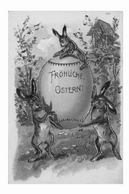
The so -called Easter hare is also connected with the hare as the personification of the fruiting of the beginning. According to ideas widely existing among the Germans, the hare lay eggs on Easter. Under German influence, this representation spread in Western Europe among the German and Romanesque peoples. Currently, the Easter hare has gained popularity in East European countries, including the Slavic (Poland, the countries of the former Yugoslavia) and the Baltic, but exclusively as an element of modern urban culture. In folk Slavic culture, the motive of Easter hare eggs has been widespread only in the West, in direct contact with the German ethnocultural tradition - especially among Luzhich residents. At the Kashubs, Poles of Pomerania and Western Galicia for Easter, children find painted eggs in a garden or in a garden under a bush, stolen by parents on the eve of. Children are explained that the hare was demolished. As it is removed east, this motive weakens, and the Hutsuls only have an image of the hare on Easter piss in, and in the Belarusian teaser only it is said that the hare was demolished from the eggs, and there is no moment of Easter dedication at all.
 A completely different nature than male marriage and love-erotic, demonological symbolism of the hare. It is connected with the world of spirits and evil spirits. As a forest inhabitant, he is subject to Leshim and is his "dog". In the Russian North, they believed that the goblin could lose hares into cards to the neighboring goblin. In conspiracies, the hunters asked the goblin to catch the hares into their traps. And the hare is not subject to the water, and he does not like the fishermen on the lake mentioning the hare. Out of fear that the water is angry and lifted the storm, the fishermen used in these cases a special, tabular name of the hare: crooked or forest lamb.
The Slavs are widespread among the Slavs about the connection of the hare with the devil, the devil, with the unclean spirit in general. According to Ukrainians, the hare was created by the devil and is in his service - he serves him “advanced”. There are general names for the hare and the line - for example, in the Novgorod province the devil was called, like a hare, oblique. In the Ukrainian riddle and in the Russian children's nursery, the hare is designated as a “oblique demon”. In the Bulgarian legend, the devil on the hare goes to the wedding of the sun. The Poles of the Western Beskik imagined a line with a hare tail, and the Russians of the Tula province believed that the witch could be recognized by her hare tail.
Especially common are the ideas about the hare-werewolf. Terrible stories about the line or Lesha in a hare appearance, which runs the way, rushes under his feet or pursues him, are popular. According to the stories of Russians and Poles, such a hare, when he is caught, becomes so heavy that he cannot be carried, and when he is thrown, he laughs and disappears. The Belarusian Polesie tells how the hare drives a hunter in the forest, lures him into the thicket and disappears in the whirlwind, and the beliefs of the native Luzhitsy are known about the whirlwind in the appearance of the hare, which can be seen if you look at the whirlwind through the sleeve of clothing. In the Karpatokrainskaya, a hare, a hare is saved from the hunter’s bullets, jumping into the hollow, and turns into tar, and in a little Polish he turns to a hawk. In the hunting stories of the Poles of the Western Besnik, a huge hare that does not take bullets appear: he threatens the hunter standing on his hind legs, or grows with each shot to such an extent that it becomes the size of a plum tree. And in the Ural Russian, a werewolf grows the size of a Christmas tree and runs away in the guise of a hare. In Czech, the hare, the hare mocks a person, offering to kiss himself in the ass, and then disappears, leaving behind a stench. Luzhitshens and Kashubov have beliefs about the evil spirit in the form of a lame or three -legged hare. The Serbs believed that the hunter to protect against the hare-draw should have a note with a conspiracy or a black dog in a gun without a single bright spot.
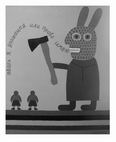 The Croats have beliefs about the spirit of the processor, who at night turns to the hare and brings money to its owner. Belarusians occasionally have stories about the brownie in the form of a black hare, and among the Russians - in the form of white. Witches and sorcerers can also take the appearance of a hare, but for the Slavic folk tradition, unlike Western European, such beliefs are less characteristic.
Mlikes about the deceased who take the hare appearance are associated with the Slavs that are common among the Slavs about the zoomorphic hypostases of the soul, including the soul as a hare. The Poles of the Lublin Voivodeship recorded a story about the appearance of her late husband in a hare, and in the Rivne Polesie-a story about someone's soul in the form of an elusive hare, who met the cemetery and disappeared without a trace there. In the North Russian lamentations on the deceased, the deceased is asked to appear to be a "gray zayush". The same performances are the basis of the acceptance of a hare who ran under the window or who ran into the courtyard (in Polesie), about a meeting with a hare (in Bosnia) and a hare who dreamed in a dream (on Volyn), as a harbinger of death.
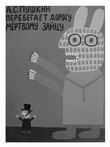
To many peoples, not only the Slavs, the sign is well known: the hare of the road or the hare met on the way serves the traveler a bad omen. This sign, also associated with the perception of the hare as an unclean and dangerous creature, in the recent past was the same popular as now a sign about a black cat. She predicted a loss of case, a hunter and a fisherman - failure in Lova, young on the way to the wedding - misfortune in marriage, pregnant - the death of the unborn child. It was believed that in this case it was necessary to turn back. Just as the traveler was frightened by a hare of a hare, a wedding train, who was running across the road, was stopped to get a ransom for fare with a hare to throw - using a log or stick thrown onto the road. It is known what role the hare of the road that crossed the road in the fate of Pushkin played. According to legend in December 1825, being in exile in Mikhailovsky, Pushkin found out about the upcoming Decembrist uprising and went to St. Petersburg to take part in him, but turned back when the hare crossed his road in front of his sleigh, and even two or three times ran through some versions. The hare saved Pushkin’s life and his future Boldin autumn, so in 2000, on the 175th anniversary of this event, the monument to the hare was opened in the village of Mikhailovsky. The monument is the figure of a hare sitting on a layout with the inscription "416 miles remained to Senate Square."
 Since the hare was perceived as an animal, demonic, dangerous, dangerous for humans, there was a ban on eating hare. It is no coincidence that in the 16th century Ivan the Terrible on the "outrageous" feasts with the guardsmen insisted on eating hare meat. The Russian ban was also explained by the Russians by the fact that the hare seemed to have dog paws, that is, not the same as other gum animals, greenhouses, whose meat was not forbidden. It is this argument that is given in the Old Testament: “Do not eat <...> a hare, because he is chewing chewing gum, but his hooves are not bifurcated; He is unclean for you ”(Levit 11: 6; the same: Second -Zaconia 14: 7). For the Croats, the ban on eating hare meat is motivated by the fact that the hare has dog paws, a cat's head and donkey ears, and the Serbs have that the hare came from a cat. Eating hares was also prohibited from other peoples, in particular among Arabs and Chinese.
The hare in folk performances is also endowed with fiery symbols. Galloping lights and flames, like a jumping speck of light (sunny bunny), are likened to a galloping hare. About the glow of blue flame lights on smoldering coals, they say: "Bunny runs around the heat." A bunny, loan, or a zainka, children or adults call the fire in a conversation with children, and matches are called bunnies on prison jargon, etc.
The hare portends a fire when he appears near the housing or runs through the village. Such a sign is known for Russians, Belarusians, Ukrainians, Poles, Czechs, Luzhichyans. In Russians and Belarusians, a hare who ran into a home is considered the cause of the fire. The Bulgarians talk about the bees that have burned out at one of the villagers after the hare ran through the village. In the Volyn Polesie, the dream of a hare is interpreted as a harvesting of a fire. The fire motive is found in some songs. In Russian and Ukrainian song texts, the hare jumps along the fire, burning his legs and ears. And in the song from the Perm province, the groom is mentioned-oblique eyes, a scythe (cf. signs characterizing a hare)-and contains a hint of an oblique look as the cause of the fire: “Yes, with oblique eyes of the ovin eyes. / Ovin-ot caught fire, looked around with a scythe. " This clarifies the motivation of the fiery symbolism of the hare: the cause of the fire is the evil eye, that is, the magical power of the "oblique" eye of the hare.
 The folk tradition connects a hare with sleep. The reason for the influence of the hare on the dream of a person is also seen in the special eyes of a hare, capable of causing both insomnia and drowsiness. A common idea is that the hare is sleeping with open eyes. “Sleeps like a hare,” they say about who has a restless, sensitive dream. Therefore, the Serbs believed that hare skin helps against drowsiness. In order to avoid children's insomnia, they tried not to mention the hare and not to call the child a bunny when they motioned him or when he woke up. However, the hare was often attributed to the opposite ability - to cause sleep. So, in the “Rudolph Magic Catalog” of the XIII century from the Upper Silesia area contains a condemnation of local women for putting hare ears in a cradle for a calm sleep. There is also a description of a bypass around the hearth with a child so that he sleeps at night. Bypass was accompanied by a ritual dialog. To the question of the following: "What are you carrying?" answered: "Lynx, wolf and sleeping hare!" A similar ritual dialogue is recorded in the same region, among the Poles of the Western Beskika, on the border with spy, and in our time. The dialogue ended with sweeping garbage, which was laid under the head of the child so that he was sleeping well. In Belarusians, in Kashubov, the image of the hare appears in lullabies in the same function as the image of the cat (cf. the general name Kot for a cat and a hare in some Polish dialects and a Serbian idea of the origin of a hare from a cat).
In the Goritsky Slovenes, on the border with Italy, there is an unusual fairy-tale character “Tsufulin”-a semi-trunk-Poluzayats. The tsufulins lived in happy time immemorial, when sausages and ham grew on trees, pies under the bushes, and the doors of the dwellings were wide open. But over time, the rumor began to blame Tsufulinov of troubles and misfortunes, and people began to kill them. It was not easy to catch the tsufulins, because they quickly ran on their hare legs, and straightening their wings, soared under the very clouds. But they were vulnerable, because they slept, unlike birds, not on trees, but in the pits dug up in the ground, and at the same time they sang beautifully and loudly at night - perhaps this explains the origin of the character’s name: Sloven. Cufulin - from Ital. Zufolino will reduce. From Zufolo, the “pier” formed from the verb zufolare, “whistle, play pigs”, as well as “make sounds similar to the sound of pigs or flute” (about birds). The tsufulins themselves were deaf, and it was not worth killing them. When the last of them was killed on the mountain of Koruda, the king of Tsufulinov, the sky darkened for three days and a terrible thunderstorm broke out, and when the water, which flooded the fields and villages, slept, abundance and carefree life came to an end, people began to hide and lock themselves on all the bolts. В другой сказке птицы не хотели признавать цуфулина за птицу и насмехались над ним из-за того, что у него не было клюва и были длинные уши. Громче всех смеялась сорока, и цуфулин предложил ей посостязаться в полете, а судьями назначили грача, сову и ястреба. На состязание слетелись все птицы из окрестных лесов. Первую половину пути цуфулин и сорока летели рядом, но потом сорока вырвалась вперед. Уже предчувствуя позор поражения, цуфулин вдруг вспомнил про свои огромные уши, замахал ими, как крыльями, и обогнал сороку. Ястреб выдернул из своего хвоста самое красивое перо и воткнул его цуфулину за ухо как победителю состязания, а недовольная сорока с криком улетела в лес.
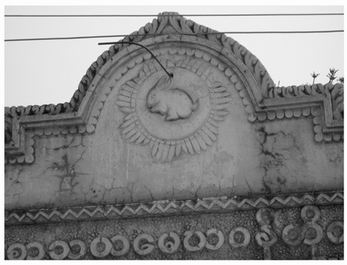
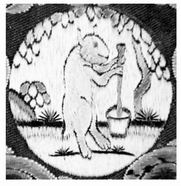
Заяц соотносится с месяцем в восточнославянском детском фольклоре: в игровых песнях, закличках и особенно считалках, например: «Заяц-месяц, где был? В лесе» или «Заяц-месяц вырвал травку, положил на лавку». Для этих текстов характерен мотив растительности, которой питается заяц: заяц-месяц «сорвал травку», «траву жал», «листья рвал», «лыки драл» и т. п. Корреляция образов зайца и месяца подтверждается и некоторыми южнославянскими параллелями. Так, в Герцеговине дразнят того, кто показывает на месяц со словами «Вон месяц!»: ему в ответ желают заячьего мяса или заячьего помета и советуют надеть на месяц шапку и называть его папой. В хорватской песне упоминаются глаза, светящиеся подобно глазам зайца от месяца. У болгар известен танец, в котором двое участников изображают зайцев, прыгающих друг через друга при свете месяца. Все эти факты внутренне мало связаны между собой и не складываются в общую картину. Заяц и месяц соотносятся друг с другом лишь в самом общем виде, что не позволяет реконструировать символический смысл мотива зайца-месяца. Фрагментарная представленность и ограниченность этого мотива сферой детского фольклора могут указывать как на его архаику, скрывающую в себе некую лунарную символику зайца, так и на сравнительно позднее его происхождение. Поэтому невыясненным остается вопрос, находится ли этот славянский мотив в какой-либо связи, генетической или типологической, с представлениями о зайце и луне (в особенности с символикой пятен на полном месяце) в иных традициях — древнеиндийской, китайской, монгольской и др. В китайской мифологии известен живущий на луне белый (нефритовый) заяц. Согласно легенде он оказал услугу Будде, за что получил бессмертие и был помещен на луну. С тех пор он толчет там в ступе снадобье бессмертия.
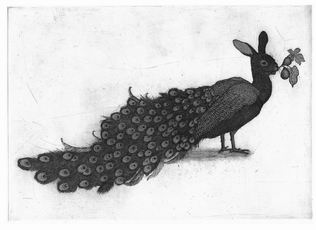
В традиционной славянской культуре заяц наделяется различными, в том числе не связанными между собой символическими значениями, обусловленными определенными свойствами и признаками, которые реально присущи этому животному (плодовитость, быстрота бега, чуткий сон) или только приписываются ему (например, косые глаза). Символика зайца и представления о нем отличаются устойчивостью и живучестью. Они сохраняют свою популярность и в нашей сегодняшней жизни — в языке как хранилище архаических взглядов, идей и понятий, в живом городском фольклоре и в современных жанрах литературы и искусства. Основной набор традиционных символических смыслов, присущих этому персонажу народной зоологии, не только не утрачивает своей актуальности, но и облекается во все новые формы, ярко демонстрируя тем самым преемственность многовековой культурной традиции.

[1] Работа осуществлена при поддержке РГНФ (проект № 12-04-00267а «Славянская народная аксиология. Оценки и ценности в языке и народной культуре»). Подробнее о символике зайца см. в книге: Гура А. В. Символика животных в славянской народной традиции. М., 1997. С. 177—199.