
Translated material
Invasion of Crimea and "lords of flies"
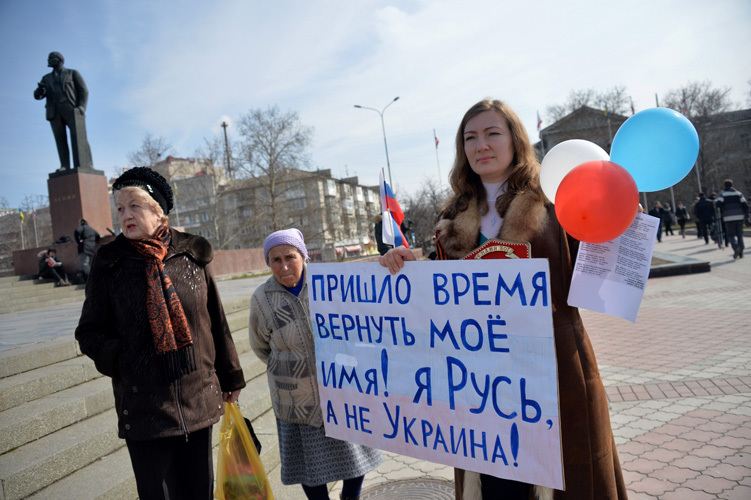
Tomorrow Alexander Etkind will fly to Moscow. And we have long wanted to meet and talk. If the meeting was before, then we would probably talk about his book “Internal Colonization” or “Hlystyshchina in the Russian Revolution”, but these days I wrote to him: we will talk about what can be called the “language of invasion”, about the discourse of war, violence and conflict. Since we are witnesses of a historical case. In relation to Russia, we have not seen for a long time that the language of conflict quickly turned into a political action into which millions of people were involved. In the life of our generation there was Afghanistan. But the connection of the language and action there was different. A military-political decision was made, simply declared to the population. It did not cause any patriotic fucker. Of course, this was explained by a completely different device of the "public sphere" under the old regime. Now, many of us, those who are familiar with the Russian journalism of the first months of the 1914 war, are asking comparisons with today: outstanding Russian minds, authoritative writers and philosophers wrote in those days the texts that they were later ashamed of. But this comparison is also too conditional. Because at the beginning of the twentieth century, the population of the empire was still among its agrarian and explained what was happening (“German attacked”) in a language almost unrelated to the language of educated classes. Today the situation is different: millions say in the networks. And therefore, the language lives, as it were, by itself. In social media, like giant jambs of fish in the ocean, not people, not “users”, but the words they say. And before our eyes, such a huge jamb of words swam in the direction of Ukraine. And along with this jamb, the political class swam, in its mind, is not distinguishable from ordinary users of VKontakte or Facebook.
And at the same time “explaining metaphors” sailed. The political language, as you know, is generally closer to the “rationality” that is contained in the poetic system of speech. And Hannah Arendt or Kozellek would generally say that the metaphor underlies rationality, because in the metaphor there is a “increase in meaning”.
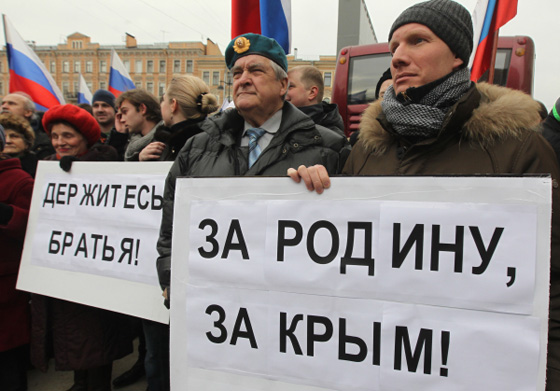 © RIA "Novosti" Participants in the rally in the center of St. Petersburg
A simple example. For twenty years, various circles in Russia used the expression “Russian -speaking population” in relation to residents of neighboring countries formed after the collapse of the USSR. This expression also had a political projection, but marginal-for example, in the Congress of Russian communities in the 90s. Later, in the zero, he also had an official projection - the “Russian world”. With an updated concept of cultural work abroad. In the political class, this concept “Russian -speaking” slowly sailed. Although Russia is not an “empire” at all, but a de facto of the same stump of the USSR and the eastern bloc as the rest of the countries of the post-Soviet space, and nothing more than the “ordinary Eastern European country”, on the territory of which there are also large diasporas of now free states, “Russian-speaking” abroad-in the mass media language, in political journalism, in the speech of representatives of the political class (deputies, deputies, deputies, deputies, deputies, deputies, deputies, deputies, deputies, deputies, deputies, deputies, deputies, deputies, deputies. Senators) - began to quickly turn from citizens (with different status) of other states into an analogue of "Volksduchece" . In the political instrument of the new imperial policy. Judging by the networks, for the zero years, a whole generation of adolescents has grown up (who have now occupied the first bossies), which mentally no longer see any “sovereignty” among other states, and “Russian -speakers” consider directly their “compatriots”. And these “compatriots” themselves quite often, judging by what they write in social media, enthusiastically relate only to the policy of “sovereign Russia”. In other words, thanks to the networks, some real cognitive “Volksdouche” has developed quite quickly. And his existence in 2014 made the theme of military invasion of Ukraine in a completely new sound. After all, if you recall, five years ago, the script of the “quick and victorious war with Ukraine” met only in the writings of science fiction writers and looked like “generally absurd”. Now, the presence of “Volksduch” as a phenomenon of the language forces previously quite sane people to write and talk about “Russian Crimea” not in a cultural, but already in a military-political sense. That is, in the language of "Anschlus". Before our eyes, for several months in Russian social media in the direction of Crimea, a multimillion -dollar jamb floated: "Ukraine never had statehood." And after him, the jamb: "Khokhlov can not have statehood at all." Moreover, he did not sail in the conditions of the virtual “trolling”, that is, bullshit, a free -object grocery, but in the context of specific plans for political and military intervention ... As unexpectedly before our eyes, “Russian -speaking” turned into “Volksduch” as subjectivity. And at the same time, how quickly the Ukrainians were deprived of subjectivity! And how quickly these forms of language took possession of the minds of the entire political class of Russia!
At the beginning of 2014, in Russia, we witnessed the movement of the language that we only read about - by the clipper, with Lydia Ginzburg. The late Soviet experience that found our generation was completely different. For us, it seems to me, this is the first experience of meeting with the epidemic spread of the invasion language. The experience of observing how somnambulically the whole society can retreat into the cognitive subsoil of teenage thinking, to lose the features of "adulthood" in the Kantian sense.