
Translated material
Faster - more powerful - more organized
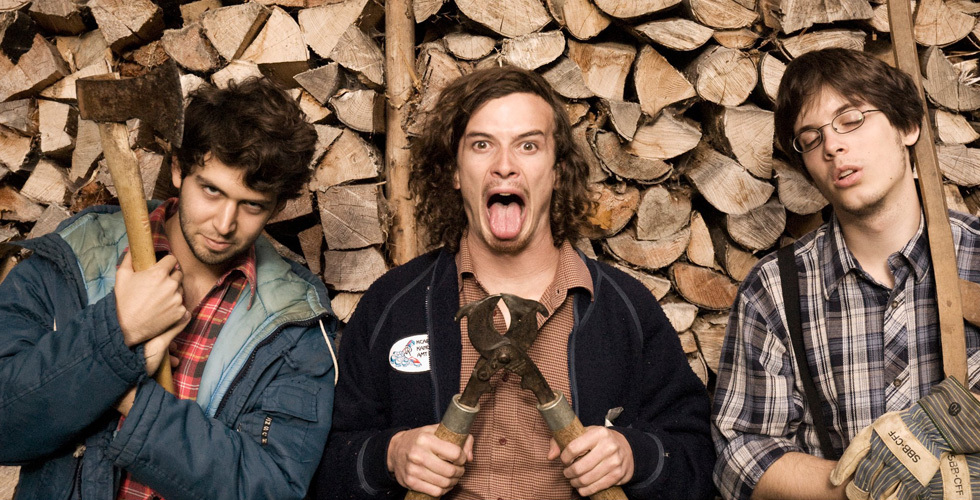
A long, in German taste, the name of the SchNELLERTOLLERMEIER Trio is formed from a joke for the distorted names of the musicians - Basist Andy Schneellman, guitarist Manuel Troller and David Mayer. The surname of the latter does not even need editing: in form it already resembles a comparative degree - only here the adjective does not exist. Mayers in German -speaking Europe called the governors of the king, and if we assume that they were responsible not only to collect taxes, but also to maintain order in the entrusted territory, then SchNELLERTOLLERMEIR can be read as "more faster." This, of course, is an aggressive attraction behind the ears, but it is difficult to resist it: too successfully, such an imperative translation describes the vector by which the trio moves.
For example, this track (above) is possible, as in a biology lesson, to trace the evolution of the group: ontogenesis repeats the phylogenesis. Schneellman, the troller and Mayer, who received jazz formation, are moving further from pure jazz. At first there was a period when a free improvisation dominated the trio’s music, and the order was crystallized in the latest phase from chaos: now SchNELLERTOLLERMEIR is playing either forecast, or as it may-music with a distinctly audible structure.
“In many of our new compositions, we tried to ensure that the trio sound like a single body,” explains the leader and main composer Trio Manuel Troller. - As one organism in which each tool has its own function. Or several functions. Or a function unusual in the context of a traditional trio. In addition, technology and modern academic music, such composers as Feldman, Liegeti, influenced our new material. There are many statics in our new plays - it’s very interesting for me to work with it. How to change a large picture with the help of small events? How to make sure that in general everything remains unchanged, but at the same time, new elements changed the listener's prospect, allowing him to look at this whole and unchanging from another corner? These issues occupy me. And there is such an Austrian writer - maybe you know him - Thomas Bernhard. He really influenced me, I read a bunch of his books. He has such a special manner-his texts in a sense resemble musical compositions: he works a lot with repetition, and then introduces small changes, the text as if cracking-and suddenly some fragment, the meaning of which you seemed to be well understood, turns into a new, unexpected meaning. In general, many things have influenced our new plays-it can be not obvious, but for me they all sound in these compositions. ”
Manuel emphasizes that, despite the hybrid nature of the music of his trio, intentionally crossing the SchNELLERTOLLERMEIER styles, unlike many equally technically technically savvy colleagues. “If something happens-excellent, it may be interesting. But deliberately-in the mode “Oh, I mix, I don’t know, the mat rocks with this and that”-I don’t do it, ”says the troller.
How to change a large picture with the help of small events?
What is related by troller, Schneellman and Mayer with other European musicians-improvisers of the younger generation-this is their versatility. In addition to Sch N EllertollerMeier, all three play in other contexts, from FRI-improving to commercially successful pop music. The troller, for example, recently played a series of concerts with Jerry Hemingway-one of the best drummers in the world, a member of the great quartet of Anthony Braxton, the 80s model. At the same time, the troller, like his partners, actively cooperates with the Swiss pop musicians, and Schneellman is one of the most popular sessors of Switzerland.
“In my opinion, this is a very interesting thing,” says the troller, when I ask him about how FRI-EPROV combines with pop music. - I spoke about this with many improvisers from ... well, say, the previous or older generation. In general, with very experienced musicians who have been engaged in almost exclusively improvisational music for the past twenty years. Some of them say that this cannot be combined with pop music, which is impossible to play both. But I - at least at the current stage - absolutely disagree with this. Even opposite. It seems to me that the most interesting musicians whom I know or with whom I worked can just play very well and pop music too. Perhaps this is due to the fact that in the pop context you have to limit itself very much, guided by what this particular song requires at this particular moment. This teaches to focus and not play too much. And this experience gained in pop music can be used in improvisation. And vice versa. I heard how many good improvisers play pop music, and they are much more interesting to listen to them than pop musicians who have been playing the same music for the past forty years. So, I think, you can move in both directions. And for academic music, all this is also fair - this is a huge field for gaining experience and for applying knowledge gained in other contexts. All this, of course, is only my opinion. Maybe in twenty years I will think differently, because there are so many things ahead. ”