
Translated material
Your documents!
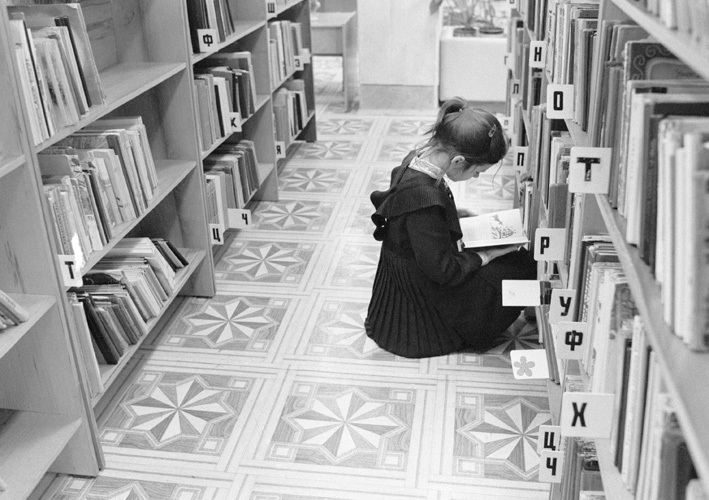
The topic of children's reading, the fate of children's books has recently become one of the most acute in our media. They discuss and forbid some, but it is necessary to answer for what is happening completely different. To look for the necessary places on the shelves, to worry about the age marking, to be responsible for the “harm done” by the library. Children's Library. For which, however, it is much more relevant to resolve the issue with the attendance, attention of the children and parent, the teacher’s audience to the fact that the library exists. To study the ideas of society about the modern children's library - who needs it, how its space can be organized, what services it provides - we conducted a survey. To the questions of our questionnaire compiled by Olga Andreeva (and she knows from her own experience not only about the work of the Russian library, but also about the work of libraries abroad: in 1993-2006, she issued a referral publication “Kaleidoscope” about the children's book culture abroad), a variety of people answered. And librarians, and teachers, and parents. Perhaps, to the question of the questionnaires below, made by Olga Viktorovna, I will add only one observation. For people of non -webelopic profiles, it was clearly difficult to even be complicated for formal filling. And there were those who refused to answer questions. That is, this area is completely unfamiliar to them. Even fantasies on this topic do not work. Do you know when this happens? When the imagination has no material, Maria Shuvalova has a very clearly said about it. Try to come up with an animal that is not. This is easy, because you know a lot of animals that are. And come up with an ideal, albeit non -existent, children's library. What is it? For most Russians, this is a place in the school where they were given textbooks.
Ekaterina Asonova
We also have such doors on which the Children's Library is written. Sometimes it’s interesting behind them, often - wretched, and such a huge number of people never looks around these doors, that the question arises: what is it - a children's library and why it is.
We decided to speculate about this in absentia - and here's what they received in response.
It is remarkable that everyone who participated in this virtual discussion considers the library an institution with their specific functions that do not duplicate school, kindergarten, and leisure center. I really liked the answer in which the author of one of the relevant functions of the library calls compensating.
And it’s true: no, for example, a person in a class of a teacher in history, literature or geography (fell ill, has become ill) or eat, but I do not like it. This is not a reason not to study these amazing sciences. Come to the library and ... enjoy.
Or at home crowded, noisy, not up to you (and it happens) - stomp into the library, where it is spacious, quiet and everything is happy for you.
Do you know what our interlocutors saw the difference between the library and the school? In freedom! “You have to go to school, you don’t want to go, but to the library - only if you want.” Here is a puzzle - how to make it want to go.
If the next question were answered in Sweden, Germany, the United States, I think almost everyone would answer the same way. And the question was about what social function is most important in the work of the children's library. What is primarily - a resource center, a communication center, an educational institution, etc.
The term "resource center" has strained many. The burned librarian, I used some professional library terms in the wording of questions - not because I like them, but because they taught me how to use them in business papers for a long time. And this is what turned out.
Firstly, in the library business, as in a serious science (who would have thought!), There are professional terms.
Secondly, many participants in the survey were not easy to decipher them, which means that the vast majority of people who see the library through the eyes of the client answered, and this is fine.
Thirdly, these terms, in all likelihood, are not very accurate and not very successful, since smart and cultural people were difficult to understand them.
So, the resource center is customary to call the place where the materials are collected, in this case, informational ones. So: in the above countries, of course, the “resource center” would be said about the main function of the library. The minority answered us so. Many as the main name called the function of the center of communication. And some - and an educational institution (obsessive pedagogy - our socialist inheritance!).
The library resource consists of documents. Many were perplexed what kind of documents were and why they were needed. And the document in the libraries is a unit of storage of the fund, that is, a book, a journal, a newspaper, a disk, an electronic book, audio or video recording, database, etc.
We get rid of stupid terms, the librarian - to the stylist, all the forces - to search and speedy delivery to the fund of all the most interesting.
The term "printed attributes" was at a standstill. And this is the name of museum or library collections of theatrical programs, posters, posters, calendars, postcards, book bookmarks, etc. For example, I have a rather big collection of packages in which the “documents” are packaged in libraries of different countries.
I agree with those who noted that it is not so important how many percent of certain documents will be in the library, it depends on many factors. Maybe this question was not worth asking. It is more important how to extract these documents for the library. Many honestly admitted that the ideas have no idea what "sources of acquisition" are, how the library is equipped and what can be improved in this regard. But what is a tender, they know everything and do not believe in his positive role.
How to make new materials go to the library faster? Some believe that this is impossible, someone would like state programs on this issue.
I want to boast. In the spring of 2007, the date of the simultaneous start of sales in different countries was announced, including the last book about Harry Potter Harry Potter and the Harry Potter and the Deathly Hallows) - July 21. The right to sell the book in Moscow received the first to sell the bookstore "Moscow". I thought, thought and decided that it would be great if this book in our library also appeared on the day the sales began. Then there was a lot of trouble. It was impossible to pay for the purchase in advance - the price is unknown. Compiled a guarantee letter. Not without roughness. Someone forgot to transfer something to someone, someone left for the cottage at the wrong time. We fussed, called. On July 21, an employee of the library arrived at the store in the morning, an hour later brought heavy volumes to the library on the subway, an hour later the book was processed and exhibited in the reading room. And next to her stood an information poster. Here, they say, today the book first appeared on the shelves, and the readers of our library have exclusive law. The book is available to them today. Whoever wanted, knew this in advance, the announcement and promotion hung in advance in the lobby.
I brag about it for a reason, I want to prove that you can get acquired faster and better.
Everyone replied that without a librarian the library cannot exist. Balm for wounds. I'll take the saw and start sawing the bitches on which I am sitting. And why, in fact, cannot? That is, the librarian must be somewhere, organize, arrange, arrange, orient the visitor. If all this is done professionally, then many will cope well without it. And the librarian-consultant can sit, stand or walk and be interested in: "Can I help you with something?" So we check whether it can help with anything.
Here is one of the answers sent to the question whether the library can do without a librarian: “No, although sometimes you think that it would be better for such a librarian.”
There was another question, which is not enough for the modern librarian. Among other qualities, we also mentioned beauty. And there was a wonderful answer: “Beauty. For children, external attractiveness is important. ”
What can encourage the reader to return the document received in the library? I myself can’t answer this question myself. Here I would like some state, legal support. Somehow through TIN, some strict measures. And our interlocutors very wisely formulated: "The presence of a more interesting and new document."
A few years ago, at the World Information Congress in Milan, researchers from the USA and Great Britain E. Black and K. Rankin made an amazing report on the history of the design of children's libraries . The design in the report was considered as the embodiment of the image of a children's library in different decades. We proposed the main models allocated by the authors of the report, and asked to identify the one that is the best today. A very good solution was found in most answers: the best model is a combination of different models, correlated with a specific situation.
To the last question - “Do you use the services of a children's library” - answered honestly. Some simply do not need her services: children have grown up, and grandchildren rarely come. And someone does not suit someone: “Luxurious publications with excellent illustrations of the library do not pamper us today. And modern children's books that I would like to read are simply not there. ” Some use it because you can’t buy everything, they even use the development of librarians for their research.
Thank you all a lot, the strategy is clear. We get rid of stupid terms, the librarian - to the stylist, all the forces - to search and speedy delivery to the fund of all the most interesting. Then the door with the inscription "Children's Library" will be opened more often. Even those who have “children have grown up, and grandchildren rarely come” will look.