
Translated material
Which side will choose Ukrainian Transcarpathia
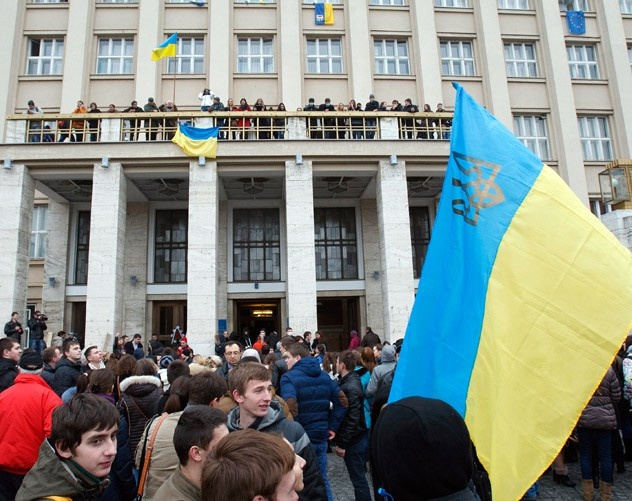
Back in 2012, they did not talk about Crimea in Kyiv, in Kyiv they said that if the collapse of Ukraine begins, then it will begin in Transcarpathia. Since Soviet times, the Transcarpathian region has occupied a special place among other regions of Ukraine. Thanks to the strategic position on the border with the four states of Transcarpathia, it was closely connected with Moscow, and not with Kiev, and the local political elite has developed a habit of a very high degree of independence. In Kyiv, the Transcarpathian leadership was accused of “regional separatism”, and in local families they talked not only about how grandfathers fought for an independent Carpathian Ukraine in the spring of 1939, but also remembered the Austrian concurrent Talerhof, where during the First World War residents of Transcarpathia were brought as “Russians”, potentially sympathizing with the enemy.
Invented a bicycle
Euromaidan in Transcarpathia began with a bicycle. Here it is even called in European: "Bicigli." Dozens of Uzhgorod students on November 28 on Bitsighi went to the border with Slovakia: to it from the center of Uzhgorod, the capital of the region, no more than 5 kilometers. Young people on bicycles, “European transport” showed their desire to follow the path to Europe.
The protesters and the authorities were restrained in the region: in political statements, in comparison with neighbors, Transcarpathian officials lagged behind several steps. In early December, Transcarpathian authorities were the only ones in Western Ukraine who did not join the calls of Euromaidan. The regional council did not vote either for the resignation of the Azarov government, or for the national strike.
The population was also calm. True, there were captures of administrative buildings on the streets, Leninopad, and checkpoints in the region, but everything was restrained: there was not a “night of anger” like Lviv, nor the capture of the police or military units. The police calmly switched to the “side of the people”, the local “Golden Eagle” returned from Kyiv, and the Golden Eagle shopping center (bird is one of the symbols of the Carpathian Mountains) decided to choose a new name from the Soviet era, because he could not work “that completely defiled and stained with the blood of the structure of the same name”.
But already at the first plenary meeting of the Transcarpathian regional council after the change of power in Kyiv, which took place on February 26, Transcarpathian deputies forgot about the former restraint and decided to become large Catholics than the Pope. The Hall with a bang accepted the Verkhovna Rada of Ukraine with the requirement to speed up the work on signing an association agreement with the EU. The deputies with the vast majority banned the activities of the Ukrainian Choice public organization in the Transcarpathian region (many perceive the “Ukrainian choice” of Viktor Medvedchuk as Putin’s hand). After that, the chosen ones demanded that the candidates of the heads of various structures and departments of the region, which are appointed from Kyiv. If the first two decisions indicated the new government in Kyiv, they say, “we are with you”, then in the last demand a desire of Transcarpathian leaders was made to return the regions to former independence.
The chosen ones of the Transcarpathian people
The alignment of political forces in Transcarpathia never fit into the schemes known in the rest of Ukraine. When other Ukrainian regions consistently became “vested” or “blue and blue”, the electoral map of Transcarpathia resembled the forecast of the tipsy astrologer.
In December 2004, the region supported Viktor Yushchenko - although sluggish compared to the Galician neighbors. But already in the parliamentary elections of 2007, Transcarpathia was the only region of Ukraine that supported the Yushchenkovskaya “Our Ukraine”-when the Galicians already spit on behalf of the then president and voted for the party of Tymoshenko. When, in 2012, the “Fatherland” won in all areas of the Center and West of Ukraine, and the nationalist “freedom” in the Lviv region, Transcarpathia generally supported the Party of Regions: there were about the same amount of voters as in the Dnipropetrovsk region as a percentage of it.
This tangle of political preferences looks extremely confusing, but everything becomes much clearer if you look at local policy at the level of specific personalities. In Transcarpathia there is no allergy to the party of the East or West, as in Lviv or Donetsk. But local regional leaders are constantly changing party affiliation.
Transcarpathian cooperative "Lake"
This cooperative is called - Barva LLC, it has several subsidiaries. “Barva” straightened the wings in the second half of the 1990s, it was headed by Viktor Baloga. When Baloga went into big politics, his brothers began to engage in Barva.
In 1998, the Social Democratic Party of Ukraine (united) was held in the Ukrainian parliament-it was headed by the already mentioned Putin Kum Viktor Medvedchuk. The party gained a fifth of its votes in the Transcarpathian region, where Viktor Baloga was the head of the election headquarters. A few years later, in 2004, the Social Democrats supported Viktor Yanukovych. But Baloga did not agree with his party comrades and became a confidant of Yushchenko in Transcarpathia.
For several years, Baloga was headed by the Yushchenko secretariat when he was the president of Ukraine. At the same time, his brothers strengthened their positions in the region. Soon, the roads of Transcarpathian politics and Yushchenko parted - Baloga created the Unified Center party, pulling a number of Yushchenkovsky politicians of the Ukrainian parliament. The “Unified Center” did not go to the Verkhovna Rada elections, but became the “Transcarpathian Party”. The Baloga family returned to the regional level. They did not reign for long: the Yanukovych family, who received power in Kyiv, took up regional leaders. And for their business. The then dissatisfied were in all regions, saved in different ways. Blogs played a Rusinsky map.
"Subcarpathian Rusyns, leave a deep sleep"
"Rusin" is a multi -digit word. Before the Second World War, the “Rusins” called themselves the majority of the population of Western Ukraine with the East Slavic roots. Such self -determination did not exclude belonging to the Ukrainian people. For those who are still not confused: the adjective from the "Rusin" - "Russian". Russian Street in Polish Lviv, Romanian Chernivtsi or Czechoslovak Uzhgorod did not belong to Russia in any way, and the content of the majority of the “Russian” Rusins in a concentration camp in Thalerhof can be considered the philological mistake of the Austrians at a price of thousands of broken lives.
Thanks to the activities of national organizations in the interwar period, and then the Soviet regime, the definition of the Rusin was completely replaced by the definition of the “Ukrainian”. But in Transcarpathia, in southern Poland and in Eastern Slovakia, the self -name remains. Due to the differences in the local language from the Ukrainian literary norm in the diaspora, the theory arose about the fourth East Slavic people-Rusyns. In the 1990s, because of the ocean, this view came to the "native lands." A lot of Rusen organizations arose, most in Slovakia and Transcarpathia.
However, the Rusyns from European countries soon parted with Transcarpathian: while moderate leaders from Slovakia, Poland and Serbia thought about the systematization of spelling, trying to combine the options of their language, the Rusyns of Transcarpathia set themselves a more ambitious task: statehood. So the Transcarpathian separatism arose. Behind him in the region they see the hand of Russia, although it is much more like the game of "local".
Rusyns of Transcarpathia woke up at Yushchenko. “Subcarpathian Rusyns, leave a deep sleep,” - this was the first stanza of the anthem of the region, taken shortly after the creation of the Ball of the “Unified Center” and the conflict with Yushchenko. Before that, the local authorities recognized the existence of the Rusin nationality, despite the objections of Kyiv and Lviv: there were panickically afraid of this word, although only 10 thousand people live in Transcarpathia, less than 1% of the population of the region.
They began to judge for Transcarpathian separatism under Yanukovych. In March 2012, one of the founders of the Rusinsky movement of Transcarpathia, a priest of the Moscow Patriarchate of Fr., was conditionally sentenced to two years in prison. Demetrius Sidor. His organization “Soym of the Comprehensive Rusyns” constantly emphasizes the illegality of the inclusion of Transcarpathia in 1945 in the Ukrainian SSR (Crimea does not recall?), Since the “Saint-Germany Peace Treaty of 1918 ordered Czechoslovakia to provide sub-Carpathian Rus' Autonomy.” Father Sidor even handed the passports of feedpathian Rus' in Moscow, and in Minsk in December 2008 he proclaimed the independence of the Republic of Farpatian Rus'. As a result, a criminal case has been instituted against the priest.
Credit of Ukrainian identity
However, playing the Rusinsky map, the local elite was unlikely to expect to add votes in the elections. The “Rusinsky movement” is rather an ideological weapon in which gunpowder from the Kremlin and local patriotism can be invested.
For Kyiv, Transcarpathia is like a square of a circle. Transcarpathia did not explode along with the Crimea only because the current situation in the capital fell on the collaboration of most local politicians: with European integrators they along the way. However, the local elite will require a special attitude to the region - at least in order to agree inside Transcarpathia.
And here Kyiv will not be easy. If in other territories of Ukraine a well -known law on national minorities is a political game of Russian and Ukrainian, then in Transcarpathia is a real necessity. Half of the Hungarian population of the region (about 70 thousand people) does not know a single Slavic language, the same can be said about the Romanians. The representations of the new authorities in Kyiv about what Ukraine is, so far are not suitable for the territories of cultural borderlands - and Transcarpathia is just such a territory. Rusins here become because the majority of the population of the region simply does not fall under the Ukrainian canon existing in the neighboring Lviv.
But there is hope for Kyiv and Lviv. The two main centers of Ukrainian culture gradually grow from the narrow -and -national understanding of Ukraine: shares of the type of “day of conversation in Russian” - confirmation of this. On the other hand, in Transcarpathia itself, the charm of the victory of the revolution affects. One of my acquaintances, Uzhgorod musician, after three months of the Maidan wrote himself out of the Rusins and called the Ukrainian. The prestige of Ukrainian identity in Transcarpathia grew up. Although for Kyiv, for more than twenty years striving for mild centralization and simple Ukrainization, this is a loan of trust at a large percentage.