
Translated material
Brothers and sisters
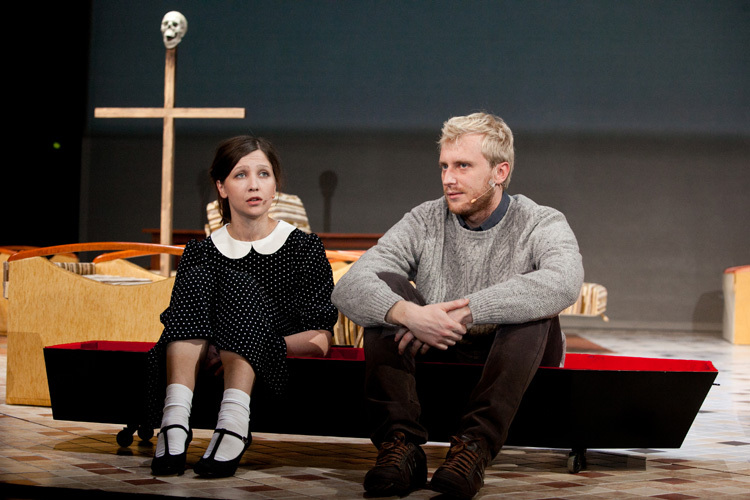
This is the appeal of Comrade Stalin, who at the beginning of the war, as you know, became Soviet people who became “meat machines” in the fields of the Great Patriotic War, could be useful to Konstantin Bogomolov in his stage version of the Sorokinsky “ice”, staged in the Warsaw National Theater and just shown in Moscow in the Extract Curular program “Golden Mask”. “ Speak with your heart ” - refrain of blue -eyed, blonde characters, sisters and brothers who awakened to a new bright life with the help of an ice ax and not sparing on their path of “meat machines”, that is, ordinary people. But Stalin Bogomolov had already married with the Shakespearean lyre, and the famous Roman Sorokina did not read at all the way it could be expected from the director of the Moscow Art Theater of Karamazov and the ideal husband : the genre of Warsaw “ice” is not related to totalitarian anti -utopia, nor to slaughter fantasy.
Entertaining here is by no means what the director discarded - he curbed - the games of his imagination, composing a strict performance deprived of any entertainment. (I’ll make a reservation right away that no Walter-Beniyaminovskaya “wisdom” in the opus of Bogomolov is not observed-although it would not interfere with the performance and would not interfere.) Entertaining is the children's simple-mindedness, a youthful rash, with whom the director listened to the text of Sorokin-not ironic (with postmodernists and this happens), but muffledly, but muffledly. charged with pathos, persistent and only partially deceptive. This pathos, contrary to the plot about blond beasts who found in themselves either fascist or enkavedeshovs, contrary to the cold light of refrigerators, awaiting almost everyone, including the pre -writers of the pastry, in the second half of the play of the Bogomolov parishes himself. At the same time, it decreases inconspicuously, in a slight gap between the text and its perception.
 © kuba kiljan / kuźnia zdjęć
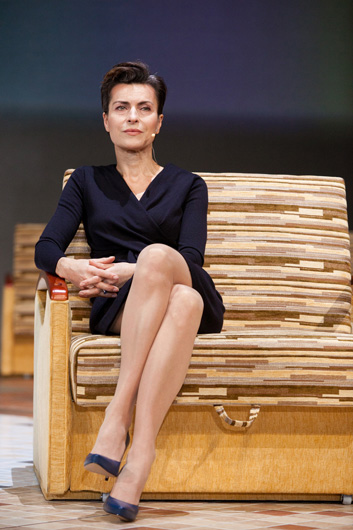
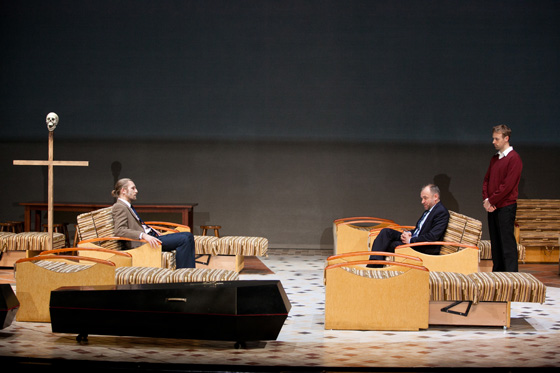
The scene of the Theater of Nations is filled with folding armchairs and sofas (scenographer Larisa Lomakin), on which meat machines are sleeping. The chosen from them in the first part of the performance awaken to tell each other “cases from life” - and show their duality: who was nobody (a prostitute, student, businessman), will become a mythopoietic person involved, a member of the fraternity of an elite division, exterminating the “empty” inhabitants, camps, in modern Moscow. The second act is a clock monologue-Benifis given to Stanka. The warrior named the temple, chosen by their hearts, is chosen in their hearts to recall how her girl was sent from the Russian village to Germany and how, after the war, they sent the MGB to the brothers and sisters, who were called to make an evolutionary jerk with the help of axes carved from the fragments (from under the blocks) of the Tungusa meteorite.
It should be admitted that Sorokin’s language is the main character of this “ice”: the usual directorial escapades of Bogomolov melted in him without a trace. In order for the written speech, not turning around with a cheat, to build up in impassive (with some exceptions like a sleep of sleep about a clogged rat or in strictly defined places of role -playing schedules are given to the Stanka) regime, the artistry (not acting) of Polish actors was needed - no matter how ridiculously this word in the context of the Bogomolov performance. The dramaturgy of each role with the obvious, at first glance, neutrality of intonation, votes are built on the fact that artists are mediums of the Sorokinsky text. This condition - becoming and being a medium - gives the Warsaw performance a raid of somnambulism, which is through the provocative and prudent prose of Sorokin in the flesh.
Sorokin’s language is the main character of this “ice”.
Of course, the distance or detachment in relation to the Sorokinsky Word-a strange, invigar, absorbed the scope of myths, posters and slogans-in combination with the naturalness with which the actors pronounce and are included in this sweet and sour text about the “lost paradise”, produces an unusual effect on our stage.
The spellbound text and faith in the word as a crushing action became the content of the performance, for which the directorial “invention”, not to mention the tricks, has come to nullified the unnecessary. This approach was somewhat reinterposed-I repeat, it was for the Russian scene and for Bogomolov, who works mainly in (art) mainstream-the concept of stage action. In my opinion, the whole thing in this: the action arises, extinguishes and pops up in the dramatic construction of the role-apparently neutral, but actually exciting in its, as it were, erased.
The collective reading of this novel at one time was made by Alvis Hermanis - but it was precisely what reading, as stated in the name of the performance, " using the imagination in Riga . " Reading Latvians pulled behind him, so that it was not boring, and reading. In other words, the action in the literal sense of the word: when, for example, the Riga actors had a clamped with plastic bottles - a demanded way of the notorious ice axes - or when the public was heard with pictures, in accordance with the episodes of the novel by pornographic or documentary.
 © kuba kiljan / kuźnia zdjęć
In the production of Bogomolov, the action acquires himself in dialogs, when the actors retell the votes and their organic presence on the stage something experienced by their characters - or read by artists in the novel. At the same time, Sorokin’s lexical quasipornoye specialty is not presented in the mise-en-scenes, but in the titers on the back screen, which does not create the impression of “expensive audiobooks of life” (I read somewhere), but makes it possible to wake the imagination of the viewer and reader, the actor and his character.
Make a non -performance performance for the big scene and in the calculation of the Great Hall is a bold solution. But it could also be strengthened - let’s say, instead of the sprace names of the two parts of the presentation (named respectively by the “Old Testament” and “New Testament”), indicating the deconstruction of sacredness otherwise. For example, "former sincerity and updated." The Bogomolovsky “ice” - so there are Polish actors in it - Sorokin’s answer to the request of the “new sincerity”, which once hung in the air, but not disgusting at that period of the writer’s work and he personally, has to answer it. The answer is crafty and at the same time deliberate - you will not dig, but calling to not too appropriate generalizations.
The final titer “Death is the best thing that can happen to you” most likely belongs to the director himself (Roman, I repent, did not re -read) - and, alas, discouraged. For the only reason: this maxim is undermined by a subtle handling of the language, which, throughout the performance of the pilgrims, along with Polish actors, surrendered either with arrogant modesty or with modest arrogance.