
Translated material
Crusade against children
The law protects the younger generation not from harmful information, but from complexity
The law protects the younger generation not from harmful information, but from complexity
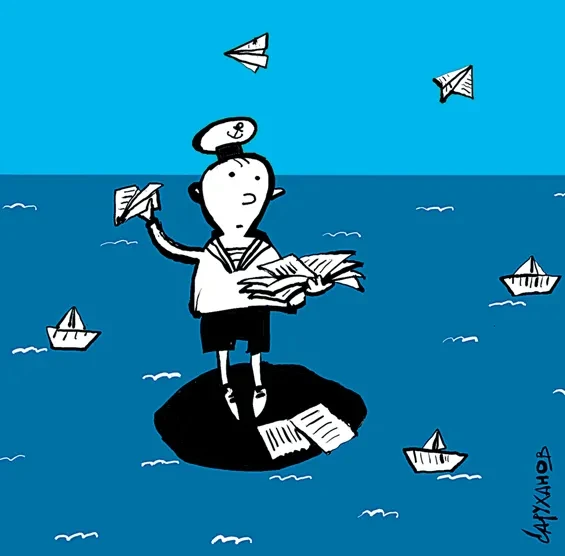
For a year and a half, children have been protected from harmful information by special law. Schools, children's libraries and publishers have almost learned to live in new conditions, almost got used to the fact that adults everywhere tripled vigilance: either Yesenin will be banned, then they won’t give a dragizer to children: it is dangerous!
Book market
According to the book publishers, one of the most powerful blows of the law on the protection of children from information causing harm to their health and development came. Book publishers are obliged to mark their products - 6+, 12+, 18+...
“Publishers who work for the children's sector are reinsured,” says Maria Rostadina, senior researcher at the Russian Book Chamber, “and overstate the age for whom the book is recommended. So, books designed for twelve -year -old children receive the marking “16+”, and sometimes “18+” - and whistle with a whistle past their target audience. Children's books are not interesting for teenagers, the circulation is lying unusual. This also creates problems for children's libraries: their funds are equipped at a public account; The library cannot complete itself with books with the labeling “18+”: any check will be interested in this. ”
“Some publishers overstate the marking to the absurdity in order to show that the law itself is absurd,” says the literary critic Ksenia Moldavskaya. “But for the parent who comes to the bookstore, marking is a guide to action.”
Parents
“The parents have a new question,” Ksenia Moldavskaya shares. - Is it possible to read this book to my child? Parents are ready to condemn the state the right to decide what is possible and what cannot be read to their children - and it seems to me the most terrible. Having adopted this law, the state deprives the parents of their parental rights without any reason, without a court sentence. Unfortunately, looking for good books for your children is work, and you always want to shift work to someone else. ”
Another sign of the new time is parents who are always ready to find and expose wrecking. And if schools have long been familiar with the phenomenon of mom, for any reason calling immediately to the Ministry of Education, then for libraries fishing pests and prosecutorial checks are a relatively recent phenomenon. Librarians are afraid and on their own initiative clean the funds, removing all the dubious.
“By and large, the censor sits in everyone’s head, and he begins to turn on on the principle:“ Let the book be, but I won’t do advertising to it, if they ask, I will give it, preferably in the presence of my parents, ”says Tatyana Rudishina, the main librarian of the Gaidar Central City Library. - Recently, I heard an idiotic fresh story from the school librarian. At school (good, Moscow, advanced), the parent asked not to take a novelty for discussion - Andreas Steinhefel “Rico, Oscar and the shadows are darker than the dark” - because there was the word “fart”. As a result, replaced with Koval (good replacement). But the fact remains. "
Librarians
“Some libraries remove part of the books from open access,” says Maria Nedadina, “and do not allow children to catalogs: after all, they can find something unacceptable there-for example, a book about sex. At the same time, cognitive books about sex or politics are usually not particularly ingenious, not the same, which should be fought from the point of view of high culture. And you have to fight, because the books cannot be prohibited! Education is a component of library activity: no one canceled the law on information. The librarians turned out to be between the two lights: one law requires to carry information to the masses, the second claims that the information is harming. And when you come to talk about new books - librarians treat them with apprehension: no, we don’t need it: here about bad parents, here they poison the child at school, here about an orphan - no, we do not need it. And we stumble upon the wall: the librarians complain that children read little, that they are difficult to interest a "mossy classic" - but they are afraid of modern literature. "
Librarians really do not want trouble. As soon as they heard that the law demands to mark publications, they rushed to mark their funds. Then, however, it turned out that this work is not needed: only the books published in 2012 and later should be marked, and publishers should march them. Nevertheless, the librarians who were waiting for troubles began to show vigilance: they hide it away in the back rooms of books that seem dubious to them, do not give children literature that seems to them an adult-here at least the same Dreiser, who was not given a 16-year-old Omsk in the Pushkin library. The library workers' special disputes were caused by the book of Daria Wilke “Shutovskaya cap”, which fell into the finalists of the teenage literature competition “Bookra” last season. In Magadan, for example, the local librarian asked the delegation of the contest how they allowed a book that incites hatred of homophobia to the final of the competition.
“Librarians - especially in the regions, are often poorly oriented in their own funds,” says Maria Nedadina. - They did not read modern literature on which audience the books “Samokat” or “Pink Giraffe” are designed for. Recently, a whole series of scandals swept through the libraries, which are usually associated with unprofessionalism of the librarians themselves. For example, one mother asked the librarian Russian folk tales for the child, and she found in the funds the publication of the tales of Afanasyev in 1992 - a wild time, when everything was published in a row. Tales were not adapted for children's reading. The problem here is not even in the law, but in the unprofessionalism of the librarian who does not know his funds. ”
“When you show the librarian a book, you have to show him at the same time how he can defend himself from attacks by the next guardians of children's morality,” says Ksenia Moldavskaya. “Sometimes this has to be taught at the methodological seminars.”
“This is part of the library work,” says Maria Nedadina. - If the book is ambiguous - so work with it! "Ah, the book is terrible, it is about alcoholics and disabled people!" Well, build club work around her! Invite children, parents, teachers, think about whether it can be dangerous, because you can defend this book - and no one will forbid you this. But this, unfortunately, is done only by a few librarians. Finally, if the vigilant public finds Kramol in some library books, experts can come to the rescue of libraries. Previously, the examination could be requested in Rospechat, and from this year, the Russian State Children's Library received the right to conduct an expert assessment of children's books. It has a staff of teachers and psychologists, the conclusion of which is quite enough for the prosecutor's office. ”
The vector of movement is clear: the law protects children not so much from harmful information as from any complexity. From discussion of difficult and ambiguous phenomena of life. From the need to think. It is much easier - to leave in funds only the school curriculum and a set of simple and safe truths.
“There is enough hypocrisy in the regions, but fear is being replaced. The fear of a small person is very strong, any indication is ready with tripled zeal. But it’s easy for me to say, they did not come to my seminar from the prosecutor's office. I'm not very afraid to lose my place of service. And I am ready to take responsibility, recommending or simply informing about a particular book, ”says Tatyana Rudishina. - Experience shows that everything can mean everything! Why did the Fox Ulysses not please the authorities with the emerging? The easiest way is to not complete anything dangerous. This is what I am afraid of sterile emasculated funds. ”
This book teaches us
Children are slowly getting used to that the book should necessarily teach something. In large letters, direct text. "This book teaches us good!" - The librarian represents a novelty to the children. “This book taught me wisdom,” the child scribbles in a school report on summer reading. “This book is bad - there is no morality in it,” another writes in a review.
The children's book ceases to be a source of joy, knowledge about the world, strong experiences - as if there was no all children's literature of the past century. We again return to those times when an instructive children's reading taught well -rehabilitation and repeated the unreasonable set of common truths.
“There is no need for any written text about the book to complete the words“ This book teaches what ... ”, the writer Dina Sabitova wrote the other day on her blog. - Adults just have books for themselves, and children have such non -grains - like a toy stroller for a doll. Adults just read themselves, and children - their book supposedly teaches what. And I would tell the teachers this in the first place. Stop the children forced to summarize.
Tolstoy’s novel “War and Peace” teaches the fact that ...
By the way, what does he, in your opinion, teach? "