
Translated material
No war
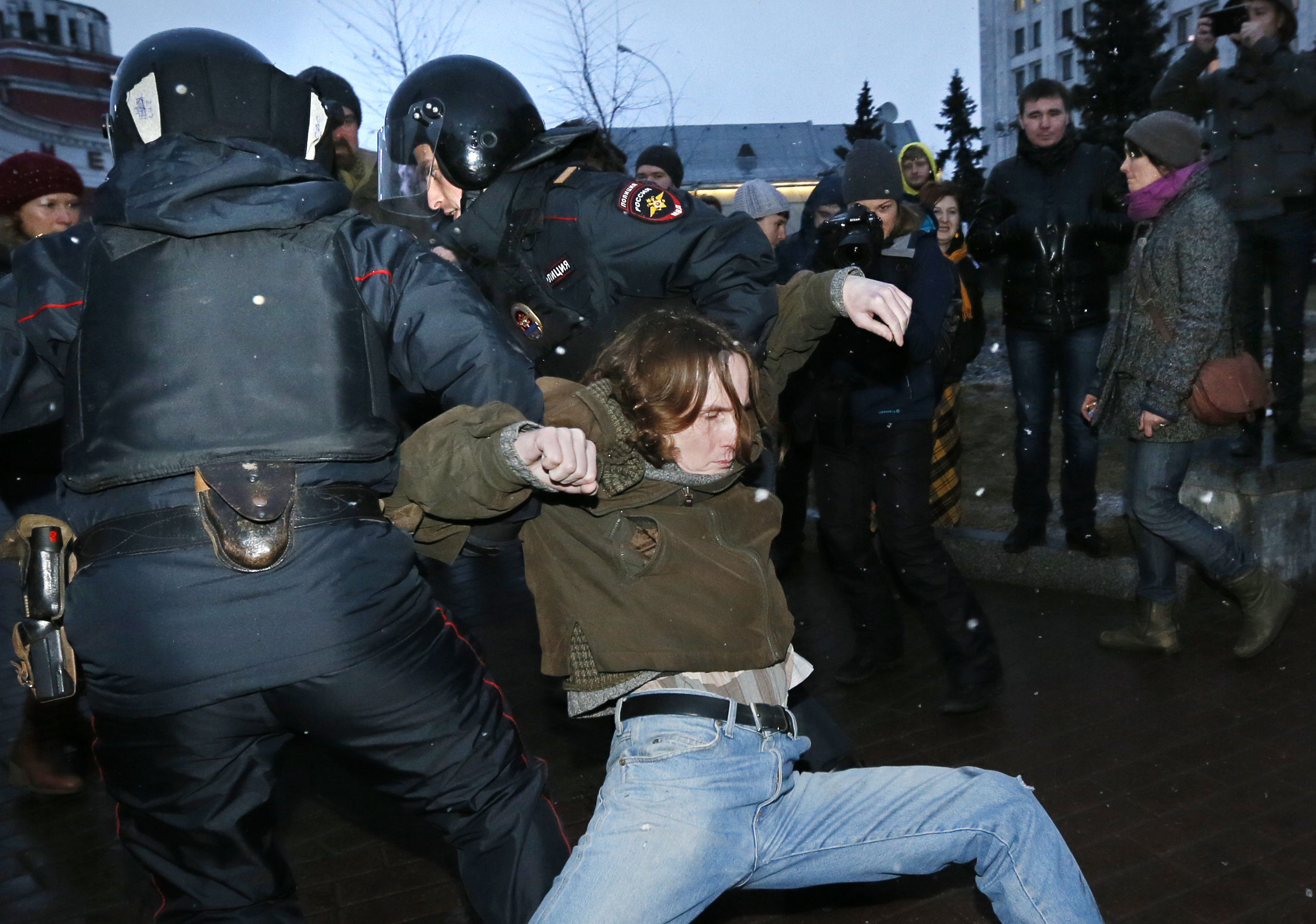
How "screwed" demonstrators
The right to freedom of assembly. Detention at anti -war rallies and rallies in support of the “Prisoners of Bolotnaya”. Features of the new wave of protest. How does the behavior of the police depend on Ukrainian events? Why are detentions at permitted or urgent anti -war rallies in principle illegal? How many hours can the detainee in the ATS be held under the law on rallies and freedom of assembly? How to appeal fines and administrative arrests? The producer of the film “Dubrovsky” as a detained for participation in an anti -war rally.Joint release with ovdinfo.org. The program involves Grigory Okhotin and Daniil Bailinson, participants in the OVDInfo project (monitoring of citizens' detention in Moscow); Lev Gershenzon, programmer, IT expert, and Evgeny Gindilis, a film producer detained at an anti-war rally; lawyer Olga Gnezdilova; poet Lev Rubinstein; Philologist Roman Leibov (Tartu). Elena Fanailova is running
Full video version http://youtu.be/gbbjyob1bou
http://vimeo.com/88442507


How "screwed" demonstrators
The text of the copyWidth PX Height PX
The url has been copied to your clipboard
No Media Source Currently Available
0:00 0:54:35 Download the media fileElena Fanailova: The producer Evgeny Gindilis had just taken the premiere of the film "Dubrovsky", which in paradoxically turned out to be about Russian violence, about people in the form that are right in everything, and Eugene was detained on the 2nd. Zhenya, your vivid impressions?
Evgeny Gindilis: Yes, in general, it was interesting ... The next day I received an SMS from one of my employees of the film company, who wrote: "Zhenya, I'm in shock! You were in a catalak!" And I answered her to this that the line between cinema and reality is sometimes very thin. I was detained for the first time, although we still took part in all rallies, there were both the Khamovnik court, and almost everywhere, but this time everything was much tougher. We stood there for 5 minutes, did nothing, in response to the proposal to go down in the subway, we said that we were just going for a walk, but at that moment they began to wrap me quite hard. I lay down on the ground, and from that moment riot police had already entered, and several people simply carried me to the bus. And Zhenya lavat, my wife, ran after me and collected things that poured out of me, phone, glasses and so on (laughs). And she was also sent for the company to this car carrier.
In Avtosak, we met many friends. On the other hand, we immediately contacted the ATS-Info. And one of the police officers, sitting behind the door, watched some loud video with the sounds of a rally on the phone, and when I asked him that he was going there so interesting, it turned out that he was watching the scenes from the Maidan and said: “You see how the“ Golden Eagle ”is beaten. It may be the same with us, so we ...” And it is obvious that they have such an attitude to watch it all and to say it, so to say.
Leo Gershenzon: I did not meet Zhenya on Manezhnaya Square, although we, apparently, were somewhere nearby. But a similar story, I spent about 5 minutes there and ... I was not the first time in the car carrier, but the third, although I do not like it, I no longer had an enthusiasm of Neophate. Indeed, we also noticed from rallies, on meetings of the Zamoskvoretsky court dedicated to the "swamp case", which was compared to what was two years ago, and less predictably began to act much tougher. There used to be a logic: there is a poster - this is participation in a rally, you are standing quietly without a poster - you are not taken. Now this logic is broken. And it is evident during the detention that OMON employees are very annoyed, angry. It seems that they really get some special video content, they clearly have their own picture of the world, which is quite difficult to change. We saw shots with Academician Vasiliev, they are led neatly, and many were harshly detained, and this, too, seems to me, is a set that is now attached with the slightest suspicion of resistance.
Lev Rubinstein: This time I didn’t get anywhere, but once I visited a car carrier, for a long time. Now I went to trial, and on the Manezhnaya Square, and a violent weeding was on me, and I was even in sight and distributed an interview, but for some reason I escaped the detention. I was not at the Ministry of Defense, but I followed the situation, and in the form of pictures and documents it is even worse. For example, the famous history teacher Tamara Eidelman, who also got there, gave a lecture on the history of the revolution in Europe in this site. So this whole story is also overgrown with folklore.
Elena Fanailova: I am surprised in the events of the last days that the intelligentsia, humanities, the protest of the last days are delayed - the protest is humanitarian.
Lev Rubinstein: It is interesting that also the pathos and the stylistics of this new protest ... There are mostly not negative slogans, but positive. There we are talking about the world. A person holds the poster "The world - the world!", This is an official propaganda poster of the time of the USSR. That is, now absolutely all symbolism is recoded, everything acquires a new meaning.
Elena Fanailova: Roman, how did you have anti -war performances?
Roman Leibov: Yes, we had anti -war performances in Tallinn. There was one rally in Tartu, small, at the very beginning, during the confrontation on the Maidan. We gathered a man of 15 in the center of Tartu. The event was registered 12 hours before the event, on the Internet. There were no spectators, but Tartu is generally a rather deserted city. There were mainly international students from the University of Tartu. Today there will be more people, including on Facebook, one of the patriarchs of the dissident movement was noted. I think that there will be 150 people in total, and basically it will be a public from the University of Tartu, mainly young people. Near the consulate of the Russian Federation in the city of Tartu.
Elena Fanailova: Roman Grigoryevich, you wrote on your page that there is already enough theoretical reasoning about Putin, it's time to sing camping songs. Today you will show you some camping song?
Roman Leibov: Only with Lev Semenovich duet!
Leo Rubinstein: We need to sing "Children of different nations, we live about the world ..."
Roman Leibov: I did not mean that I should urgently beat the drum, as one German poet wrote.
Elena Fanailova: Listen to lawyer Olga Gnezdilova, she talks about how things are with the Law on rallies and freedom of assembly, and how the detentions are appealed.
Olga Gnezdilova: The Law on Freedom of Assembly, on the procedure for conducting street events, says that if the event is held with a notification, then it should be calm, it should not stop the police. Even if the event is violated by the procedure for holding, then such citizens in a separate manner should be brought to administrative responsibility by the police. The Code of Administrative Offenses says that all protocols should be drawn up on the spot, only in exceptional cases a citizen is delivered to the police department. It turns out that all cases are exceptional in our country, and this, of course, is wrong. As such, the concept of "permitted" rallies we do not have. We are all allowed, which is carried out with a notification, or single pickets for which notifications are not needed. Or other forms of, say, meetings, where also the submission of the notification is not required. Therefore, detention is such a fairly vicious practice, and again the termination of a public event, any, should be accompanied by paper from a representative of the local government, where he substantiates the reasons for such a cessation. It is issued either immediately at the time of the termination, or within 24 hours.
Elena Fanailova: And with what formulations did people delay now? I mean the latest anti -war rallies and a rally in support of convicts in the "swamp case".
Olga Gnezdilova: The protocols wrote that they violated the order of the event. This is also incorrect, since the procedure for holding it is established by law, and it says that participants in a public event are not entitled to be intoxicated, have weapons, close the face with a mask, and so on, there is a list of duties of participants. If it is violated, then this is a violation of the procedure. What is written in protocols that a person should be liable, because he participated in an event that was not filed with a notification, this is incorrect, because the organizer is responsible for the notification, and the participant is not obliged to be interested in whether the notification was filed, this is not his function. Here, law enforcement agencies, if they even finish someone, must find the organizer, draw up a protocol for a violation of the organization’s order. And the participants are responsible only for their decent behavior, roughly speaking, on the picket.
Elena Fanailova: How much can detainee detainee at such a rally be kept?
Olga Gnezdilova: Here they also go to the trick. If we are talking about a violation of the procedure or organization of a rally, then only up to three hours. To keep people longer, draw up protocols under Article 19.3 "Introduction to the legal requirement of a police officer." Here is an interesting story, because this article, as many experts, should not be applied in such cases. If we are talking about a rally, then the issue of the legality of its termination is related, including, with paper from the representative of the city hall, why the event is subject to termination. I have never seen such paper in my life, although article 17th Federal Law provides that the rally can be stopped only according to such a document, but no one is anywhere. And when a person is accused of disobedience, then detention is possible for up to 48 hours without a court order. And here, of course, this is used, since this is actually a punishment if a person spends the night in the department. I think the application of this article is incorrect.
As for anti -war rallies, the situation here is very interesting, since almost simultaneously rallies for war and against war were passed. We saw a large procession and large events in different cities that could not withstand this period of notification provided for by law 10 days before the public event. There is not a single detainee at rallies for the war, and a lot of detainees at rallies against the introduction of troops. This is a clear political decision, skewed. Many times we talked about the fact that we need such amendments to the legislation, which provide for the opportunity to urgently gather without notifying in 10 days or in three, when really important events take place, as what happened on March 1. We do not have such a procedure. And it turned out that the people who came out with peacekeeping slogans were detained because they had to file a notification, the law provides for this. At the same time, rallies organized by the authorities went without detentions, although the situation is absolutely the same: people did not submit notations, or they submitted them to some simplified order, and a preference for political reasons turned out.
Elena Fanailova: Olga Gnezdilova also said that when an appeal to the European Court of Human Rights, this political moment will necessarily be taken into account. On this wave of protest, things such as mass detentions, the cruelty of detentions, and the special information training of police officers were discovered. What are your impressions, Grisha?
Grigory Okhotin: All of the above is completely not new. Similar in the mass of detention were May 6, when 650 people were detained. Now 1400 people were detained in a week, on three promotions. Then in May they detained 1500 in two weeks. There is nothing new in this, it was to white -legged protests. The rigidity of the detentions varies from the social composition of those present on the shares, the "other Russia" is twisting harder, the intelligentsia is softer. You also said that it was surprising that they delayed almost everyone, not by posters, is one of their methods, they sometimes delay to stop some specific action, and sometimes to disperse the action, they have many different methods. One of the methods is to detain 30-50 percent of those who have come if the action is small. All the shares on which there were now detentions were, in general, small ones, and people were delayed almost half.
What is the difference between these detentions, this is that this is the first action since the introduction of a new law on rallies, which has increased the fine to 20-30 thousand rubles. They detained a huge amount of intelligentsia and hipsters, that is, the social composition of the auto -zaks was different than usual on political actions. Zhenya Gindilis has a voice, information capabilities, and the dissemination of information about how the detentions are taking place, what is happening in the police, in court, and after such a composition is delayed, the situation changes sharply. In particular, when the intelligentsia and hipsters are delayed, they say: oh, how terrible everything is ... But here you can only recommend reading the OWD-Info website: they are not for the first time, they are delayed every one and a half to two days, and they detain a lot from time to time.
Lev Gershenzon: And the percentage of the detainees who remained to spend the night in the police department, isn't it a record, not a new story?
Grigory Okhotin: No, the record was May 6, when almost everyone was left, and on December 5, when 300 people were detained, everyone was given 19.3, and everyone remained overnight. And on May 6, almost everyone was given 19.3, and everyone was left to spend the night.
Daniil Bailinson: It all reminds me of the Strategy-31 shares. They also grabbed it like that, carried upside down, their eyes tried to squeeze out. On the 21st, the police closed people from two sides on the Tatar street, near the Zamoskvoretsky court, and began to speak to the Megaphone "Dive!", And there is nowhere to disperse. I think that many people did not want to get into a car zak at all, but there was simply no way out literally. As for the numbers in the courts, under article 19.3, which implies administrative arrest or fine, mainly write out fines, except for two citizens, one of them is a Belarusian, another Ukrainian who was given 5 days in the first campaign. According to the second action, the situation was completely different, 9 people left at night, tried, one was given 15 days, three - 10 days, one - 5 days and 20 thousand rubles of a fine. That is, there are already people who remained for the night in the police department simply close.
Leo Gershenzon: Several people did not have time to judge and left on the second night in the police department.
Daniil Bailinson: Yes. And to those who were awarded for a day, they also spent the night in the police department, and they were now returned to judge under Article 20.2.
Elena Fanailova: Now each such person has a graph "Harvesting"?
Daniil Bailinson: No. Here you need to distinguish administrative criminal record and criminal.
Lev Gershenzon: But several people at once in two articles were convicted - both for a fine and administrative arrest. And this, in my opinion, is new. We have this decision of the Supreme Court ...
Grigory Okhotin: This, unfortunately, is also not new. They just begin to draw up under Article 20.2, and then for some reason they need to leave a person for the night, for example, they did not have time to draw up a protocol, and they add to this 19.3. This vicious practice, but against people detained at rallies, is generally unlawful to apply article 19.3, that is, disobedience to the police officer. Because if a person, after they said to diverge into Megaphone, did not leave, and he was detained, then he should be issued according to the law of 20.2. The fact that he did not disperse is an aggravating circumstance in article 20.2 is not a separate article. So there was nothing new there. We have been monitoring for two years, and all this was.
Leo Gershenzon: I do not mean the new one in the sense that this was not at all. I mean my feelings about how the situation has changed in two years. For me, a new one is in relations with OMON employees and the police officers with whom we communicate in the department. Two years ago, when you talked with the police in the departments, there was a feeling that they were emphasized polite, understood the absurdity of the situation, and even sometimes they said something like “Yes, guys, we understand, we are for you, if you were more ...”-something like that. I have a feeling along the street, and on the bus, autozaca, and what happened later in the department, that now we are obvious enemies. And any question, any appeal to the law causes only irritation and anger. For me this is new, rather. And yet, now they took hipsters, and it seems that the course of reasoning is this: you wanted to ride - we will hold you longer; You’re normally driving, it’s not scary, it’s not a pity for the time - let's give you a ruble, 20 thousand rubles - a lot of money in Russia. And it works.
Evgeny Gindilis: I would share those people who detain and those people who draw up. Our experience in the Danilovsky police department was that we spent 4 hours, well, boring, and I just started talking with the police. And of course, they are very worried about the situation in Ukraine, because they project Ukrainian events on themselves. And it is clear that the element of counter-propaganda, which is conducted in relation to them, is primarily associated with a very simple position: see what they did there with the “golden eagle”, they will do the same with you, if you are not ... but, on the other hand, they perfectly understand that the situation is not easy, and when they are given some completely serious arguments about the fact that the Crimea is not part of the Russian territory, and the presence of the Russian military there is serious there. a violation of our obligations, they hear this logic. And the second, everything is very dependent on some local rules, because Danilovskoye was extremely loyal to us in the Danilovskoe police department, no one infringed on our rights there. Наоборот, они были заинтересованы в том, чтобы максимально быстро нас оформить и отпустить, а некоторые особо информированные наши товарищи просто вышли оттуда, как только истекли три часа. Потому что они не отдавали никаких документов, а просто там с копией паспорта попрощались со всеми и были таковы.
Роман Лейбов: Хотел бы обратиться к тем, кто приводит аргумент, что в Эстонии были события "бронзовой ночи", когда довольно жестко были разогнаны люди, вышедшие на защиту памятника Советскому воину-освободителю в Таллинне. Действительно, была такая история, вышло довольно большое количество людей, критически большое, я бы сказал, по символическому поводу (то, что имеет отношение к убеждениям, к мыслям, к свободе выражения мнений). И эти люди были довольно жестко разогнаны полицией. Но это не аргумент по нескольким причинам. Во-первых, никого не выхватывали из мирно стоящей цепочки граждан. Там ситуация накалилась, и полетели камни в витрины. Не знаю, можно ли назвать это массовыми беспорядками, я не специалист, но, в принципе, полиция обязана здесь вмешиваться. Действительно, иногда полиция неадекватно жестко в таких случаях действует, и не только в Эстонии, а и в разных других европейских странах. Германские товарищи жалуются, датские негодуют. Есть одно простое соображение по поводу событий "бронзовой ночи". Прокуратура вышла с обвинениями в организации этих беспорядков, и все эти обвинения развалились, все люди, которые обвинялись, были оправданы. Просто задайте себе вопрос: возможно ли это в России? Вот это - большая разница! Полиция везде зарывается, и политики не всегда очень умны, но должны быть механизмы, которые регулируют эту ситуацию.
Григорий Охотин: На самом деле, проблемы свободы собраний есть во всех странах, и в Европе, и в США, свобода собраний нарушается достаточно сильно почти везде. Разница заключается в том, что комплекс вопросов, которые выстраиваются вокруг задержаний, включает не только свободу собраний, но включает поэтапно сотрудников полиции, отделение полиции, комплекс законов, практику вокруг этого, и потом комплекс вопросов вокруг судебной системы. Задерживают очень жестко в США и в Британии, однако потом их не очень жестко содержат в отделениях полиции, не нарушают там их прав. И потом у них есть реальная возможность оправдаться. В Британии, когда там были массовые беспорядки, задержали около 5 тысяч человек, было большое дело, большое количество людей пошли в тюрьму, примерно 18 человек сели, но там реально были доказаны факты разбития витрин, драки с полицейскими и так далее. И средний срок тюремного заключения этих людей составлял 9 месяцев.
Если вернуться к тому, что было нового в наших последних задержаниях, видимо, надо смотреть состав людей и какова культура протеста в России, какова культура протеста в Америке и Европе, в культуре победившего протеста. У нас культура протеста - выйти с лозунгом, задержаться, рассказать об этом в фейсбуке. В США движение за права черного населения, женщин и так далее - все проходило через большую стадию походов в суд. Люди реально отстаивали свои права шаг за шагом. Меня, например, совершенно устраивает Владимир Путин, если будет работоспособная судебная система. Меня не интересует, Путин, "Единая Россия", меня даже не интересует война в Крыму, меня интересует, чтобы была нормальная полиция, нормальная судебная система. А судебная система заработает только в том случае, если у нее появятся клиенты, если в нее будут ходить такие люди, как вы, и реально заставлять эту систему работать. Это все уже было показано на примере наблюдения за выборами, когда вменяемые люди прочли законы и массово пошли наблюдать, и выборная система вдруг подчинилась практически полностью в городе Москве.
Лев Гершензон: У нас история с судами - история победившей лжи. Вот история с задержанием Навального. Есть герметичный эпизод, он длится минуту или полторы, когда человек поднимает руки и говорит: "Я иду, иду... Смотрите, я никак не сопротивляюсь", - говорит Навальный. Есть эта видеозапись, она приобщается в суде, но потом судья говорит: "Да, на этой видеозаписи никакого сопротивления нету, но у нас есть свидетельские показания сотрудников полиции, и они этому противоречат, и я склонен доверять им". Что касается моего задержания, я подготовился тоже и сказал, например, что меня обвиняют в том, что я мешал проезду общественного транспорта на нулевом километре, а там не ходит общественный транспорт. И плюс сливается абсолютно история про твое задержание и про историю, которая стала поводом твоего выхода. То есть для них если ты против войны, а мы за войну, значит, ты виноват.
И второе, у нас так было в ОВД "Войковское", и я знаю историю про ОВД "Тушино", когда там 40 минут адвоката, которого позвали к задержанным, просто не пускали, и формулировка очень хорошая. Адвокат говорит: "У меня адвокатское удостоверение, вы по закону должны меня пустить". На КПП полицейский говорит: "Я знаю, но у меня инструкция..." Вот сейчас инструкция важнее закона. И они все понимают, что они все врут, они на суде лжесвидетельствуют. Все построено на лжи! Мое наблюдение, что максимум, что ты можешь сделать, это им показать, что это так, ты человека можешь поймать. Я спрашиваю: "Почему меня задерживают?" - "Вы не подчинились законным требованиям сотрудника полиции". - "Но вас же там не было". - "Да, меня не было, но были другие, кто вас сюда доставил". - "Так пусть эти другие придут и мне скажут, что были за требования". - "Вам сказали расходиться". - "Я слышал, что мне сказали расходиться, но это не является законным требованием". И человек злится. Нет ни одного закона, который запрещает мне кричать на улице.
Лев Рубинштейн: Вообще находиться на улице, да.
Лев Гершензон: Все это понимает, но есть круговая порука. И мое наблюдение, что их уже это не смущает.
Евгений Гиндилис: В этом нет ничего удивительного, потому что если наш президент, комментируя ситуацию в Крыму, может позволить откровенную ложь, о которой мы все знаем, что это не так, знаем прекрасно, что в Крыму сейчас находятся представители российских вооруженных сил, эта ситуация не отличается, на самом деле, ничем от тех микроситуаций, в которые каждый из нас попадает. Если возможна ложь во имя каких-то геополитических задач на самом верху, то дальше все это по вертикали спускается вниз, эта ложь необходима для того, чтобы решать задачи, и эти задачи очень четко сформулированы. И каждый элемент этой системы эти задачи в силу своей компетенции решает. А мы являемся элементами, которые этому противостоят.
Лев Рубинштейн: Вот я оказался среди людей, имеющих свежий и яркий опыт, и я сижу и их слушаю. Женя сказал, что торжествует ложь на всех уровнях, и эта ситуация усугубляется, причем усугубляется в ту сторону, что если чуть раньше, скажем, ложь чем-то прикрывалась или мозги пропагандистские работали, чтобы эту ложь сделать хотя бы минимально правдоподобной, сейчас она просто узаконена. Вообще, происходит в каком-то смысле лингвистическая катастрофа. Это не катастрофа совести, рефлексии. Это слова перестают иметь значение. И это серьезная штука, и что с этим делать, непонятно. Но точно надо что-то делать!
Даниил Бейлинсон: Полностью согласен про ложь, но это не повод не сопротивляться. Нужно идти в суд апеллировать до ЕСПЧ.
Григорий Охотин: Действительно, это конвейерная система производства лжи, документированной лжи. Но если это ложь, то логично превращать ее в истину, то есть надо опровергать эту ложь такими же документированными действиями. И смысл не только в том, чтобы выиграть в суде, но в том, чтобы доказывать, доказывать и доказывать и публике, и судебной системе, где ложь, а где истина. И бумажка с ложью, и твоя бумажка с истиной будут подниматься по инстанциям. Смысл в этом очень простой: ровно так же система производства фальсификаций есть избирательная система. Когда туда пришло 500 человек, люди увидели это, страшно удивились и рассказали. А когда туда пришло 5 тысяч человек, избирательная система подчинилась. Выборы у нас не стали конкурентными, но избирательная система в Москве, в принципе, починена. А вот когда первые 500 человек, которые сейчас, интеллигентные, хипстерские автозаки пойдут в эти суды, возможно, это приведет к тому, что все поймут, что суды правда производят ложь, а потом придут уже 5 тысяч человек.
Елена Фанайлова: Гриша, вашими устами бы да мед пить...
Лев Рубинштейн: Я тоже оптимист! Такая ситуация человека, который привык находить вокруг здравый смысл, просто парализует. Но сопротивление является абсолютным императивом, оно должно находить различные формы. Я считаю, что уличная активность важна, просто очень важен количественный фактор. Не знаю, что для этого должно произойти, но на улицах в какой-то момент должно появиться очень много народу! Кстати, Комитет протестных действий подал заявку на проведение 15 марта "Марша мира".