
Translated material
New. Russian. Not yours
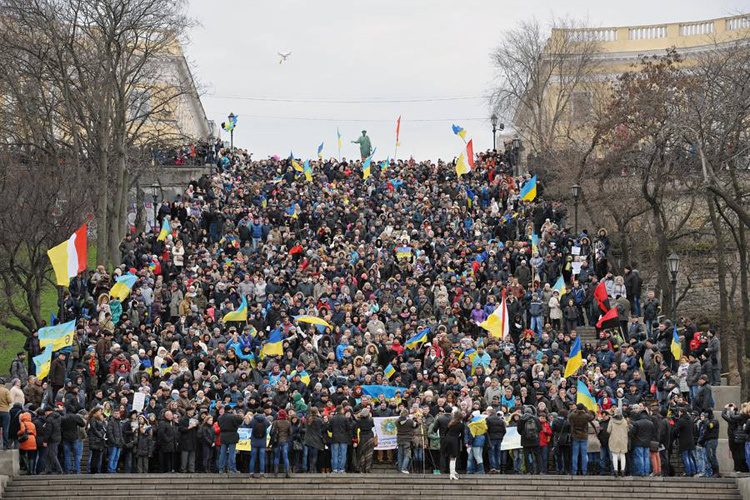
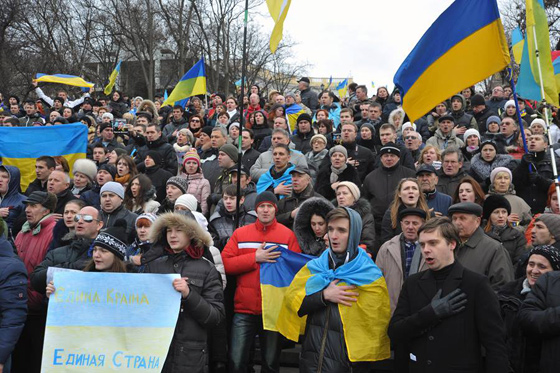
On Wednesday, March 5, 2014, I saw what I had never expected to see in my life. Not personally, unfortunately, I saw, but in video and photographs, but still. In Donetsk, there was a massive, about 10,000 people, a demonstration in support of independent Ukraine. A huge crowd with Ukrainian flags. In the center, dozens of people carried a panel several meters long. You usually see these not at protest rallies, but at sports parades. They symbolize not protest, but pride in involvement in something more that not to take away one, like this huge banner.
I have been in the Donbass many times, I talked with many people, but I have never met either in Donetsk or in other miner cities of people tuned to pro -Ukrainian. Villages - another matter; Donbass villages cannot be distinguished from other Ukrainian ones: ointments, sunflowers, Ukrainian speech. But the city Donbass has always been prose. The last week has changed. Now pro -Ukrainian citizens - at least active citizens, are ready to go out into the streets - in the Donbass an order of magnitude more than pro -Russian.
Now the Ukrainian media write a lot about the fact that Putin with his Crimean landing managed to rally Ukraine as not a single president of it succeeded. That in a divided country, a single Ukrainian people have finally formed.
The statement is beautiful, but most likely premature. Yes, the Russian -speaking population did not succumb to provocations and did not show a mass desire to be part of Russia. For decades, the split between the Ukrainian -language and Russian -speaking units of the country has been overcome to some extent. True, that a new, whole nation has developed in Ukraine, to speak early. Although the West of the country shows an unprecedented openness, the East still treats it very wary. However, the birth of the nation still took place. But not a common Ukrainian (although, perhaps, this will follow), but the second Russian.
In order to isolate it, you need to push away from something.
For the past 20 years, Russian -speaking citizens of Ukraine lacked national identity. They were not part of the Russian people, because the Russian people lived in Russia and had Russian passports. Part of the Ukrainian one, too, because the Ukrainian people speak Ukrainian, and not in Russian. So they lived, not possessing any general identity, except for the regional - Odessa, Kharkiv, Kievans. They lived well, no one oppressed them, no one, no matter what Russian TV says there, was forced to forget the Russian language. Actually, therefore - because they had no pressure from either the Ukrainian or the Russian side - they had no need to determine. Or, rather, there was no way. Indeed, in order to separate yourself, you need to push away from something.
In history, this has happened more than once. So, having broken off from Britain, the American people appeared. To become a people, he needed a war for independence. When this happened, the free population of the rebellious thirteen colonies was four times less than the population of Great Britain.
Having freed, the United States itself became a catalyst for the appearance of the Canadian nation. In 1812, the British army and navy got bogged down in the war with Napoleon, and the Americans decided to free their brothers in the British colonies in the north from the English rule. The northern brothers did not want them to be released, and despite the fact that they were ten times less, they drove the Americans home. As a result of the war against the uninvited liberators, the scattered residents of the territories north of the great lakes felt for the first time a single people.
 © Oleg Kutsky 3000 Odessa sings the anthem of Ukraine on the Potemkin ladder, March 9, 2014
The fact that war often leads to the creation of a new nation is not by chance. To realize their separateness, people need external pressure. So from soft graphite under the influence of high pressure and temperature, diamonds are obtained. Now this pressure has become the occupation of Crimea by the Russian army and permission to enter the troops into Ukraine, which Putin asked for the Council. They blew up a bomb in Russia, and the shock wave in some hours rallied the amorphous mass before.
This most likely does not apply to the population of Crimea itself, but quite to the rest of the eastern and southern Ukraine. Familiar journalist Mark Krutov, who had just visited Donetsk, spoke about an accidental acquaintance with the local security officer (!), Ready to protect the Donbass from Russian liberators with weapons in their hands: “To fight against the same weapons and speaking the same language in the same language, it will be difficult, but only before the first big blood.” I see similar conversations now in Ukrainian Russian -speaking forums. Some of them, of course, are empty chatter. But only part. The next morning after the decision of the SF on the introduction of troops before the military registration and enlistment office throughout Ukraine - including in Russian -speaking regions - stood lines.
The mood has also changed in my Kyiv and Odessa acquaintances. A month ago, they, in principle, supported the Maidan, but did not believe that with the departure of Yanukovych in Ukraine, something would change seriously. They did not go to the demonstration, they thought instead about emigration. In early March, they, along with thousands of others, took to the streets to support the independence of Ukraine. Some are even ready to sign up for the army. I really hope that this is not required and it will not reach the war.
If the Russian Ukraine becomes a separate nation, they will be able to get along with the Ukrainians, organizing an “umbrella” people.
Of course, among the Russian -speaking there are also those who are not at all against entering the Russian troops. They also rally, but they are much less. About 5,000 people came out for the largest pro -Russian demonstration in Odessa. On Prokraineskaya - from 12 to 20,000. And this is in a city that has never considered himself Ukraine. The ten thousandth rallies took place in Dnepropetrovsk, Nikolaev and Krivoy Rog. People carried Ukrainian flags, sang the Ukrainian anthem and shouted “Glory to Ukraine”, but they spoke to each other in Russian.
These people are not a nation, but only its core around which it will crystallize. If the Russians of Ukraine really become a separate nation, they will be able to get along with the Ukrainians, having organized an “umbrella” people with them, as they managed, for example, to different -language Swiss. Moreover, Ukrainians seem to have already extended the hand of friendship by Russian -speaking neighbors.
It will take another two to three decades, but the process has begun. And he is unlikely to stop. Some consider patriotism stupidity, but people have a need to feel their belonging to something more. And it is more pleasant when it is more associated with freedom, and not with riot police and tanks. For the successful existence of a nation, in addition to freedom, of course, legality and well -being are needed. If Ukraine fails to defeat corruption, put things in order in the legal system and raise the economy, then all national control will be meaningless. Yes, and the country itself may not be.
But now, when the Ukrainian -speaking and Russian -speaking parts of the country finally got the willingness to negotiate, it also had the opportunity to build a normal, prosperous society. If this succeeds, it will have great consequences for Russia. If only because many Russians also have problems with national identity. It is difficult for them - and I don’t want to - to be associated with a state living on the principle of “time, back!”, And with people who support this rollback to a gloomy past. As Solzhenitsyn wrote on the same reason: “We are not Russians with you!” The problem is that those who want to live in the first half of the 20th century may represent the vast majority in Russia. Therefore, the idea to emigrate to free neighbors who speak your language and with whom the Russians want to be, can become very tempting for many. In 2012, according to official figures, 12,473 people moved from Russia to Ukraine. Soon there can be many more people. The question is whether Ukraine wants to accept them. After the war of 1812, Canadians did not want to accept American immigrants for more than a dozen years, considering them a potential threat. They can be understood. Now the Ukrainians cordially calls to live all sympathetic Russians. But this is only until they began to shoot. As soon as the first shots sound, Russians will finally become enemies on different sides. It would be better if they did not sound.