
Translated material
Crimean law
The annexation of Crimea to Russia was predetermined by the outcome of the Russo-Turkish war of 1768-1774: according to the Kyuchuk-Kainargi peace treaty that ended this war, the vassal dependence of the Crimean Khanate on the Ottoman Empire was terminated. Already in 1783, Catherine II issued a manifesto on the accession of Crimea. Türkiye recognized the annexation in the Yasian world of 1791. The vast majority (about 90 percent) of the Crimean Khanate population made up Crimean Tatars. Subsequently, their share in the population of the peninsula decreased - as a result of the influx of immigrants from Russia and emigration of part of the Crimean Tatars to Turkey.
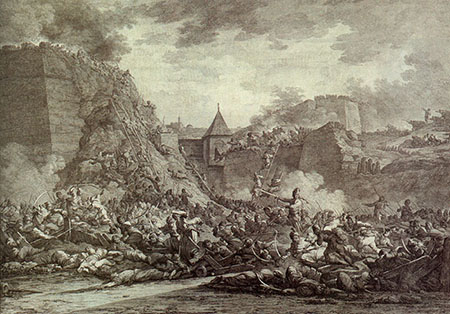
The assault of Ochakova. Engraving A. Berg. 1791
In 1921, the Crimean Autonomous Soviet Socialist Republic was formed as part of the RSFSR, in which Crimean Tatar and Russian were state languages. In 1944, immediately after the liberation of the peninsula from the Nazi occupation, the Tatars were suturedly accused of collaboration and expelled from Crimea. Other national groups were also deported - Armenians, Bulgarians, Greeks (the Germans were deported from Crimea at the beginning of the war). In 1944, the Crimean Tatars were deported by 183 thousand people. In 1945-1946, they added another 9 thousand demobilized from the Red Army. The vast majority of Tatars (more than 150 thousand) were deported to Uzbekistan, the rest - to Kazakhstan, Tajikistan, Mari Autonomous Soviet Socialist Republic, to the Urals and to the Kostroma region. In Uzbekistan alone, until the end of 1944, more than 16 thousand Tatars died.
On June 25, 1946, the Crimean Autonomous Soviet Socialist Republic was transformed into the Crimean region. In 1948, Sevastopol became a city of republican subordination of the RSFSR.
Dear transfer
On February 5, 1954, the Presidium of the Supreme Council of the RSFSR decided "taking into account the community of the economy, territorial proximity and close economic and cultural ties between the Crimean region and the Ukrainian SSR ... to transfer the Crimean region from the RSFSR in the Ukrainian SSR". The text of the resolution repeated the decision of the Presidium of the Central Committee of the CPSU of January 25. On February 19, a decree was adopted by the Presidium of the Supreme Soviet of the USSR on the transfer of the Crimean region from the RSFSR to the Ukrainian SSR. On April 26, the Supreme Soviet of the USSR approved this decree and made appropriate changes to the Constitution of the USSR. Sevastopol became the city of republican subordination of Ukraine. Its inhabitants voted in the All -Union and local elections as part of the Crimean region, and the city was funding from the budget of Ukraine.
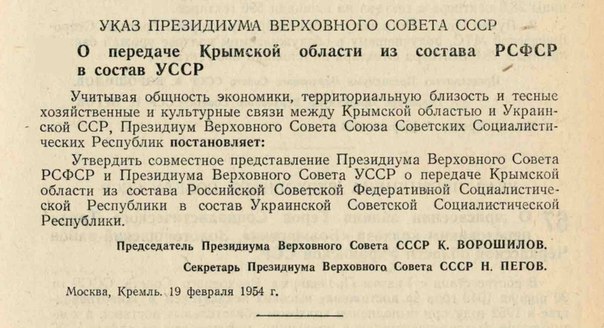
Decree on the transfer of the Crimean region from the composition of the RSFSR to the Ukrainian SSR
The transfer of Crimea to Ukraine was due to the fact that almost all the water, electricity, raw materials and food received the peninsula from Ukraine. It is no coincidence that in imperial Russia Crimea was part of the Tauride province, which also included the south of Ukraine, from where the peninsula was supplied with everything necessary. The agriculture of Crimea after the deportation of the Tatars was destroyed, and the Soviet leadership hoped that its accession to Ukraine would not only facilitate the management of the economy of the peninsula, but also stimulates the resettlement of peasants from the south of Ukraine, who would restore local agriculture. It is usually believed that the initiator of the transfer of Crimea was Khrushchev, who thus wanted to enlist the support of the Ukrainian elite. In fact, at the beginning of 1954, when a decision on Crimea was made, Malenkov played no less role in the Soviet leadership. It was he, as the chairman of the Council of Ministers, who primarily resolved economic issues and could well be the initiator of the transfer of Crimea to Ukraine. In any case, the documents that allow us to establish, on whose initiative the corresponding decision was made, have not yet been published. And for the Ukrainian leadership, the transfer of Crimea, as a deeply subsidized region, was rather an additional headache.
Sounding sometimes claims that a referendum was not held in connection with the transfer of Crimea, they look strange. In the USSR, for the entire time of its existence, the transfer of territories from one republic or region, as well as the inclusion of part of the territories of other states or these states themselves in the Union, as it happened, for example, with Estonia, Latvia and Lithuania, has never been accompanied by referendum.
By a decree of the Presidium of the Supreme Soviet of the USSR of September 5, 1967 "On Citizens of Tatar Nationality living in Crimea" it was recognized that "after the release of Crimea in 1944 from the fascist occupation, the facts of active cooperation with the German invaders of a certain part of the Tatars living in the Crimea were unreasonably attributed to the entire Tatar population of Crimea." However, the Crimean Tatars, unlike most other rehabilitated peoples, even formally until 1974 it was forbidden to return to the Crimea. In fact, the mass return of the Tatars to the Crimea began only after the Supreme Soviet of the USSR on November 14, 1989 adopted the Declaration "On recognition by illegal and criminal repressive acts against peoples exposed to violent resettlement, and ensuring their rights" where the "barbaric action of the Stalin regime", among others, was called from their native places of the Crimean Tatars.
If in 1959, out of 1201.5 thousand inhabitants of Crimea, Russians were 71.4%, and Ukrainians - 22.3%, then in 2001 2024 thousand people lived in Crimea, including 58.3% of Russians, 24.3% of Ukrainians and 12.1% of the Crimean Tatars. Since then, the share of the Tatar population has increased and is, according to various estimates, from 12 to 15%.
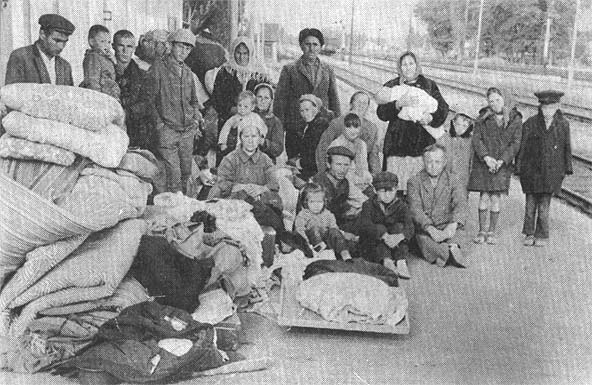
Deportation of Crimean Tatars
Warranty letter
On January 20, 1991, a referendum was held in the Crimean region on the reconstruction of the Crimean Autonomous Soviet Socialist Republic as a subject of the USSR and a participant in a new union agreement. 93% of voters voted for the restoration of autonomy. On February 12, the Supreme Council of Ukraine adopted the Law "On the Restoration of the Crimean Autonomous Soviet Socialist Republic." The reconstruction of the Crimean autonomy was carried out within the framework of the policy of the Union Center, which sought to have a counterweight against the desire of the Union republics to greater independence in the form of obedient to the will of Moscow autonomies on their territory.
On September 4, 1991, the Emergency Session of the Supreme Council of Crimea adopted a declaration of state sovereignty of the republic. Nevertheless, on December 1, 1991, the referendum has 54 % of the voters of Crimea, including Sevastopol, voted for the independence of Ukraine.
On May 6, 1992, the Crimean Supreme Council adopted the Constitution of the Republic of Crimea . In fact, this constitution made Crimea a semi -dependent state. On March 17, 1995, the Verkhovna Rada of Ukraine canceled the Crimean Constitution and abolished the post of president of the republic. This was preceded by the signing of the Budapest Memorandum. According to this memorandum, signed by the heads of Russia, Ukraine, the USA and Great Britain on December 5, 1994, the indicated countries in exchange for the refusal of Ukraine from nuclear weapons confirmed their obligation in accordance with the principles of the final act of SBSA to respect independence, sovereignty and existing boundaries of Ukraine, "as well as" the obligation to refrain from the threat of force or its application against the territorial integrity or political independence of Ukraine and that there is no Their weapons will never be applied against Ukraine, except for the purpose of self-defense or in any other way in accordance with the Charter of the United Nations. "Great Britain, the United States and Russia also pledged not to use" economic coercion aimed at subordinating to their own interests the exercise of the rights inherent in its sovereignty, and thus ensure the advantages of any kind. "It was agreed that the memorandum is applied from the moment of its signing, it is applied from the date of its signing And nothing was said about the need for its ratification.
There is no doubt that Russia, having occupied Crimea and about to change its status, violated the indicated provisions of the Budapest memorandum. However, in the memorandum there is no mechanism of action in case of violation by the parties of the obligations taken.
The territorial integrity of Ukraine was also confirmed by an agreement on friendship, cooperation and partnership between the Russian Federation and Ukraine , concluded in 1997 and ratified parliaments of both countries. Art. 2 of this is: "High Contracting Parties in accordance with the provisions of the UN Charter and obligations on the final act of a conference on security and cooperation in Europe respond to each other's territorial integrity and confirm the indecency of the borders existing between them." Undoubtedly, the current actions of Russia in Crimea are grossly violating this contract.
Anti -Constitutional order
On October 21, 1998, the Verkhovna Rada of Crimea adopted the new Constitution of Crimea , formally acting so far. On December 23, 1998, this constitution was approved by the Verkhovna Rada of Ukraine. In Art. 1 of the Constitution says: "Autonomous Republic of Crimea is an integral part of Ukraine and within the limits of the powers determined by the Constitution of Ukraine, solves issues classified as its jurisdiction." Article 2 confirms the priority of the laws of Ukraine over the Crimean ones: "In the case of the contradiction of the provisions of the regulatory acts of the Verkhovna Rada of the Autonomous Republic of Crimea and acts of the Council of Ministers of the Autonomous Republic of Crimea of the Crimea of the Constitution of Ukraine, the provisions of the Constitution of Ukraine, the laws of Ukraine are in force." The Verkhovna Rada of Crimea can only coordinate the appointment of the leaders of law enforcement agencies, since the authorities of Ukraine make such appointments. According to Art. 26, "In the event of a decision on the dismissal of the Chairman of the Council of Ministers of the Autonomous Republic of Crimea in connection with the expression of distrust of the two -thirds of the vote of deputies from the total composition of the Verkhovna Rada of the Autonomous Republic of Crimea, the President of Ukraine gives consent to the exemption of the chairman of the Council of Ministers of the Autonomous Republic of Crimea."
The current head of the Crimean government, Sergei Aksenov, was not approved by the Ukrainian authorities, since there was no evidence that two -thirds of the deputies really spoke out for the removal of his predecessor. In addition, Art. 37, according to which "the Chairman of the Council of Ministers of the Autonomous Republic of Crimea is appointed and dismissed by the Verkhovna Rada of the Autonomous Republic of Crimea on the proposal of the Chairman of the Verkhovna Rada of the Autonomous Republic of Crimea and in agreement with the President of Ukraine." There was no coordination of the candidacy of Aksenov with the authorities of Ukraine.
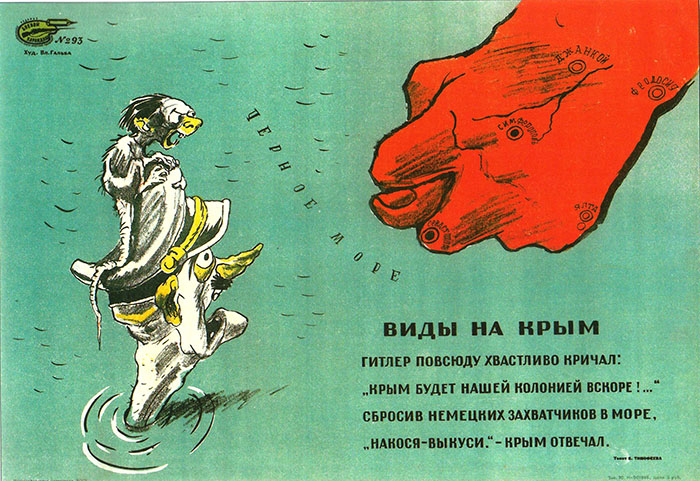
V. Galba. Combat pencil No. 93