
Translated material
Everyone gets up. Everyone is singing
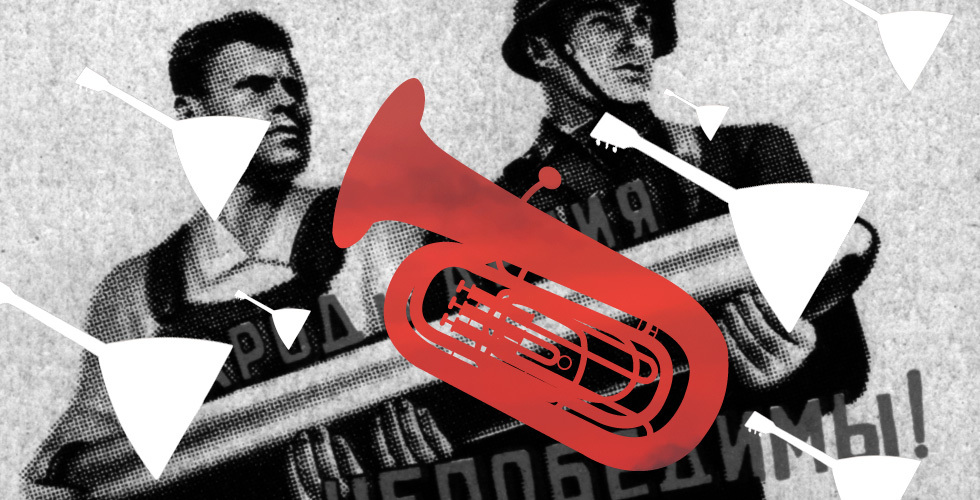
The title is a quote from the poem by Jan Satunovsky “Dear Matusovsky!” Written in the same 1970, when a “blue light” was recorded with a “song about the Dnieper”.
Among the posts and reposts flashing in the last days on social networks there was one who made me stop and think about what the aesthetic genesis of the current patriotic fucker. It was a record of “Songs of the Dnieper” by Mark Fradkin to the verses of Yevgeny Dolmatovsky, most likely, on the “Blue Light” of 1970, in connection with the 25th anniversary of the victory. First, the author and the first performers of the song - Ostap Dorkchuk and Pavel Karmalyuk - talk about how they first performed it, what feelings they experienced at the same time. Then the execution itself begins: Fradkin sits behind the piano standing between the tables and accompanies Dorkchuk and Karmalyuk, who sing the first and second grabs sequentially. “Guests of the Studio” - the military and veterans - nod approvingly, talk, smile. But in the third piece, the camera takes place to the scene on which an ensemble of the song and dance ensemble of the Soviet Army is built under the leadership of B.A. Aleksandrova - soloist, choir and orchestra with a halved gray -haired conductor.
The composition of the orchestra in the Alexander ensemble is very curious: folk instruments [1] (tongs and button accordions), wooden oven and brass copper. First, on the pianissimo choir and soloist, they sing under the delicate overkill of balalaks: “Oh, Dnipro, Dnipro, you flow in the distance, / And your wave is like a tear ...” - the choir picks up these words and at all a Cappella , in a processing that maximally resembles male church singing-Aleksandrov Sr., who prepared the first record of the song of Frakin in 1942, was in 1918-1922. The regent of the Cathedral of Christ the Savior and possessed this art in perfect. The listener first receives the image of a “folk voice”, “folk tuning” about the lost Dnieper, and then the image of the spiritual song. But the song does not end there. The fourth verse begins, telling how the Dnieper was again conquered by Soviet troops. The pace is accelerated, the soloist increasingly enhances the sound. And finally, the code: “The glorious hour has come, / we went ahead, / and we saw each other again with you ...” - the choir repeats these lines with the full support of the orchestra and the growing role of copper winds in it.
“The blood of fascist dogs / let the river flow, / the enemy of the Soviet region / does not take ...” - the ensemble on Fortissimo solely sings. The camera snatches in the hall female and male faces with tearful eyes. The song ends on Fortissimo not only the choir, but also the orchestra, under the ongoing fanfare sound of copper winds, merging in a single impulse with domra and balalaikas: "Like a spring Dnieper, / all enemies will sweep away / our army, / Our people." On the last chords, the camera grabs the sculptural faces of the first performers - Ostap Dorkchuk and Pavel Karmalyuk.
I was interested, in fact, this is a symbolic combination of tools in the accompaniment of the red -digging ensemble: the symbiosis of the military brass and folk orchestras, which produced (it seems to me, still produces) such a strong emotional impression on the listeners.
The history of the stage and musical image of the ensemble of Alexandrov is the story of the aesthetic and social constructing of the army image in its relationship with the “popular whole”. If you carefully study the old records of the ensemble, which was from 1928 to 1935 the ensemble of the Red Army song of the Central House of the Red Army named after M.V. Frunze, we will see that the army choir is one of the options for the folk choir, and the army itself is the same “people”, only dressed in military uniforms: Bulf -clicks sing under the accompaniment of harmonists or orchestra Balalaechnikov. By the second half of the 1930s, when the ensemble acquires a new status and becomes a red-digit ensemble of the Red Army song and dance of the USSR, its sound and the image of the army lined up by it are changing. Even in the marches, almost to the last note of copying pre-revolutionary military, to the traditional harmony and good-natured voices of the Horista soldier, a pipe is added in the background-perceived here as a sign of militaryness and determination.
Further changes are made quite rapidly, within a year or two. Now singing are no longer good -natured "people from the people." “On the roads of friends / for your beloved People's Commissar / We will lead the horses of battle horses,” the soloist cheerfully sings in 1937, and his determination to act just like that - “if new wars praise in our region,” confirms the shock loss of the orchestra, where the forceps are almost completely drowned out by the winds. Now we have a completely different collective community: not the brave representatives of the peaceful people who have fought their own civilians, but armed (verbally, and therefore real) aircraft, tanks and old kind tachas [2] Representatives of the militarized Vanguard. Their musical image must certainly combine both folk instruments and winds. The former substantiate, legitimize the right to weapons, the latter confirm the technical and moral power of its carriers.
Of course, we are not talking about the universal meaning of folk (tongs and linguistic) and wind instruments - and because there is no such general meaning, it changes depending on the specific musical aesthetics and the composition of the orchestra, and because the timbre of different forceps and winds differs significantly: it is enough to compare, for example, thrombone and valor. However, as part of the Aleksandrov ensemble of pre -war years, each of the two groups of tools, as can be judged from today, acted as a single generalized whole and acquired just such a semantics.
The cardinal fracture occurred in June 1941, when Alexander Alexandrov wrote the music for the song “The Holy War”, which was already performed on June 27 at the Belarusian station [3] . I would venture to assume that the Piller Party invented by Alexandrov for this song no less contributed to the success and long life of this work than the fierce text of Lebedev-Kumach. In this song, copper winds are needed not only to portray an alarming alarm, a “pipe”, which calls the fellow citizens to the fulfillment of a patriotic duty. Perhaps, for the first time in the history of the ensemble, the spirituals here sounded as the tread of a large story, an almighty jaggernaut, who inexorably involves in their sphere of their impact , without exception, regardless of whether they serve in the army, whether the weapons are weapons, whether the party members are ...
Of course, this semantics of brass and drums were not invented by Alexandrov: he focused on well -known symphonic precedents - primarily on the recognized "Soviet classic" Beethoven [4] , but perhaps also on Wagner allowed before the war and not prohibited until 1936 by Mahler. The same, but now Aleksandrov will give the victorious and triumphant tread of history two and a half years later in music to the new Soviet anthem . The singer and the listener, in fact, have only one choice - to join with his body and his life into this shock wave, for every one standing aside is not just indifferent, but the enemy. “We raised our army in battle, / we will swim the vile invaders from the road ...” - sang in the first edition of the anthem. This intonation will also remain in dozens of other post -war songs, including in the "Song of the Dnieper", with which my historical excursion began.
However, having said about the winds, let's not forget about the balalaikas and domra, the sound of which is reached to listeners even in other verses of the first edition of the Soviet anthem. Without them, nowhere, nothing. They are indicated in the music of the ensemble as the call of soils - lands, grass, foliage and water, this promise of memory and posthumous retribution - that which only justifies millions of human lives, which have been carried away and broken by Jaggernaut. "But we lie down in it and become it ..."
Since 1941, a military song is no longer a “military song”, but the ensemble of Alexandrov is not a representation of a militarized avant -garde. We are talking about a narrative in which any subject, any citizen contacts history and becomes part of it. The one who converts this narrative to the listeners is only endowed with the best abilities - vocal, instrumental, finally, organizational. A lot of threads of co-sensations and co-students are stretched between the narrator and the auditorium, because they are all involved in the all-free march of history. However, we must not forget that these storytellers are a vivid image of a collective whole, which is at the same time endowed with the features of the Russian national and militarized .
The relationship between the ensemble of Alexandrov and the similar groups on the one hand and the audience - on the other, set very important directions of the Soviet and post -Soviet emotional culture. To hear the sincere, and sometimes tragic melody with an alarming batch of wind instruments, to be involved in its presentation over time and began to mean “to be a patriot”. The ensemble of Alexandrov became a kind of universal meaning to Soviet patriotism.
It is easy to notice that in the current conditions of the “viewer society” (the term B. Dubin), this emotional pattern is constantly operated by state media. The foreign policy and public events of recent days are a serious challenge for people prone to reflection of “themselves in history”. Some of us soon have to find out what pipes and thrombones resonate with, and with which - domra and balalaikas. I do not exclude that the results will be unexpected and instructive.
[1] The orchestra of folk instruments is a phenomenon of non -folklore origin. The first orchestras of this kind were created in Russia at the end of the 19th century as an attempt to objectify the musical image of the “people”.
[2] Let me remind you that during the Great Patriotic War, the Tacha women were in service with the Soviet Army, although their number compared to 1920 has greatly decreased.
[3] About the origin of this song, there are a number of hypotheses. V. Suvorov believes that it was written several years before the start of hostilities in the USSR, A. Malgin proves that its text was written by the literature teacher A. Bode back in 1916, a number of researchers insisted on the correctness of the canonical version: the song was created on June 23–26, 1941 by Lebedev-Kumach and A. Alexandrov. Without going into the discussion on this issue, I will allow myself to stipulate one minimum boundary condition: if the evolutionary scheme I built is true, then the song orchestration of the song, known already from the early records, was created in the early days of the war.
[4] For more details, see: Cancer M. “Work on Beethoven” in Soviet culture of the 20s // Russian Musical Culture. Modern research: Sat. TR.: Issue 164. M., 2004. S. 149-173.