
Translated material
Mountains. You didn't know? They really are
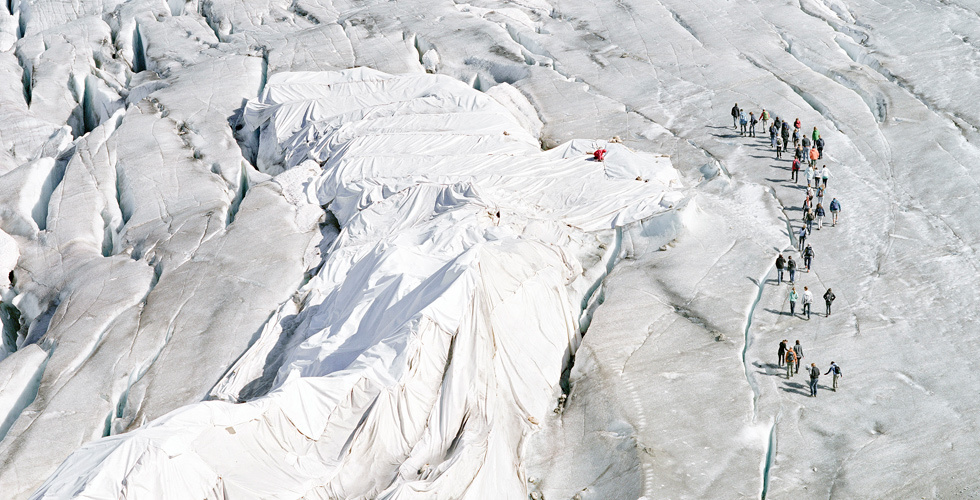
In the Moscow Museum of Contemporary Art, the tenth photobiennale was launched - the main Russian show of relevant and classical photography. One of the three topics of the festival this year is Visual Power , the power of the visual. Exhibition of the young Lausanne photographer Matier Gafsa “Welcome to the mountains! Anti -romantic Switzerland ” (curator - Gabriel Meshtetter) is perhaps the most accurate proof of how strong this power is, regardless of the political and temporary context.
Two dozen works, first brought to Russia, represent the most famous series of Matier Gafsa-Alps (2008-2012) and La-Sh-de-Fon (2009-2011), in which the greatness of a mountain landscape, albeit deprived of an open gloss, is opposed to the pure rationality of a small alpine city, where the photographer accidentally turned out to be several years ago. Gafsa Alps are fog, immobility, melancholy, bleached non -contrast landscapes and deliberate the geometricity of the composition. Human figures here appear only to indicate the scale - a second to eternity. Romance gives way to the tense concentration of the photographer on each detail, whether it is light, which is weakly breaking through the clouds, or a random gesture of a person who has fallen into the frame. Such a maximum fixation on the seemingly most ordinary objects gives rise to almost religious associations. And now the dull circle of light over the mountain peaks seems to be strange like a halo, and exhausted travelers, despite phones and cameras in each hand, are increasingly reminiscent of pilgrims.
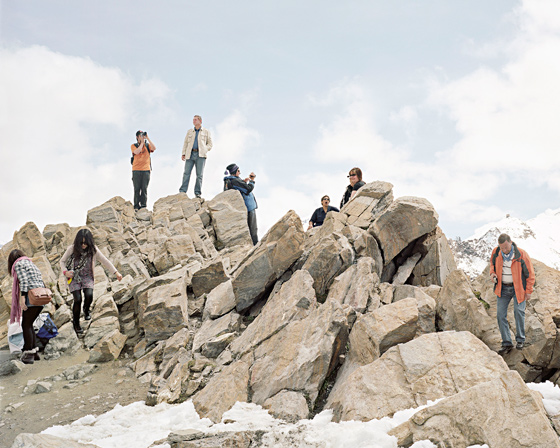 Mattieus Gafsa. From the series "Alps". 2008-2012. Courtesy Galerie C, Neuther
The frozen streets of La-Sh-de-Fon are hung in a different magic-man-made and from that no less fascinating. One of the most important values here (as, indeed, in any other corner of Switzerland) is the art of living in a civilized world, without violating the connection with nature. True, in the pictures of Gafsa, it is brought to the frightening absolute. Ascetic cold architecture, as it were, is embedded in the surrounding landscape, making the presence of a person as inconspicuous as possible: here the snow flooded the roofs of the houses, and only the black doors give out a mountain of stones in them, but garage buildings. Each frame is the story of one enchanted place. Wires, rails, radio extensions, mysterious deserted streets and an all -pervasive fog - all this non -renounced Saspence of Alpine cities will have to open not only us, but also the Swiss themselves, accustomed to visual stamps like sunny ski slopes and elegant chalets no less than any tourist.
A dull circle of light over the mountain peaks seems like a halo.
Matthew Gafsa says that the main thing, what he achieved, working on this photo serpers is to find a non -trivial look at the familiar things and phenomena, even if he turns out to be repulsive and frightening. “When the Swiss takes pictures of Switzerland, it is very difficult to invent something new and get away from the stamps, even to everyone else. It took me three years to find a new approach: I traveled a lot around the Alps, I saw a lot in different ways, and I discovered something for myself at all. I have been seriously engaged in photography not so long ago-since 2008, when I graduated from the local photo school, so the alpine history in a sense has become decisive to me in the sense of finding my own method of work. ”
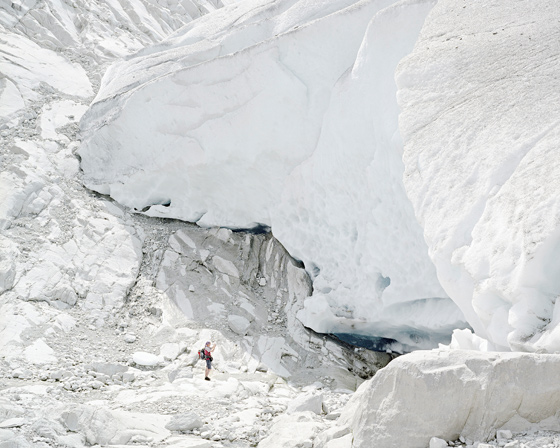 Mattieus Gafsa. From the series "Alps". 2008-2012. Courtesy Galerie C, Neuther
Despite the declared anti -romantism, Switzerland Gafs, of course, is penetrated through romance through - in addition to the author of the author. And the point is not in individual artistic techniques (strictly verified composition, filigree work with light) or magic of the scene - you never know the mountains. These are removed as if they really exist. And not only in commercials. This sometimes happens with a good photo.
Moscow Museum of Contemporary Art, Ermolaevsky, 17. Until April 20