
Translated material
In Kamchatka, they tried to hand over the stolen gun of Vitus Bering to the intake of scrap metal.
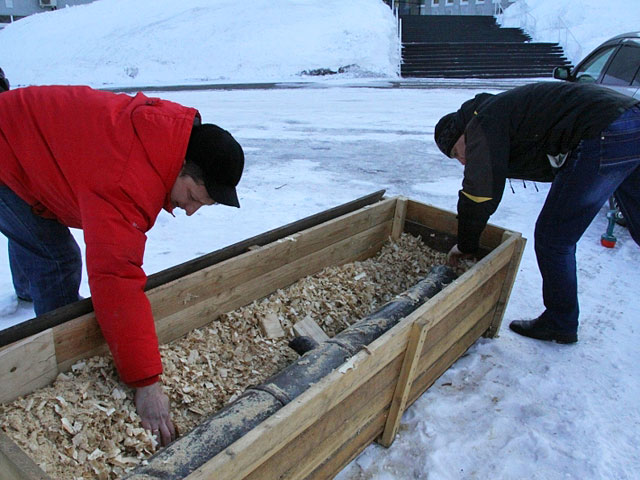
A cast-iron gun, stolen two years ago from the museum in the village of Nikolsky Aleutsk district on the island of Bering, was found at a non-ferrous metal reception in Petropavlovsk-Kamchatsky. They tried to put a rarity worth 14 million rubles for remelting.
At the intake of the scrap metal, the gun with the legendary package of St. Peter, whose age exceeds 273 years, was delivered in a wooden box with sawdust along with the metal party. According to the regional Ministry of Internal Affairs , the gun was seized, the issue of transferring it to the regional cultural department is being resolved.
Police hope to establish circumstances and perpetrators of theft of rarity from the museum. It could be delivered from Bering island to Petropavlovsk-Kamchatsky only by sea or air, overcoming a distance exceeding 700 kilometers. This circumstance will help narrow the search area.
The gun was stolen from the exposition in the open air in the spring of 2012, said IA Kam24 . The gun was raised from the bottom at the crash site of the vessel, who participated in the Second Kamchatka expedition of 1773-1741 under the command of Bering, and was stored in the museum, and on the anniversary of the opening of the Commander Islands in 2011 was installed on a special pedestal on the high bank of the island of Bering, reports "5 Channel" . At this place, a gun weighing 300 kg did not stand even six months, and museum workers found it lost only when the snow came down.
The illustrious navigator Vitus (Ivan) Bering, the Dane by origin, was an officer of the Russian fleet and in 1725-1730 and 1733-1741 led Kamchatka expeditions. He went through the strait between Chukotka and Alaska, reached North America and discovered several islands of the Aleutian ridge, which later became part of Russian America.
In the preparation of the Second Kamchatka Expedition, which was carried out on the Packetboat "St. Peter" and "St. Paul", in particular, Arseny, which was canonized by the Russian Orthodox Church (Matskevich) took part. He helped the commander overcome the resistance of the authorities in Yakutsk and Okhotsk.
One of the ships under the command of Bering in 1741 was thrown ashore with a strong wind. During a forced wintering, part of the crew, including Bering himself, died of scurvy. In the spring, the survivors built a two -masted vessel from the fragments of the packetball and returned to Kamchatka.
Subsequently, the discovery of Bering was confirmed by the English navigator James Cook. It was he who proposed to name the strait between Chukotka and Alaska by the name of Bering.
In 1991, during the expedition dedicated to the 250th anniversary of Bering’s voyage, in the bay of the commander, underwater archaeological work was organized at the crash site, during which metal artifacts were found. In addition, scientists managed to detect and send the remains of a sailor and five of his associates to Moscow. After the study and work on the reconstruction of the appearance of Bering, his remains were buried in the Commander Islands.
In 2008, the name of Vitus Bering was included in the list of 500 heroes of the Name Russia project.