
Translated material
Clement Redko loop
On March 14, 1935, Clement Redko (1897-1956), who by that time had lived for several years in France and gathered home, recorded in his diary: “He wrote the drafts of the statement to the consul. I decided to get out of Paris in three months. Eight years are given to France. What are these years, and yet, it seems, the ninth spring of 1935 is no different from the first spring of 1927. Now Moscow! Now your own! Now the homeland! " In the country of Soviets, where the avant -garde was so striving, there were already other realities than when he left for the main forge of art of that time from there. And although his most famous work remained a contradictory “uprising” of 1925, and he himself perceived himself as an artist of the new system, you can’t call him a political author. Who was he?
Starting in the icon-painting workshop of the Kiev-Pechersk Lavra (however, at first he even managed to learn from the porcelain painting), and having ended in the Timiryazevka art studio, the fate of the radio artist described a dashing loop. He was welcomed by Lunacharsky, who helped the artist go to Paris (possibly, wanting to save), and when Redko returned, he fell under the rink of accusations of formalism, for which he was expelled from the Moscow Union of Artists in 1948 (although he entered his ranks only three years before).
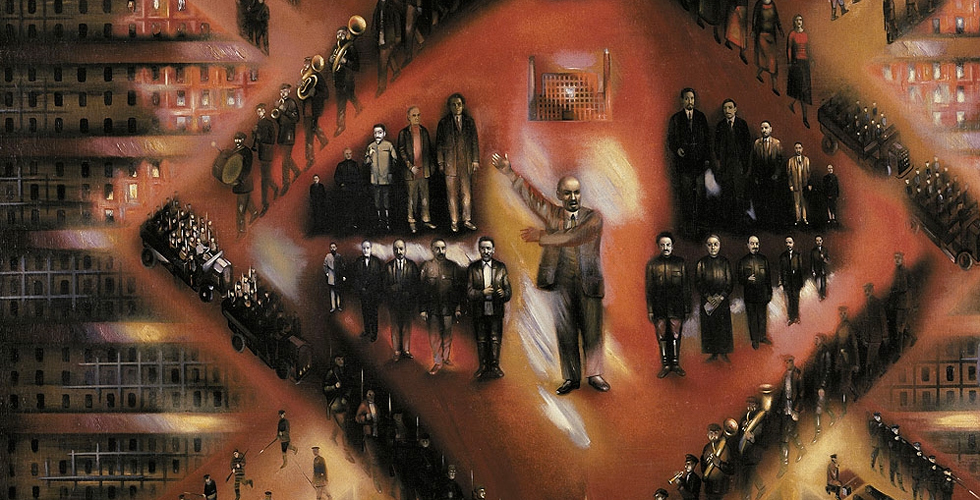
Around the middle of life, a year after the death of Lenin, in 1925, Redko finished the “uprising”. Not that he is an artist of one picture, but it is precisely this work that is invariably represented. First, Redko thought to call her “RCP”, then replaced the name with the “revolution” and eventually showed as “uprising”.
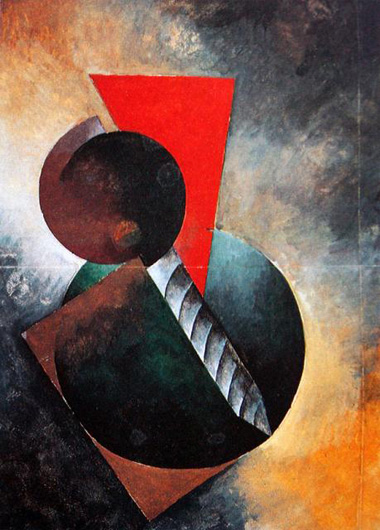 Clement Redko. Light and shadow in symmetry. 1922
Before you get into the Tretyakov Gallery, the picture was in the collection of George Kostaki, who, as the director of the GTG Irina Lebedeva said in one interview, wrote on the back in 1977: “A picture of the century, the greatest work of revolutionary Russia. George Kostaki. Moscow, April 14, 77. " According to Lebedeva, today's public, apparently, first saw a picture at the 1987 exhibition “Art and Revolution”, since then the work has not left the halls of a constant exposition.
Like many avant -garde, Redko accepted the revolution. Like many, he believed that the era that came from the artist of creating other paintings, models and explanation of life - taking into account technical innovations. Actually, his “uprising”, despite the admiration of the painter Lenin, someone considers the image of the tragedy-a rebellion that crushed the former system for himself, someone guesses in a leader’s figure in a giant red rhombus (here it is, a red square, which has risen) iconography “Savior in Sila”, only on the sides of Trotsky, which will call a new leader in 1926 already in 1926 “The burial of the revolution”, Krupskaya, Lunacharsky, but Stalin is not nearby, but only in the second row. Redko risked, and who knows what it would have turned out for him if the artist had not moved to Paris in 1927.
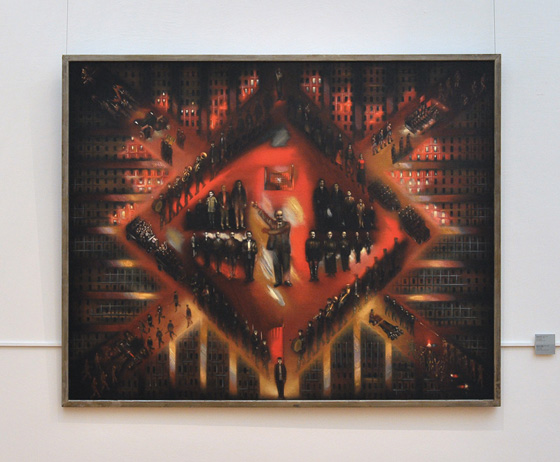 © Pavel Sepa Clement Redko. Insurrection. 1924-1925. State Tretyakov Gallery.
You can not see in the “uprising” of church iconography, even if it was written not like an icon, but anyway-like an emblem of revolution, built in the rhythm of the march, on the geometry of straight angles and diagonals, on dynamic rays of veins, cutting out a red-black city, the houses of which, however, are similar not only to the design of inertia, spreading in all directions, but also to prisons. Redko was interested in the issues of energy, light as its embodiment, by the design as an expression of form, and, consciously or not, the “uprising” turned out to be contradictory. Welcoming the revolution, it speaks about its dark sides. The world here is a debugged mechanism. Redko will also fall under the press of this overgrown mechanism many years later, although the exclusion of artists from the Moscow Union for Western influence - of course, is not the worst thing that could happen.
Its art is a strange batch received from studying in the same icon-painting workshop at the Kiev Pechersk Lavra, studying at Arkady Rylov and Nikolai Roerich in the company of encouraging arts, in the studio of Alexandra Exter, in Vsilia Kandinsky. Between Kyiv, Kharkov, St. Petersburg and Moscow. Redko began and eventually returned to the rather traditional realistic works-pasty landscapes of the 1910s or 1940s or its completely ordinary late portraits like the “Girl with the Missiles of 1941” (however, her sad thoughtfulness was contrary to the requirements that at that time satisfied socialist realism) concluded, “roam” his artistic career into kind prayers. At first, they say, he was still accelerated, then he no longer found his use, in general, he was not to the court. His French works are Overn peasants, young ladies full of languid lyrism to the same extent as the landscapes filled with air and melancholy. There will be boxers and lambs, but everything somehow does not leave the category "what I look at, I sing about that." In these things, the color becomes softer, but experiments with the form that occupied it in the early 1920s and remained the main thing for him, come to naught. Therefore, apparently, the artist wrote that the first French spring was like the latter.
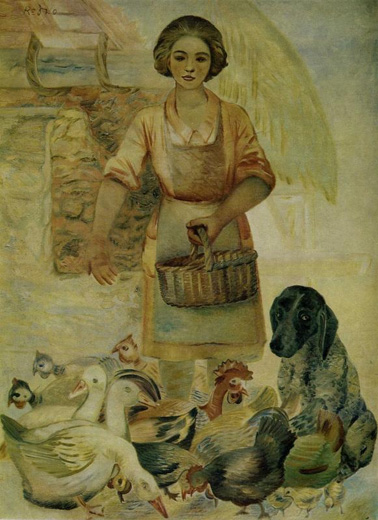 Clement Redko. Morning on the farm. 1933
It turns out that the most active time Radko is the first half of the 1920s. Although the avant-garde, if we talk about the innovations of Malevich and Kandinsky, was released at the beginning of the century, in the 1910s, an impulse heated by the revolution, and for the next decade-until the socialist realism actively appeared in the 1920s. Redko, of course, did not pass by Malevich, reflecting whether he would fit his own style of Suprematism, and creating the composition of the same name in 1921-1922. The circle, the square inscribed in it and on top of all this is two wedge crashing into each other as a static sign. Perhaps this is not the affirmation of the square and the circle of Malevich and not the movement of his geometry, but these wedges are not a couple of red that shortly before that “beat” whites at Lisitsky. Redko himself seems to be more interesting how the image looks spatial. In the Suprematic samples, even if a dynamic diagonal appears, the elements still do not strive to fly apart, like Malevich’s, but behave “collected”, precisely as an emblem, which later will become a “uprising”.
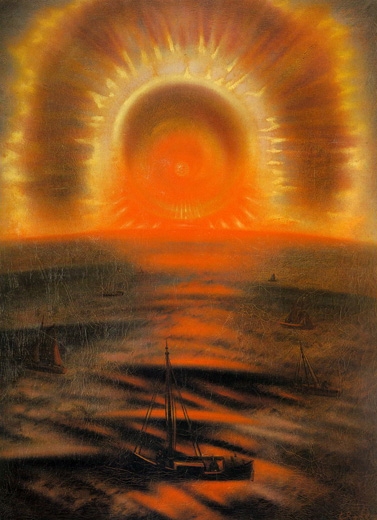 Clement Redko. The midnight sun (northern lights). 1925
In 1921, he, Solomon Nikritin, Alexander Labas, Alexander Tyshler, united in a group of projectionists, otherwise called electroorganism-just according to Redko’s theory (the artist wrote the corresponding declaration in 1922), and in 1924 they became the Method group. Electorganism - in the spirit of time and not without the influence of his teacher Kandinsky - speaks, on the one hand, about the sensitivity of art to scientific research, on the other, about the mental influence, which the author translates through the picture. Redko calls the energy “future culture of life” and electricity, the light beam considers the light to pass on time and space: “The artist must affirm new concepts of realism by creatively meaningful facts. The first visual structure of the structure is a line. The second is the color, further - severity and image ”, but“ light is the highest detection of matter ”. And he will replace the electorganism with candlestick (he is also luminism), where the finds of the 1910s will respond again-the same rays of Mikhail Larionov.
The color of the light and the light of color, the artist showed the energy of both in the “uprising”, combining the conditional geometric construction with realistic figures. Otherwise, he applied light to the northern landscapes, where the northern lights would remind the electric flash (Northern Lights, 1925). And even in another way, Redko uses this most expression he found in works like “dynamite”, which came close to abstraction. (It’s funny, by the way, that, for example, Natalia Goncharova, who also thought about the concept of energy in the spirit of time, also spoke out in 1913 in the language of abstraction. True, it is not clear whether her “emptiness” is a destructive or creative force that transforms an uneven color “Luzhitsa” into something new.)
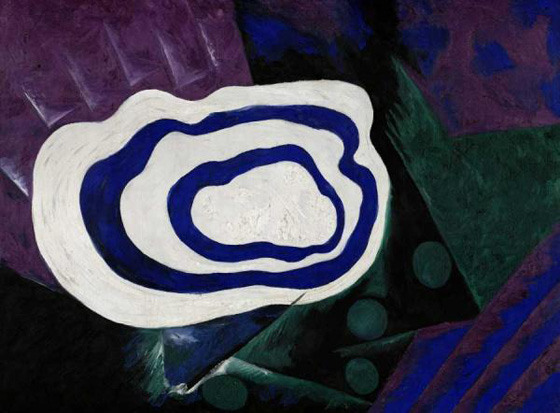 Natalia Goncharova. Emptiness. 1913
Redko shows the visible form as perceived, dynamics (however, not satisfied with the finds of the futurists), expressed in geometrization, was also combined for the “factory” (1922), where the verticals of pipes are mixed with diagonals of the rails, close to distant, moving with static and visible with what appears. In the same year, he “missed” the “husband and wife” through the same geometric filter. And in 1924 he wrote “composition I”-either in height, or in the depths of the last space of eight cells, in which very businesslike (albeit conditional as a scheme) men, connected both with each other and with those very rooms-cells with multi-colored lines. And, apparently, the flat image is compensated by a mental picture, where all lines and spatial levels form a big world, body. Symptomatic that Redko called the work “Cinema”. By the way, from here you can stretch the thread to the second Russian avant -garde and Vladimir Yankilevsky, who can even teach biomorphic forms in a mechanistic interpretation.
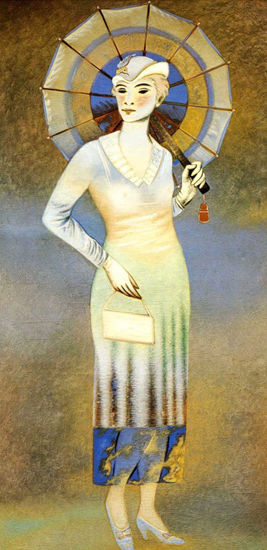 Clement Redko. Parisian. 1931
The search for Clement Redko, so it took place, fit between the beginning of the 1920s and the departure to Paris (he managed to get out with the efforts of the People's Commissariat of People's Commissariat for as “the most talented and serious of younger artists”). There, by the way, he managed to talk with Pablo Picasso, but the impression is that all this did not hurt his painting. Rather, France and, possibly, what he managed to see, passing, say, through Italian cities, although they did not bring a new impulse, one can assume that they were implicitly, or something, from socialist realism, who was waiting in the USSR.
He wrote realistic motives, but not in the socialist manner - and, for example, the strange “motherhood” already in 1937, among the few details, equipped with a riser of a Red Army on the windowsill behind a nursing woman, is not quite about the requests of a split regime (not that letter) and not about the experiments of the former Redko. However, he had an episode with work at the All -Union Agricultural Exhibition (for earnings) in 1938-1940, he even did a portrait of Stalin (this is not to delete the episode, but we can remember that the same portrait was written by Pavel Filonov, which is who you can’t blame for flirting with the regime, and both artists have a plotted, distant. Image of the head).
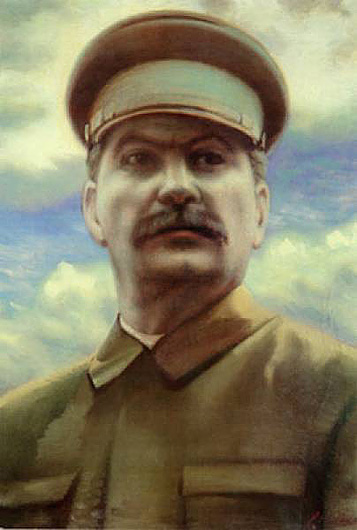 Clement Redko. Portrait of I.V. Stalin. 1940
Only a new round no longer happened. The “artist and power”, “art and revolution” in the case of Redko gave a variant of a person who was inspired, then from him, then from him who left (but not escaped), and upon his return to the recovery in the recruitment of the regime. The story, of course, does not tolerate a subjunctive mood, but ... If he had remained, it is not known in which direction he would be carried, it would not be known whether he would survive.