
Translated material
Olympics and Maidan | Colta.ru
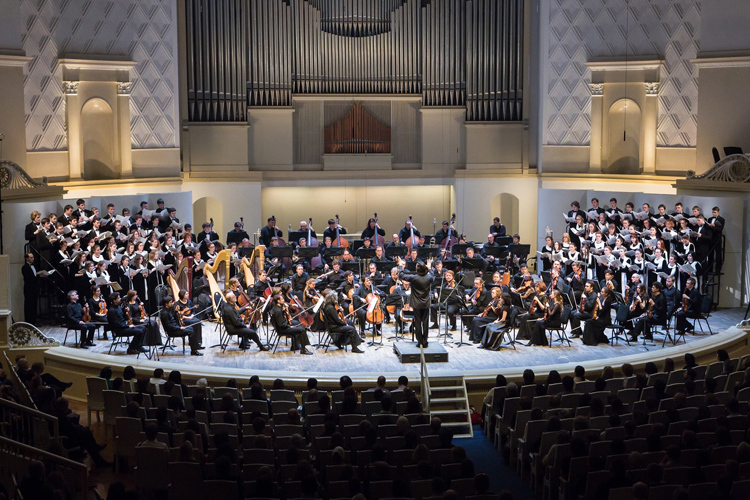
Vladimir Yurovsky dedicated the next visit to his state order and Moscow public - from a formal point of view - the history of German music. In all its diversity. Over two evenings, the most wide spectrum was shown.
From completely old times - Henry Schyutz, who lived in the XVII century. Two of his motets were performed from the collection "Psalm of King David." Yurovsky himself, however, at that moment did not appear on the stage, on ancient zincs and thrombons dudel the ensemble Alta Capella under the direction of Ivan Velikanov, painting the singing of the choir of the Popov Academy of Church Art, who participated in most other numbers of both programs. Of the three centuries later - “Schanberg’s“ surviving from Warsaw ”and the“ eckensastic action ”of Zimmerman. And from the golden German classics, attracting simple -minded music lovers, there are two main dishes: Brahms’s “German Requiem” and Beethoven's ninth symphony.
However, Yurovsky’s audience is not suspected of simple -mindedness. Maestro consistently accustoms her to look for a scratch of musical culture, knots and gaps, roll calls and dialogues, dusty museum secrets and forgotten milestones of the time. And, of course, the ninth symphony was not just the ninth, but with the note "for the first time in Russia." Because - in the orchestration of Mahler, the first great conductor of the 20th century, who, not yet knowing the upcoming era of authentism, treated the Beethoven heritage without any political correctness. And, of course, the prosperous masterpieces of Brahms and Beethoven were placed next to the completely unsettled and almost non -performed (in our region) works of the 17th and 20th centuries and from this unexpected neighborhood were considered from a completely new angle.
But this time was not in cultural enlightenment. Classical music is not something beautiful and distant; No, it's close, it's about us. Yurovsky expressed this thought very clearly, both evenings began with a microphone in his hand. He was categorically not going to entertain his art, on the contrary, he had the intention to break the sores and succeeded in that.
Bernd Alois Zimmerman is the author of the opera “Soldiers” (1958), this is his most famous composition, he was even brought on tour to Moscow in the late 80s, and a couple of years ago an important event of the Salzburg festival was the production of Alvis Hermanis. Yurovsky undertook to fulfill another composition of this composer, an “ecclesiastic action” for two readers, a bass and an orchestra. It is dated to 1970 and, one might say, is an example of radical actionism in music. A few days after the completion of the score, ordered to him for the Olympics in Munich, the composer committed suicide. He was 52 years old. Yes, with the word "Olympics" you can already start.
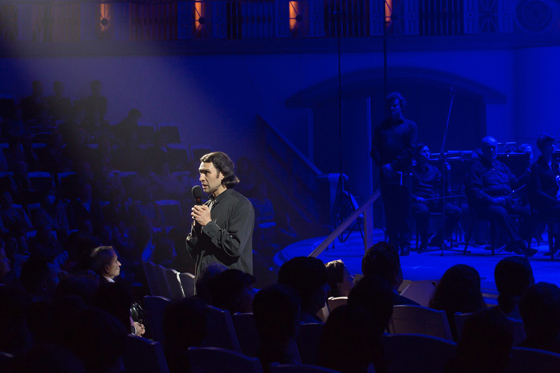 © Vera Zhuravleva Zimmerman. Ecclesaic action
In the introductory word, Yurovsky did not forget to mention the tragic outcome of that 1972 Olympiad. The essay of Zimmerman was not executed on it, but it went down in history with an anti -Israeli terrorist attack. In general, the bloody facts from the history of the twentieth century become a clear, restraint and harshly reminiscent of the Philharmonic public (we can recall the Meyerchold plot in his summer lecture cycle). It seems like a non -core, but very important thing - at least in order to better understand the music of the twentieth century.
Is it worth adding that the very essay of Zimmerman on the texts from Ecclesiast and the “Karamazov brothers” (“Great Inquisitor”) has already left no illusions about the festive Olympic mood. This is such a terrible hysterical hopelessness of a brutal-placket, with a significant theatrical component (thrombones under the dome of the hall, readers depicting athletes, a conductor sitting on the floor for meditation). In the final, a quote from the Bakhovsky choral " ES IST Genug ” (“ Enough from me ”). Of course, Zimmerman outweighed Brahms following him.
Approximately the same story happened in the second program and with the 7-minute Shenberg, which became a climax for the many evenings of Bas-Bariton Dietrich Henshel. A tiny cantata, which is based on a live certificate of a resident of the Warsaw ghetto, was written in 1947 and for subsequent generations became a reference point in the aesthetic experience of the Holocaust tragedy. Yurovsky put her in front of the Beethoven symphony, asking not to applaud between two works. Millions over the past 200 years could not hug, he stated, and the loss of human life forcibly in the prime of life is the biggest tragedy, regardless of whose banners there is a war.
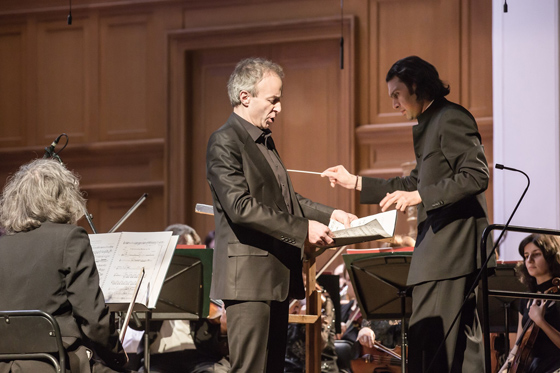 © Vera Zhuravleva Shenberg. Surviving from Warsaw
No specific geographical names were uttered, but they are already in their heads now. In fact, from the scene of the Great Hall of the Conservatory, Yurovsky asked for a minute of silence in memory of those who died during Ukrainian events.
The ninth symphony sounding after that had nothing to do with that sleek and arrogant jewel, which the Viennese Philharmonic Orchestra with Christian Tileman was presented to us last fall. The onslaught and the absolutely Maleovsky plaque of the first part were unusually convincing, the strange unbalanced of the final quartet of soloists is not. But what caused unequivocal admiration was a re -flowering late Soviet art between lines, sympathetic ink, embed the second and third meanings, not directly expressed, but so that everyone understands.