
Translated material
The official representative of the Yakut Diocese of the Russian Orthodox Church will visit Alaska
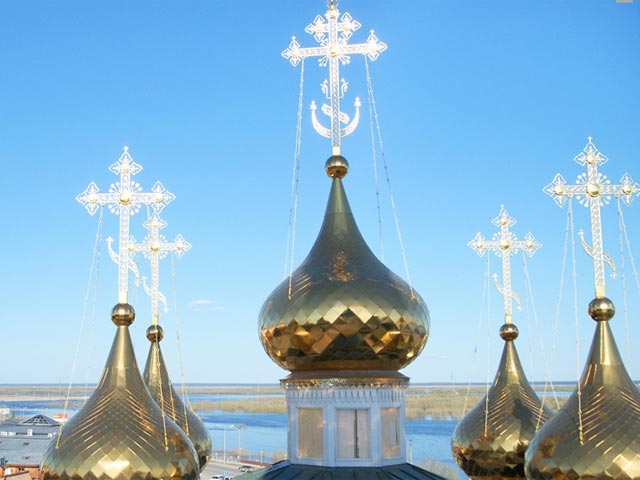
On Friday, a delegation of the capital of Yakutia arrived in an official visit to the United States.
With the blessing of the head of the Yakut and Lensky diocese of the Russian Orthodox Church, Bishop Roman Roman, the delegation was part of the diocese, Jerodyacon Simeon (Berezkin).
The official visit has a visit to a number of cities and territories related to the history of spiritual and cultural relations between Russia and the USA. In addition to San Francisco, the delegation will also visit Alaska, where he will visit Anchoridge, Ferbenx, June and on the island of Kadiak. As part of the visit, meetings with public representatives and work in the archives are provided, the Orthodox Yakutia website reports.
Pages of the history of Orthodoxy in Alaska
The presence of the representative of the Russian Church as part of the official delegation of Yakutsk is quite justified if we recall the history of Orthodoxy in Alaska, which has more than one century. There is even the concept of "Russian America" , which means a set of possessions of the Russian Empire in North America, which included Alaska, the Aleutian skeleton, the Alexander Archipelago and settlements on the Pacific coast in current California (Fort Ross). At the same time, experts note that without Orthodoxy it is impossible to understand the phenomenon of "Russian America".
A detailed excursion into this story was made several years ago by the American scientist Jeffrey McDonald - a native of a Protestant family, who accepted Orthodoxy during his studies at the University of Baptist in the United States. His essay was published by the portal "Orthodoxy and the world."
According to McDonald, who himself lived in Alaska, after the appearance of the first Russian merchants of furs and sailors (until the middle of the 18th century), they gradually began to master the Aleutian islands and the coast of the peninsula. Well, the vessels were also present by ship priests who turned some Aleuts to Orthodoxy, although it was still an unorganized, individual appeal to a new faith for the inhabitants of Alaska at that time.
In 1795, Catherine II sent a group of monks-missionaries from the Valaam Monastery to Alaska. They arrived at the island of Kadiak, where the Russians founded a colony called the Harbor of St. Paul. Now this city is also called Kadyak. In addition to the civilian population, there are now the base of American marine border guards.
Some of these missionaries were priests and baptized thousands of people. One of them was Hieromonk Juvenal, and during a missionary trip he was killed by local residents. The place of his death is definitely unknown.
In the city of Haban of St. Paul, an orphanage was founded in which, in addition to religious education, they also taught practical skills, such as navigation and other similar subjects.
However, the conflict has gradually matured between the administration of the Russian-American company (it was a private trading corporation) and mining monks. The essence of the conflict was that the monks stood up for local residents, who were soldered and oppressed by merchants. As a result of this conflict, the company cut funds for missionary activities, and, in the end, only one monk named German, who is now known as the Monk German Alaskinsky, remained in Alaska.
He left the harbor of St. Paul and settled on a small island - the island of Elov, where he lived alone in silence, like an ascetic -isihast. He was not a priest, but a simple monk, could not perform services, but nevertheless it is interesting that of all the missionaries of the early period, the peoples of Alaska remember only the Monk Herman. And not only remember, but love and revere. For Aleuts and Eskimos, St. Herman is the main prayer book. In the worldly sense, he did not engage in systematic missionary activities, but he was a man of very high personal holiness, already during his life he committed many miracles. And now, after centuries after his death, Aleuta and Eskimos come with their troubles and problems to pray to the place of his graves, collect the earth from it and receive healing and solving their problems.
For a long time, the Monk Herman was forgotten by the outside world. His widespread veneration began after his canonization by the Orthodox Church in America in 1960.
The second important phase of missionary activity began with the arrival of Priest John Veniaminov to Alaska. He arrived at the island of Unalashka, built a beautiful church in which he served. Father John was a man of various talents, including gifted as a mechanical engineer. In addition to the tireless missionary work, he left many ethnographic notes and was elected an honorary member of the St. Petersburg ethnographic society. He learned local languages and began to translate the Holy Scriptures. He translated a huge number of texts.
Priest John Veniaminov, having arrived in Sith, built the Cathedral, studied the very complex language of the Kalosha Indians and began to translate the Holy Scriptures into him.
After a few difficult years, he went to St. Petersburg to obtain permission to publish his translations. During this multi -month journey, his wife died, and he was tonsured in the monks by the name of Innokenty and erected to the bishops.
Bishop Innokenty returned to Sith and continued the missionary activity of his diocese, founded the school. Unfortunately, the temple he built was wooden and burned down in the 1990s. He ordained the first local priest, the father of Jacob Neubrutov, who was half aleut, half Russian. The Father of Jacob worked among the Aleutian people, was sent to the Yupikas Eskimos, and from the 1840s to the 1860s he transferred the center of the mission to the village, which is still called the "Russian Mission". He evangelized in these areas not only Eskimos, but also of Indians.
In 1867, Russia sold Alaska to the American government, and many Russian clergy left Alaska. It was a very chaotic time, for a long time only furs and gold miners were present there, representatives of the American government were at first absent, and the church mission was very affected by this.
At this time, Bishop Innocent was elected Metropolitan of Moscow, and he founded a missionary society in Moscow. The efforts of Russian missionaries continued to spread Orthodoxy in Alaska, and soon the work of this society surpassed the activity that was carried out in those days when Alaska still belonged to Russia. Many church buildings were built there just at that time. More than 45 schools and two seminaries were founded throughout Alaska, the church flourished. The Alaskan bishop transferred the center of the diocese from Sith to San Francisco, and a new mission began in the main territory of the United States to appeal to the Orthodoxy of emigrants who arrived from Eastern Europe. For the efforts of the mission, more than 100 thousand uniats returned to Orthodoxy. Thus, it turned out that the continental states became much more Orthodox than in Alaska.
Already in the twentieth century, St. Tikhon became the bishop of American. He scurried many monasteries, seminaries, schools. The mission received the main financial support at that time from the Russian missionary society.
In Alaska, the period of decline began between 1910 and 1913. The American government decided that it is finally necessary to give real education to the north to the north. Alaska was divided by Medu in various Protestant groups, where they could freely perform their mission, enlightening the dark locals. The Aleutian Islands went to the methodologists, the Kodiak went to the Baptists, the Sith went to the Presbyterians, the Jupiki went to the Moravian brothers. Mission received financial support for the American government. Boarding schools were organized, children were taken from their parents and kept it in the dormitories, forcing them to receive real American education. Since 1910, American missionaries have convinced the American government to forcefully close all Russian schools. For the then Protestants, Orthodoxy was almost equated with paganism, and they tried to block all the sources of its spread. They also wanted people to stop speaking in local languages, and speak “normal civilized”, that is, English. The Moravian brothers also wanted to change the local economy so that it did not completely depend on hunting and fishing, which, of course, did not succeed. The result of such efforts paradoxically was that the remaining pagan villages became Orthodox.
Orthodox missions used local languages, prepared local residents for the priesthood, respected local traditions. The Orthodox saw that not everyone in the local pre -Christian life needs to be thoughtlessly destroyed, so even the shamans in many respects prepared people to adopt Christianity.
In 1917, a Bolshevik revolution occurred. This was a disaster not only for Russia, but also for the American Orthodox mission. Many priests returned to Russia. Financing was instantly discontinued. Both in Alaska and in the continental states, the entire administrative structure of the church collapsed, most church institutions were closed. The church has split into many ethnic groups that were mainly engaged in preserving their property. This division completely distorted the direction of the church’s activity: instead of being a missionary church, which is aimed at the outside world, it turned into multiple ethnic groups, interested in how to preserve their cultural heritage, which was understood very narrowly: mainly folk customs, and not a high culture.
In addition, emigrant psychology is characterized by the desire to join, fit into the culture of the country into which people entered, not to stand out and not try to change this culture. Thus, after the revolution, the mission gradually came to naught.
But gradually the following processes took place: on the one hand, the church learned to create mechanisms in order to maintain their own life, and on the other hand, new generations born in America thought less about their national affiliation, and more about the religious content of their faith. The understanding that it was necessary to maintain missionary work in Alaska returned.
In the 1960s, a small missionary school in Sith opened. In 1973, a large seminary opened on the personnel. "Big", of course, by local standards: about 20 students studied in it, instead of two. Efforts were made so that it was the locals who entered there. The territory of the resettlement of the Eskimos-Yupiks (the most numerous Orthodox people of Alaska) was never under direct Russian administrative management, and most of the clergy of the mission consisted mainly of Aleuts. And now the territory of the Yupikov is still the largest territory in Alaska, where the people are turned to Orthodoxy.
During the period of decline in all of Alaska there were from four to nine priests, now about 90 parishes, 35 priests and more than 100 readers with a seminar education. Where there are no priests, readers conduct worship. Most priests are from local residents, so they can live in a village that still exists thanks to fishing and hunting.
Until now, there are many people who speak Russian in Alaska. And the Slavic language is used in worship throughout Alaska. In addition, in local temples they serve in English and in local languages.
Among the Indians there are also Orthodox. But the Russians managed to convert only some of the Indians (mainly Tlinkites) to Orthodoxy, while others were converted to Presbyterianism after the departure of the Russians from Alaska.
The Orthodox Church in Alaska is part of the Orthodox Church in America. Relations with the Russian Orthodox Church are good. In 1970, the Russian Orthodox Church provided the American Orthodox Church with autocephaly - independence. Patriarch Alexy II came to the 200th anniversary of Orthodoxy in America, who, in particular, visited Alaska.