
Translated material
How to return from offline
What to do if your Internet resource is disabled "for extremism"
In February, a law entered into force, which allows to block any Internet resource, which the prosecutor’s office will consider “extremist”. Several Internet resources were subjected to such a blocking on the eve, including Navalny LJ.
The New Times* compiled an instruction: to do it if you were banned.
*Continuation. About how to prepare for a search - The New Times No. 5 of February 18, 2013 ; How to behave during interrogation - The New Times No. 7 of March 4, 2013 ; How to survive the first days in the conclusion - The New Times No. 9 of March 18, 2013 ; How to choose a lawyer - The New Times No. 12 of April 8, 2013 ; How to behave if you are being followed- The New Times No. 14-15 of April 22, 2013
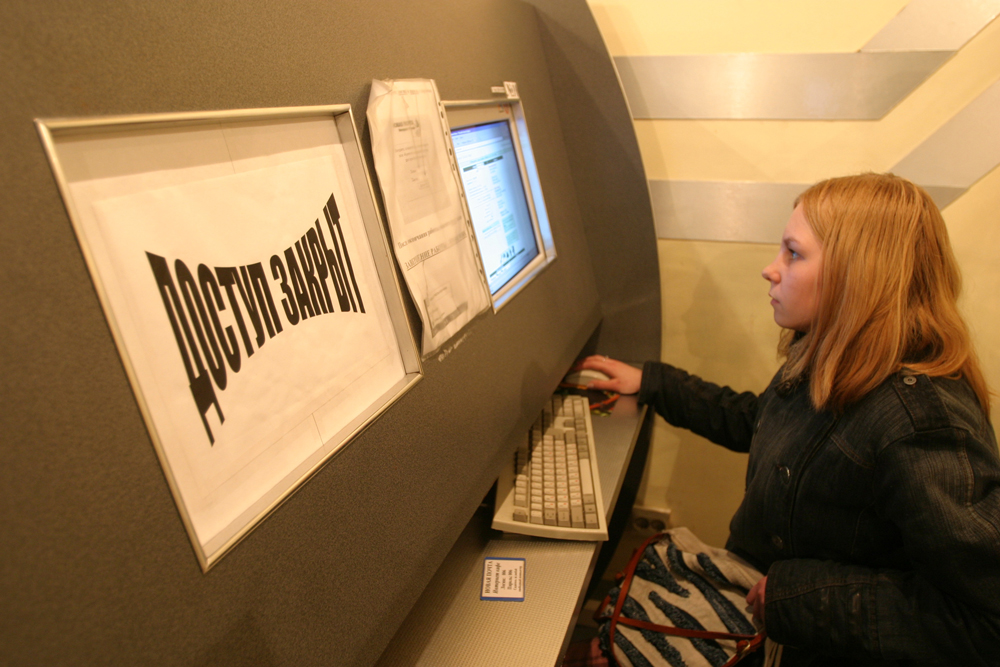
Even respectable citizens can lose access to the network "for extremism". Internet cafe, Moscow, December 2013
| ** Amendments to the Law "On Information, Information Technologies and On Information Protection" entered into force on February 1, 2014. |
The free information space, which is still considered the Internet, is narrowing faster. In the summer of 2012, the State Duma legalized black lists of sites with information harmful to children. A year later, she took up copyright violators, allowing to block sites with pirate film products. Well, at the end of 2013, the deputies adopted the law on blocking "extremist" resources at the request of the Prosecutor General **.
The new technology is simple. Having discovered “extremist” information on the Internet, the Prosecutor General or his deputies send to the Federal Service for Supervision of Communications, Information Technologies and Mass Communications (Roskomnadzor) a requirement to restrict access to the corresponding resource. The supervisory authority redirects this requirement to the telecom operator, which makes a shutdown. At the same time, no trial to confirm their correctness is required by prosecutors. Almost like in a bearded joke: the doctor said to the morgue - means to the morgue.
Risk zone
Why can you get under the punishing hand of Roskomnadzor?
According to the law, information containing “calls to riots, extremist activities, participation in mass events conducted in violation of the established procedure” is subject to blocking. Do you think this is not about you? After all, you do not call on to the revolution on your Facebook, you don’t justify the terrorists, you don’t offend people by national basis - and, therefore, do not belong to extremists? Take your time with conclusions.
In Komsomolskaya Pravda, they probably also thought that they didn’t do anything illegal when in March 2002 they published a joke test “Are you a bribe takeress on their website?” (“You are a bribe taker, if you are able to chew a thousand dollars with single -Bax bills in five seconds ...”) NO - Ulyanovsk prosecutors did not understand jokes, after 11 years (!!!) they found this text in the archives and considered it the propaganda of bribery and “a demolition of authority of state power”. Well, they blocked through the court the KP website in the territory of the Ulyanovsk region.
“Many Internet materials are prohibited as extremist for reasons that are generally impossible to guess about,” agrees Alexander Verkhovsky, whose owl center is monitoring “illegal anti-ejeskomism”. “Because these issues are resolved at the level of district prosecutors, and complete illiteracy reigns there.”
If you simply express your civic and political position on social networks - you can also easily fall under the blow.
For example, in June 2013, he was recognized as extremist posted two years earlier in the blog of Alexei Navalny Video against the “Party of Crooks and Thieves”, which, according to Owl experts, does not contain any signs of extremism. And in November 2013, an opposition activist from Barnaul Andrei Teslenko was fined for the repost of this video on his VKontakte page.
“Pedophilia, drugs, gambling, Nazism and other cannibalism are not at all what you want to protect. But the guards in an attempt to protect citizens from extremist ideas will splash out with the child’s water, ”the programmer Vladimir is afraid of the programmer, who works in a large IT company, helps with the design of the pages of socially active friends and conducts seminars on computer security equipment. “Not only platforms containing anti -Semitic books, dissected migrants and sex with minors, but also resources with a repost of the post, unauthorized by the authorities of the demonstration, can be out of access.”
“The only consolation is that according to the new law, blocking will be carried out through the Prosecutor General,” adds Verkhovsky. -And some particularly crazy idiocy will probably be eliminated. Nevertheless, there is always a risk that someone is so prohibited in your Internet records. ”
Check the content
So, what to do if your Internet resource (site, page or account on social networks) blocked?
To begin with, contact the technical support: perhaps we are talking about minor problems that the provider will solve without the intervention of higher powers. But if they answer you that the resource is blocked at the direction of Roskomnadzor, get ready for the worst.
According to the law, during the day after blocking, the provider must officially notify the owner of the resource about this and invite him to delete unlawful information. But while you are waiting for revelation from above, just in case, check your content again.
“The reason for the closure may be the contents of the site, and the replica under the old article, where a person scolds Masons or shares a link to porn,” explains Anton, an editor of the news feed, who is responsible for tracking reader comments. “Therefore, in the case of blocking, check whether there are really no sensitive materials on your resource that can be regarded as an excuse for forbidden ideas.” “The reason for the blocking is the complaints of ill -wishers, while the moderators are not always ready to understand - the staff is small,” adds one of the employees of the domestic social network, who wished to remain unnamed.
If you still decisively do not understand what the prosecutors could complain about, but the notification never reached you, study the black lists. Three of them are on the website of Roskomnadzor: this is a single register of prohibited information (according to the law on the protection of children), a list of copyright violators and a list of resources banned for extremism. To find out if you got into one of them, just drive your data into the search bar.
If there is nothing about you, look at the federal list of extremist materials on the Ministry of Justice’s website. The reason for blocking may be the repost of some of the previously prohibited materials. True, it is more difficult to look here: in this list as of mid-February, more than 2200 points, and finding “your” among them will not be so simple. Especially taking into account the fact that some records look something like this: “The text document“ Terrorism ”, the“ Decree1 ”folder CD-R disc No. 1”, or even “File under the name“ Khayutdin Gimmadeevich Gimatyatdinov ”.
If you still found yourself in black lists or a notification has finally reached you - you need to decide what to do next.
The first option is to delete the forbidden information: if you, without thinking, reposted something extremist, it is better to correct the error voluntarily. After that, you must announce the following instructions to Roskomnadzor: the corresponding form is also on its website. The department, having checked your message, will “immediately notify the operator to resume access to the resource, and that access will“ immediately ”resume. True, how much this double “immediately” will last, the law does not specify.
If you are still sure that you have not violated anything, but just expressed their purely personal opinion about the burning problems of our time, you can go to court. To do this, you need official paper about the reasons for the blocking - if you have not received it, send a request to the provider, and he will send you the requirements of regulatory authorities.
“In essence, there is nothing to talk about with Roskomnadzor, he only fulfills the decision, and other authorized bodies make it,” explains Verkhovsky. “And if you received a specific document on this subject, this is already half the age, because you at least know which department made a decision.”
With such paper, you can safely apply to the court with a lawsuit to appeal the actions of state bodies. Success, of course, is not guaranteed to you, but it is still necessary to sue, as experts believe.
“The precedents of applying to the court from the affected site soldiers can be counted on the fingers,” admits the lawyer of the Human Rights Association of Agora, Damir Gainutdinov. - But if there are no appeal, then we will be deprived of the opportunity to break the current order. You can hope to win officials only as a result of several hundred appeals with the prospect of the European Court of Human Rights. ”
Duplicate resources
If you could not achieve the truth or you got involved in a long lawsuit, but would like to quickly return to the network, then you need to think about the restoration of your resources.
The easiest way to return the personal account on the social network: you just need to register again with another email address. The situation is somewhat more complicated with groups: you will not be able to restore the group under the same name, so it is better to think in advance about duplicate resources.
“In case of blocking the main groups on Facebook and VKontakte, there should be spare ones that are already known to users,” Vladimir explains. Make these understudies for a large number of administrators so that in case of blocking, one of them has the opportunity to manage the community. Register accounts on reliable comrades who know what “really $ l0) I (ny n@p0l.” At the same time, it is advisable not to hang the administrative powers to personal pages where you correspond with friends: in the case of problems, these people will turn to the competent authorities. If a specially established administrator account will be friends with the group’s subscribers, then he will be able to notify in the case of a ban Frequence of a new subscription.
If the site is blocked, more serious measures are needed. Vladimir is sure that the only way out is the registration of the site on the new address, and it is best to “look for landing” at foreign hosting and domain, because foreigners are more resistant to the requirements of our femid. But after the change of domain and IP, do not forget to notify the readers about changing the address through social networks or e -mail.
True, in this case, the whole company providing the site for the site can be blocked by the IP address. “Then there will be several spare addresses and a mirror server,” Vladimir recalls. Step -by -step instructions, according to him, are easily accessible for understanding.
Be literate
However, not everything in this struggle depends on the owners of the sites.
“If users begin to improve their computer skills, then the question of the inaccessibility of content will not stand,” Vladimir is sure. Therefore, the task of sites afraid to get under prohibition measures should be to inform users about the methods of bypassing censorship.
Most of these methods are due to the fact that even if in Russia a site located on a foreign hosting is banned, it will still be available from the outside, which means that it is only necessary to change the Russian registration of your computer using traffic anonymization programs.
The easiest and fastest way is to use an Opera browser in a Turbo mode. In this case, the requested data is caching on the company's servers and only then visible to the user. Mozilla Firefox and Google Chrome browsers also have such functions if you install a special plugin on them. Other common options are anonymizers and proxy servers that allow you to hide the IP address from the site, or a virtual private network (Virtual Private Network), when the entire traffic is redirected through this connection, and your provider does not see what sites you visit.
Finally, the programmers consider Tor (The Onion Routing - “Routing by the Bulbs”) in the most reliable way to read the material bypassing prohibitions. As Vladimir explains, this is a network of hundreds of thousands of computers around the world: “They drive user traffic back and forth, trying to confuse traces. The required site sees not a real IP address, but only the address of the last Tor server. ” Accordingly, the provider knows only about the encrypted request, but not about the subject of the final search.
Now all these methods are legal and are actively used in a corporate environment. Although it cannot be ruled out that over time, some of them will also be banned.