
Translated material
On the line of separation
What live and what the inhabitants of Crimea are waiting
It is customary to speak loudly in Crimea. “Referendum”, “Russia”, “Putin”-since the end of February, mothers with strollers, old people behind a chessboard, random passers-by, talking with someone on the phone-everyone is discussing the same
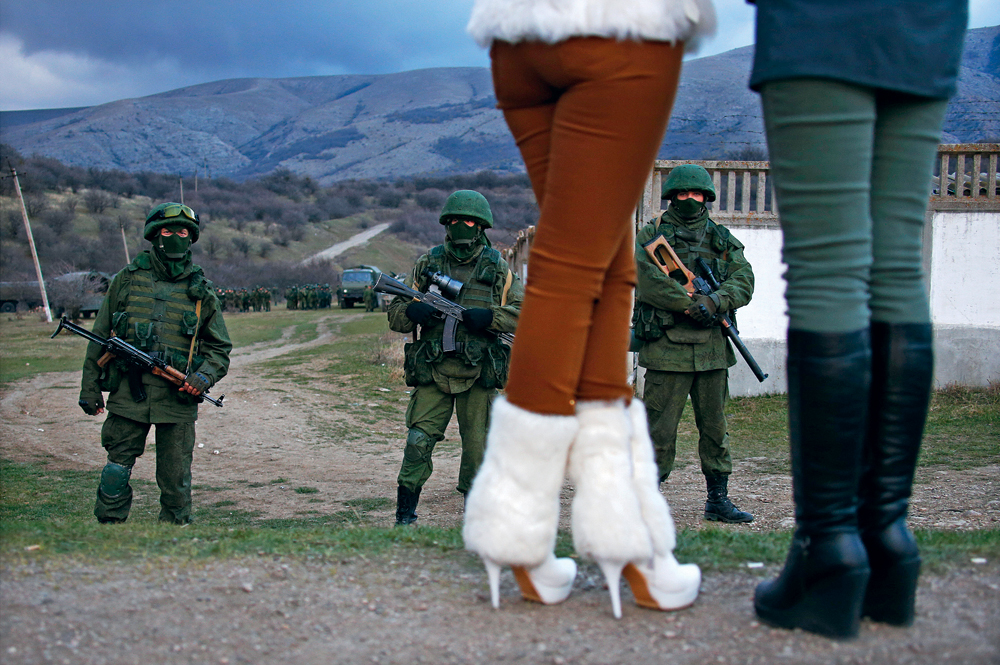
The Ukrainian military unit in Perevalny, like many others, was blocked by unknown armed people. Local residents (and residents) played the role of onlookers. Crimea, March 5, 2014
“Why is there no Russian flag by car? Do you have a homeland at all? Where is your homeland? - shouted at The New Times correspondent in camouflage with children's tights stretched over his head. It was near the blocked Sevastopol airport Belbek. And a person with tights was to be identified as a representative of a local patriotic movement that realizes the dream of the unity of Crimea and Russia - Crimean self -defense. - Do you have to pierce the wheels? These are at home you are a journalist, and here you are nobody! "
Armed people without insignia are a sign of Crimean time. For three weeks, the peninsula actually has been living in martial law. On February 27, unknown armed people who left here only March 3, were occupied by the Verkhovna Rada of Autonomy and the Cabinet of Ministers. All this time, self -defense units carried a round -the -clock duty before Rada. But the Crimean airports and Ukrainian military units are still blocked by strangers in the latest form without bangs and chevrons, which, as the President of Russia assures, can be bought at any store.
On February 28, the airspace over the Crimea was closed, a week later - slightly opened with the “strong winds”. On March 12, the Crimean sky again closed for all flights, except for Russian ones, the local authorities promised to open it only on the 17th, after the referendum.
The Russian passport saved the correspondent of The New Times. The Ukrainian colleagues were less lucky: on March 7, journalists of the Kyiv television channel “Inter” were beaten, on March 6 an attack was attacked on the correspondents of the Crimean television channel ATR, on March 5 they detained and sent back to the airport of the UN specialist Robert Cersi, the 8th Self-Defenseians did not allow the OSCE mission to the Crimea (and twice more in the next days). “We do not recognize the new government in Kyiv and do not want to allow provocations by local extremists,” Anton Sirotkin, chieftain of the Cossack fraternity “Unity” explained The New Times.
By the beginning of the second decade of March, the peninsula was apparently completely cleaned from the “extremists” - the military without identification marks with the help of the Crimean Cossacks began to strengthen the Chongar checkpoint on the Crimea’s border with the Kherson region of Ukraine: only one lane was allocated to the peninsula to travel from the continent, fencing it with concrete blocks, and the fortifications began to dig, and extend the thug of prickly. The wire ... The sky above the Crimea of the 17th, maybe they will open, but the concrete blocks in Jongar, it seems, will not be removed soon.
"Dark" prime minister
The Ukrainian military units in Crimea are largely blocking the residents of the surrounding villages that entered the self -defense, they say, “to prevent bloodshed”. But for patrolling the center of Simferopol, both Crimean Cossack organizations and the party of the new Prime Minister of Crimea Sergey Aksyonov “Russian Unity” are responsible. In many cities of the peninsula, tents appeared, where donations are gathering in favor of the party, and those who wish are recorded in volunteers. In Yalta, the tents of “Russian unity” are located on Lenin Square under the leader’s monument. They are hung with the last decisions of the Crimean government, here is the list of media: who can be trusted and who cannot. As the activist Venus explained The New Times, people come in the morning, on average about a thousand people daily.
Many of those who came excitedly praised Sergei Aksyonov: a charismatic leader, says without a piece of paper ... But at the same time they admit: until recently, they knew nothing about Aksyonov, although the “Russian unity” was in hearing. However, the new premiere of Crimea is not too much known now. Born in Moldova in 1972, studied at the Simferopol Higher Military-Political Construction School, but after graduation he quit in the reserve and took up business: in the yard there were "dashing nineties". Further, the biography of Aksyonov is overgrown with criminal hearing, which is not easy to check. It is only known that Aksyonov is not convicted. According to the official version, he was the deputy director of the Cooperative "Ellada", who traded food. In 1997, businessman Samkhan Agayev, an supposedly close friend and business partner of Aksyonov, was shot in in Simferopol. They say that after the death of Agayev, the future prime minister personally headed all the retail outlets and restaurants belonging to the deceased, and also took the currency in his “roof” in the Simferopol Central Collective farm market under his “roof”.
There are rumors about groups that were engaged in theft and resale of cars in the early 2000s, which included former and current employees of the Crimean criminal investigation.
Aksyonov began to actively engage in politics in 2008: at first he became a member of the Russian community of Crimea, and a year later he created the Russian Unity party, which quickly incorporated the pro-Russian Crimean movements. The President of Ukraine was then Viktor Yushchenko, in the peak of which Moscow sponsored “friendly” organizations throughout the country. By 2010, the rating of “unity” has grown to 15%, so in the elections to local councils in October the party hoped to receive up to 15 out of 100 seats in the Crimean Rada. However, the plans were not destined to come true: in February 2010, Viktor Yanukovych became the President of Ukraine, who appointed Vasily Jarta Prime Minister Vasily Jarta. “It was a very tough politician who quickly cleaned the political field in the Crimea,” Crimean political scientist Denis Baturin explained The New Times. “It was important for him that there was nothing left but the State Party of Regions.” It is to this that Baturin explains the so low results of “Russian unity” in the 2010 election-only 4%. Since then, the Russian Idea, the expert explains, has not particularly in demand. But at the end of 2013, due to the unstable situation in Kyiv, the Renaissance of the Russian movement in Crimea occurred: “They remembered about Aksyonov again: he became the most convenient candidate not only for Moscow, but also for Crimean elites.”
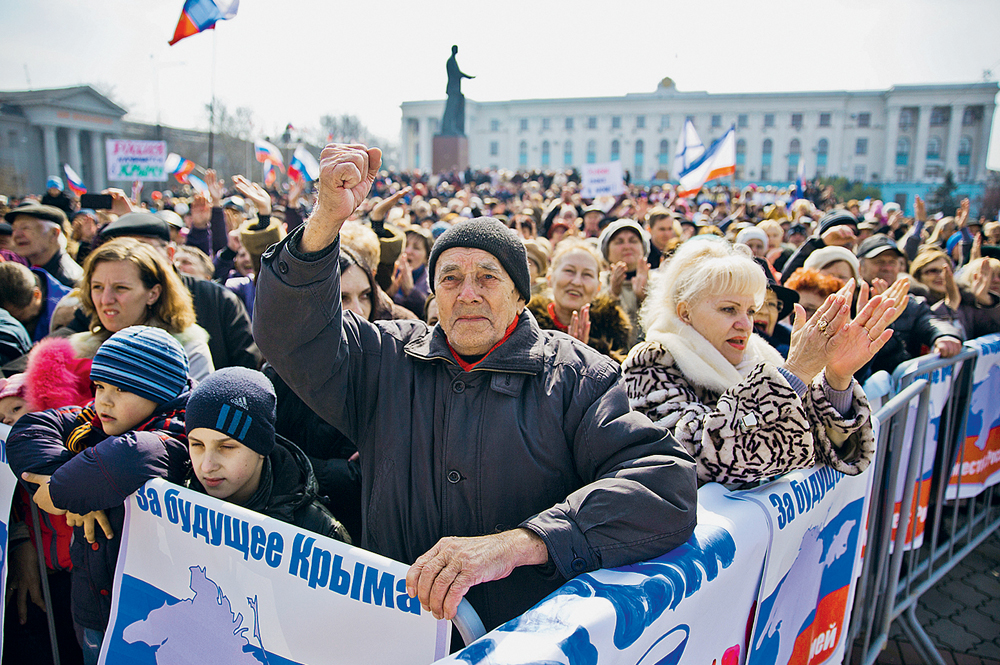
In the center of Simferopol, supporters of the annexation of Crimea to Russia were constantly gathering. A rally on Lenin Square. March 9, 2014
To the referendum, anger
If on the streets of the Crimean cities to ask everyone in a row about the accession of Crimea to Russia, the vast majority will be both hands “for”. The main hope of many Crimeans: the standard of living in the republic after joining the Russian Federation will be reached the Russian one. The average pension here is 1 thousand hryvnias (about 4 thousand rubles), the average salary is 2500 hryvnias (10 thousand rubles). On the broken roads of the Crimean cities, the same broken “Zhiguli” and trolleybuses of the 60s of the last century are driving, pre-revolutionary mansions often gap with empty eye sockets of windows, in small coastal towns are hibara instead of hotels, on which there are announcements about the delivery of housing. Even in the main resort cities - Feodosia, Yalta - in most residential areas, water is turned off at night.
Nevertheless, tourism brings Crimea $ 700 million per year, Russians, according to official statistics, account for 42% of 6 million vacationers and, according to representatives of the tourism business, "spend more than others and on a scale." During the summer season 2014, the local tour network is calm: “What was the war in Egypt, and the Russians went,” says Tamara Petrovna, director of one of the Yalta hotels, 58-year-old representative Killenia Lady. According to her, there are many apartments purchased by Muscovites and Petersburgers in Yalta, in addition, there are many Russian festivals and conferences: “Russians are making such banquets!” In addition to financial benefits, there is also moral. “I am outraged that a portrait of Bandera hangs in Kyiv, and people go with fascist stripes on their sleeves, I have two grandfathers in the war,” says Tamara Petrovna. “And, on the contrary, it impresses me how Vladimir Putin keeps historical memory, how he relates to veterans.” Tamara Petrovna is sure: what is happening now in the Crimea is a great luck for the Crimeans, there will be no other chance: “And this is also a great merit of Putin. He is generally a big politician, and speaks equal with the Americans. Thank you very much from me! "
"
“These old people in Nakhimov Square do not think about what they will have to pay for the water, like for gas!”
"
Another problem that makes Crimeans strive for Russia is the status of the Russian language. In 2012, the Party of Regions held a law according to which non -state languages could receive official status in those regions where at least 10% of the population uses it. The abolition of this law was one of the first steps of the new Kyiv government. “What do they sing to me about a single and indivisible Ukraine? Is this, we will be one and we will force us to speak in Ukrainian? - the accountant of the same hotel Tatyana Vladimirovna was indignant. - And so for 20 years, a horse and trembling doe have forcibly harnessed in one cart, but they didn’t learn anything! ” According to Glavbukh, if you choose between Ukraine, from which it is not known what can be expected, and Russia - the answer is obvious: “Yes, I will run to vote on March 16!”
The local activist Larisa Kurazhkin will also run to the referendum, who explained the New Times correspondent at the blocked base of Ukrainian marines in Feodosia that if there were no extraneous military people in Crimea, the Bandera from the Maidan would have already opened shooting here. “We are happy with Russian soldiers,” said Larisa Kurazhkin. - You do not understand what the "right sector" is! They themselves shot their own on the Maidan, so that then they would dump everything on ours! ” But the self -defenseman Andrei Rybin, retired lieutenant colonel, guarding the Ukrainian coast guard base with his squad in the village of Perevalnaya, 20 km from Simferopol, in addition to the “Bandera” there are other enemies: “If it weren’t for the Russians, the Tatars would have arranged pogroms.” To the question of how 240 thousand Tatars can defeat the 2.4-million population of Crimea, the lieutenant colonel explained: the Tatars take their daughters and wives to study at teachers and doctors, occupying all important posts for life, and at the same time they themselves seize the lands around the cities to cross the roads and ensure Turkish invasion to the Crimea.
To whom Russia is not sweet
Crimean Tatars are really the most active opponents of the Union with Russia. You will talk to any of them, the number one theme is the deportation of 1944. Stories about how people were raised at 4 in the morning, gave 15 minutes to fees, and then in the Stolypin cars were sent to Central Asia, passed from generation to generation. Of the 183 thousand deported, almost half, according to activists of the Crimean Tatar movement, died during the move.
The Tatars began to return to Crimea in 1974, but they began to arrive massively only in the late 1980s. They were not happy in Crimea, the local authorities did not prescribe the Tatars, did not give work, they were evicted from the purchased houses. “We have nothing to lose,” Tatars say about today's situation, which they do not call occupation otherwise. “Ukrainians have Ukraine, Russians have Russia, the Jews have Jerusalem. And we have only Crimea, we have nowhere to go, ”says Seyran, a resident of the village of Zuya, which is 20 km from Simferopol. But no one seems to be going to deport the Tatars. “We have experienced so many things, everything is turning over. Enough, they have already suffered quite from Russia, ”notes the fellow Syran Delyavir. And he adds: - Today, every Crimean Tatar is ready to fight for his land. " According to Delyavir, he dreams that if not he, then at least his children could live in a rule of law, where the right of private property is guaranteed, and laws are strictly fulfilled, including by power.
"
“We are still here in the Crimea. That's when we get to Kyiv, like our grandfathers to Berlin, then everything will be fine. "
“Oddly enough, with the elderly Tatars from the Crimean villages, city youth often agree, which, however, does not always dare to openly express their opinion, so gleeing on the Crimean streets is accompanied by confusion in the kitchens.“ I, I don’t know what to think. It seems to me that this is a dream, that I will wake up now and everything will be okay, I will leave for Kyiv, ”she recognizes the correspondent,” he recognizes the correspondent. The New Times Anton, the 30-year-old Sevastopoles, an employee of the local branch of one of the Ukrainian banks, and many of his friends never thought about his nationality, but after the events on the Maidan they felt like Ukrainians on Nakhimov Square (for demonstrations of the Sevastopol City Council in support of Russia. The New Times) do not think about what they will have to pay for the water, like for gas! ” - Anton says not from scratch: 85% of the drinking water receives from the Dnieper (Kakhovsky reservoir), that is, from the mainland Ukraine. Having served the Sochi Olympics.
In addition to the issues of provision, Anton and his own fate are worried: the bank in which he works will most likely have to turn his activities in the Crimea in the event of an accession of the region to Russia. The possible transition to the Russian ruble is also in question: “I came to the bank to withdraw 100 thousand hryvnias (400 thousand rubles),” another Sevastopolets, 50-year-old businessman Alexander told The New Times. - They told me: come after March 20. That is, after a referendum. At what rate this will be calculated, in which currency it is not clear. ” However, the Crimean leadership has no doubt about this: according to the speaker of the Supreme Council of the Crimea Vladimir Konstantinov, if the transmission is connected to Russia, a transitional period will be established - from three months to six months - during which two currencies - hryvnia and ruble will be freely applied.
But financial concerns still remain in the background compared to the main fear: what if they start shooting. “My family and I will leave for Kachu (urban -type settlement near Sevastopol. - The New Times), there is a Russian base, they will not bomb their own,” Anton said. So far, machine guns and light machine guns are silent, although the mood of the fighter soldiers. “We are still here, and not in Kyiv,” the fighter at the Simferopol Airport said, grinning, grinning. “That's when we get to Kyiv, like our grandfathers to Berlin, then everything will be fine.”
Photos: Thomas Peter/Reuters, Evgeny Feldman/New Gazeta