
Translated material
Joining and punishment
Sanctions of the USA and Europe: threat or horror story?
While the United States and the European Union coordinated a package of tough sanctions against Moscow, many Russians, as it turned out, began to prepare for the worst. What exactly people are afraid of and are they afraid of - the New Times sorted out
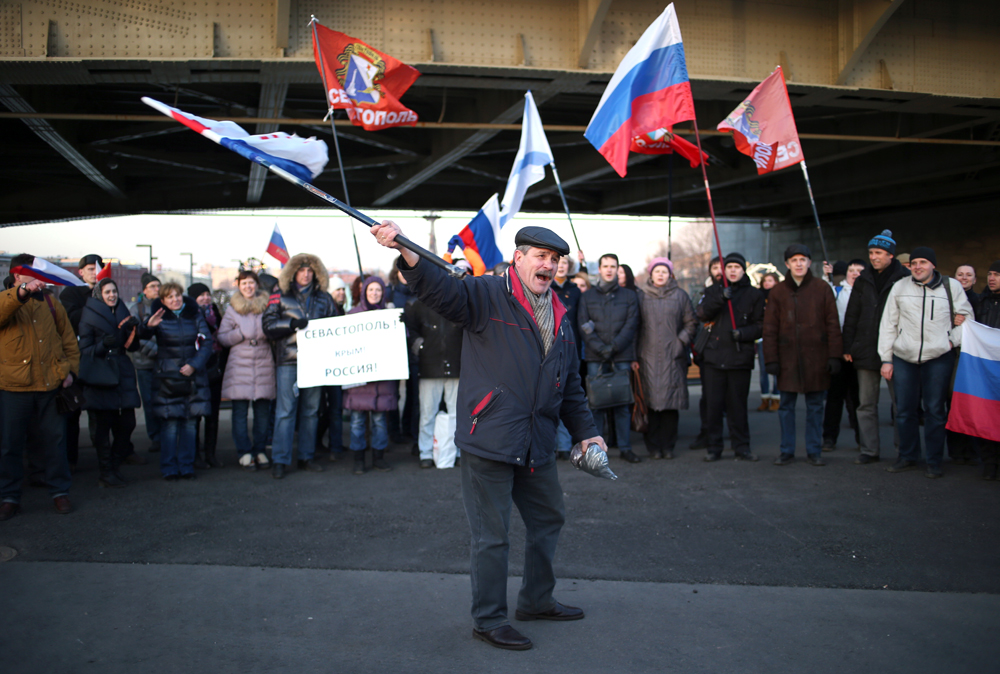
Muscovites gathered in Gorky Park to express support to the residents of Crimea. March 1, 2014
On March 11, Sergey Filonov, a venture investor who is engaged in research in the field of biotechnology and anti -Eigeng (counteracting aging), called the British company Twins UK, specializing in the study of the twins, and reported: all agreements are canceled.
“No, they did not say that it was because of the Crimea, but, you see, everything happened strangely: we conducted negotiations with them, they were ready to provide data from our research, everything was fine,” says Filonov. - A week ago, we decided what specific data we needed, tried to contact them, but they stopped in touch. And then they call and say in such a dry tone: "Our data provision policy has changed."
Last straw
| *Cm. The New Times No. 24 dated 08/12/2013 |
The New Times already wrote about Filonov*-in August 2013 he and another 37 businessmen (then another 160 people joined them) openly supported Alexei Navalny in the elections of the Moscow Mayor. Filonov then transferred a million rubles to the Navalny election fund. In that summer interview, the businessman said: if for a year in the country “some kind of positive trend does not output” and the business climate will not change, he will leave to live and work abroad. The “trend” turned out to be as follows: according to the results of the “swamp process”, seven people were in prison, and Navalny himself was sent under house arrest. So Crimean history hardly became the last straw for Filonov. But she clearly pushed to decisive action.
Now Filonov chooses a new platform for his business - the USA or France. According to the businessman, he lost the remnants of faith that someday in Russia it would be possible to work effectively.
Filonov recalls how once a long time, when he was still engaged in the helicopter business, he faced a problem: his company could not buy American equipment, because the United States at that time banned its shipment to a number of countries, including China, Somalia, Senegal and Russia. “Then there were no economic sanctions. Now, if the EU and the United States impose such sanctions, we will not be able to buy neither equipment nor technology abroad. This will stop our work, ”the entrepreneur is sure.
Foreign partners will already bombard him with questions - what do you have there, damn it, is happening? “What can I say? - Filonov is angry. - It remains only to blush for your ethnicity. All the same, you involuntarily share responsibility for what is happening. ”
Buyers will pay
Not all businessmen that The New Times spoke with are as radically as Filonov. Hass hastily turning the business and many are not going to leave yet. But everyone has sad voices, and they do not expect anything good from the future either. True, what specific sanctions they should be afraid of - they do not know. But they understand: any serious measures from the West will hit the economy, and this will already affect everyone.
Sergey Kogan, who has a small IT filler in Omsk, says that it will probably be like “Crisis 2008”: “What can we do? Well, we will dismiss some of the employees and continue to not attract freelancers. ”
Kogan holds all free money equally in three currencies (rubles - dollars - euro). “Given the ruble exchange rate, apparently you have to think about gold,” Kogan argues. “We will leave only a little rubles for payment of rent and taxes.”
Evgeny Streltsov, who founded the Internet aggregator “Shmoter” (search for clothes and shoes), fears that partners from the USA and Europe will tear contracts. “There is no production in Russia, which means that sanctions will affect prices - all problems will be paid by end customers. The price tag will increase two times! ” - Wasmers the fears of Sagittarius. And he adds that if the foreign currency jumps as a result of sanctions, he will have to fire half the employees: “At one time, in Belarus, the rubble there fell three times, we may have the same - a small business is well felt, because we invest all the money in business.”
Dubious citizenship
Students who want to study abroad have their own problems. Julia Lim from Novosibirsk, who is going to go to the magistracy of the Brandenburg Technical University, told The New Times that she had already sent all the necessary documents to Germany, but had not yet received a positive answer. The story of Ukraine is worried about Julia, will affect the competitive selection: “The other day I contacted my acquaintance in Germany, she says that they now have all the news about Ukraine, and Russia is not presented in them far in the best light. This theoretically can affect whether I will act or not, because in the selection committee they can look at citizenship. ” And even if it acts, problems may arise when communicating with the German Embassy: "I may be refused a visa or a residence permit."
Educational institutions and curators of international programs in Russia also complain about “continuous uncertainty”. The press attache of the Estonia Embassy in Moscow Regina Palandi said that New Times: “We can only talk about today-now all the curricula to attract Russian students in Estonia are lying on the table, but everything is very changing-it is difficult to say what will happen in the near future.”
And the coordinator of the international programs of the European University in St. Petersburg, Maria Trofimova, outlined the situation from the opposite side: “There are international master's programs in our university, which are trained by EU and the USA. We are waiting for new training applications until April 30, and now it’s hard to predict their number. ”
According to Trofimova, if the West introduces visa restrictions, Russia can take symmetrical measures, and then foreign students will have difficulties with visas. Moreover, American students are a special article: “They are very serious about their own safety - in the conditions of military operations in the neighboring region they can refuse a trip.” Most likely, joint programs of Russian and Western universities will suffer, and therefore Russian students abroad are in wait for difficulties, Maria Trofimova suggested.
"A little in fainting"
Irina, a pensioner from Moscow, who asked not to give her last name, told The New Times that her son working in Canada called her recently and warned her: the United States and the EU can impose sanctions against Russia that were previously applied to Iran. In particular, Russia can block access to the international system of interbank payments, which means that he will no longer be able to send his mother money.
“How does we have a budget now? - explains Irina. - The son sends part of the salary to me. And I send part of this amount to my 84-year-old mother, who lives in the North Caucasus. And everything is fine with us, we have enough. But my son told me: he knows for sure that when sanctions were imposed against Iran, money could not be sent from Canada to this country. And what will happen to us? I have a pension of 13 thousand rubles, my mother has 5 thousand. You can’t live with that kind of money in Moscow or in the regions. ”
Irina and her family have been doing nothing yet. But they have relatives who recently bought an apartment in Greece and are in a hurry to issue a residence permit - they are worried that soon the EU countries will cease to give out such documents to Russians.
“In general, we are all now a little in fainting. These sanctions will affect first of all, ordinary people, ”Irina worries. She herself fully realizes that “the main task of such measures is to allow the country's population to feel that its standard of living has decreased significantly. So that the people themselves begin to fuss about relations with their power. ”
United front
The question, however, is what sanctions against Russia are really ready to apply the European Union and the USA? According to the assurances of the magazine’s interlocutors both in Brussels and in Washington, the West is determined to act decisively and quickly. “Since the Caribbean crisis of 1962, relations (with Russia) have never been worse than now,” complained in a conversation with The New Times David Kramer, head of the Freedom House human rights organization, in 2008-2009 - deputy US Secretary of State.
Sanctions will be imposed in several stages. On March 17, Brussels will host a summit of the heads of foreign ministers of the EU member countries, which will talk about visa restrictions for Russian officials and politicians involved in the violation of the sovereignty of Ukraine, and the arrest of their accounts and property in the EU countries. It is also planned to abolish the June Summit of the EU - Russia. Another package of measures implies the introduction of an embargo for the supply of Russian weapons and the restriction of trade relations.
The source of the magazine in the US Congress, which took part in the discussion of the Magnitsky Law at the end of 2012, explained: if then the “Magnitsky list” was compiled with the hard opposition of the Barack Obama administration, which did not want to deteriorate relations with Moscow, today both the administration and the Congress are about sanctions by the United Front.
I agree with the overseas colleagues and the head of the press and information department of the EU representative office in Russia Suren orrius: Europe is ready for the reproach if Russia does not revise its policy. “We expect from Moscow not talking, but of actions, first of all, the withdrawal of troops from the Crimea and the beginning of negotiations with Ukraine,” said the diplomat in a conversation with The New Times.
In the United States, by the way, visa restrictions on some Russians are already valid, but their names are not disclosed. So, it does not yet inflict any political damage to its defendants. But this is for now. The second step of America, after the visa embargo, will be the arrest of the property of Russian politicians and officials in the United States, and the list of “prisoners” will be open - after all, to banks to impose restrictions on accounts and avoirs will need specific names.
“I am sure very soon we will see black lists from Europe and the USA,” says David Kramer. “Putin simply did not leave the West.”
Iranian recipe
Does the West count on the real effect of sanctions? The question is difficult. The interlocutors of the magazine in the US Congress and in European diplomatic circles recognize: neither visa restrictions, nor freezing of individuals of individuals bring the desired effect - and the West has long understood this, but there is little to change here. “No one will dare to include Vladimir Putin himself, because then we will have much fewer pressure tools for Moscow. So you have to engage in acrobatics, ”explains an anonymous interlocutor in the American Congress. On the one hand, in Washington and Brussels, everyone understands that the president of Russia personally gives orders. On the other hand, you have to punish those who follow his orders: “What to do? Otherwise, Putin will have to be attributed to the category of politicians like Lukashenko, but we are not ready for this yet. ”
However, the interlocutors of The New Times make it clear: if Russia goes to the escalation of the conflict, the West will be ready to introduce an embargo for the supply of Russian oil, from the sale of which the budget of the Russian Federation receives about half of its revenues - such a measure has already proved its effectiveness using the example of Iran.
“The EU imposed an embargo on Iranian oil two years ago, and since then, oil exports from Iran have fallen almost doubled,” explained Michael Emerson, leading expert at the European Studies in Brussels. (In 2012, Iran’s GDP decreased by 1.9%, in 2013-another 1.3%.-The New Times.)-for Russia, such a scenario will also be a serious blow: more than 80%of its oil is exported to the European Union. ”
Another “oil scenario” is being discussed now - a deliberate collapse of the prices for “black gold”. So, by the way, it has already happened. In 1986, Saudi Arabia first reduced production volumes for several years (from 10.2 million barrels a day in 1980 to 3.6 million in 1985), thanks to which oil prices were held at a high level, and then sharply opened the crane, and the prices collapsed-from $ 27 per barrel to $ 10. The United States and the EU may well agree with Saudi Arabia about a similar script and bring down the price of oil to $ 80–90 per barrel - despite the Russian budget of Sverland at the rate of the minimum price of $ 101 per barrel.
| *Swift (Society for Worldwide Interbank Financial Telecommunications - the World Interbank Financial Telecommunications Community) is an international calculation system and interbank payments, organized in 1973, owners of which are more than 9 thousand financial institutions from 209 countries. Swift headquarters is located in Brussels. |
Finally, sanctions against Russian banks are planned, in particular, the disconnection of some part or all banks of the Russian Federation from the SWIFT* international settlement system-any transactions in foreign currency will be restricted. The result may be a complete collapse of the Russian financial system.
By the way, for such a solution, coordination between Washington and Brussels is not even needed: the United States can be punished unilaterally. If, for example, the United States imposes sanctions against individual foreign companies, prohibiting American business to cooperate with them, then the effect is often relative: Americans are quite capable of replacing Europeans. “In the case of sanctions against banks, everything is simpler: European financial institutions find themselves in a situation where we must choose - either Russians, or we,” explains the source of The New Times in the US Congress. “The financial weight of America is incomparable with the Russian one, so draw the conclusions yourself.”
The price of the crisis
Until the last moment, Moscow did not take the threats of the West seriously, hoping that he, as usual, would lower everything on the brakes - he would bring the adamance of the Russian leadership in the Ukrainian issue to such conclusions. And only in the last week in the Kremlin and on the Krasnopresnenskaya embankment they realized. In high offices, meetings on the topic of protective measures from sanctions according to the Iranian script were almost daily.
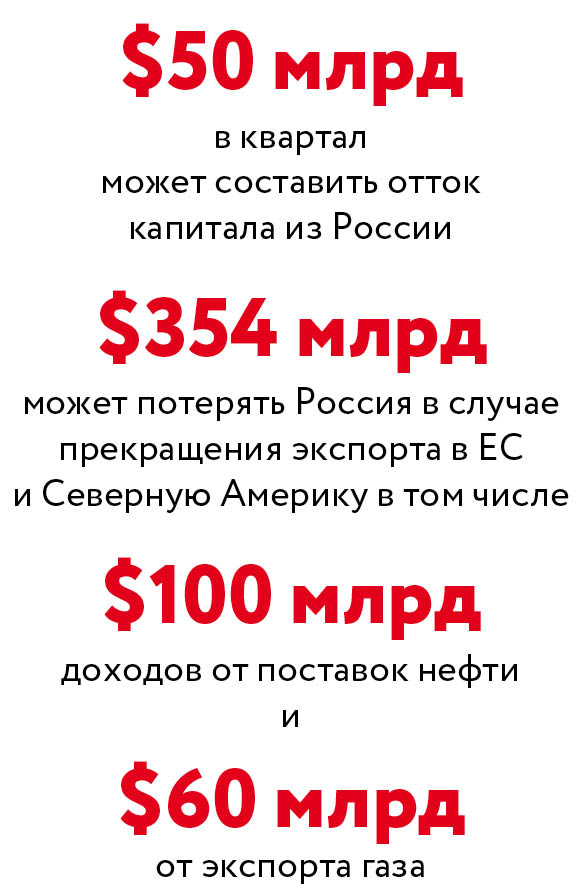
According to the calculations of the ex-Minister of Finance, Alexei Kudrin, the outflow of capital from the country in the case of sanctions against Russian banks can amount to $ 50 billion per quarter-he voiced these figures on March 13 at a meeting of the unions of industrialists and entrepreneurs of St. Petersburg and the Leningrad Region. And he added: the growth of Russian GDP in 2014 may be zero (at the end of 2013 the forecast was 2.5%).
In addition, in the case of strict sanctions according to the Iranian script, Russia will not be able to trade with either the EU countries, the USA and Canada. The total share of Russian exports, which came to these regions in 2013, amounted to about 66%, that is, about $ 354 billion. If the sanctions are affected only by export of Russian hydrocarbons, then the losses from stopping European supplies can amount to $ 100 billion for oil and $ 60 billion for gas.
The suspension of Russian exports will cause the decline in the value of Russian companies, which already becomes clear to the domestic elite: on March 14 it became known that the chairman of the Board of Directors of Gazprom sold his share in the monopoly.
The reduction in exports will certainly be sensitive: the payment balance will worsen, increased pressure on the ruble will lead to its devaluation. Further: price increases, inflation acceleration and a drop in real income, although citizens will not feel it right away. “Everything will happen gradually - the effect will begin to work in six months, although the sanctions will affect the national currency much faster. We see the first increase in prices for individual goods now, ”said Oleg Vyugin, head of the board of directors of the Bank of Bank.
Iran from 2010 to 2013, when especially stringent sanctions acted, $ 120 billion lost, according to the US Ministry of Finance, there seems to be not many in comparison with Kudrin's predictions. However, inflation in Iran was approximately 30% in annual terms, and the Iranian Real Madrid in 2012 lost 80% of its value.
Partial compensation for losses is possible due to the accession of Crimea - for example, the local authorities have already promised to nationalize and sell to Russian state -owned companies. Chernomorneftegaz has 17 licenses, gas production last year amounted to 1.6 billion cubic meters, the companies own 1.3 thousand km of trunk gas pipelines and a fleet of 29 vessels. There were even rumors that the initial goal of the “Crimean campaign” of Russia was the shelf deposits in the north-west of the peninsula.
However, experts think differently. Analyst Nord Capital Roman Tkachuk refers to the prospects of the Black Sea shelf with skepticism: “There are too frivolous reserves, and at the same time the Crimea has an extremely incomprehensible status. Even if the peninsula becomes the subject of the federation, it is unlikely that Russian companies will want to work on the shelf, there are still more interesting projects, at least in the same Siberia. ”
In addition, the production of oil on the Crimean shelf is complicated by disputes with the new Ukrainian authorities - it is unlikely that she meekly agrees with the nationalization and sale of the Black Sea deposits of Russia.
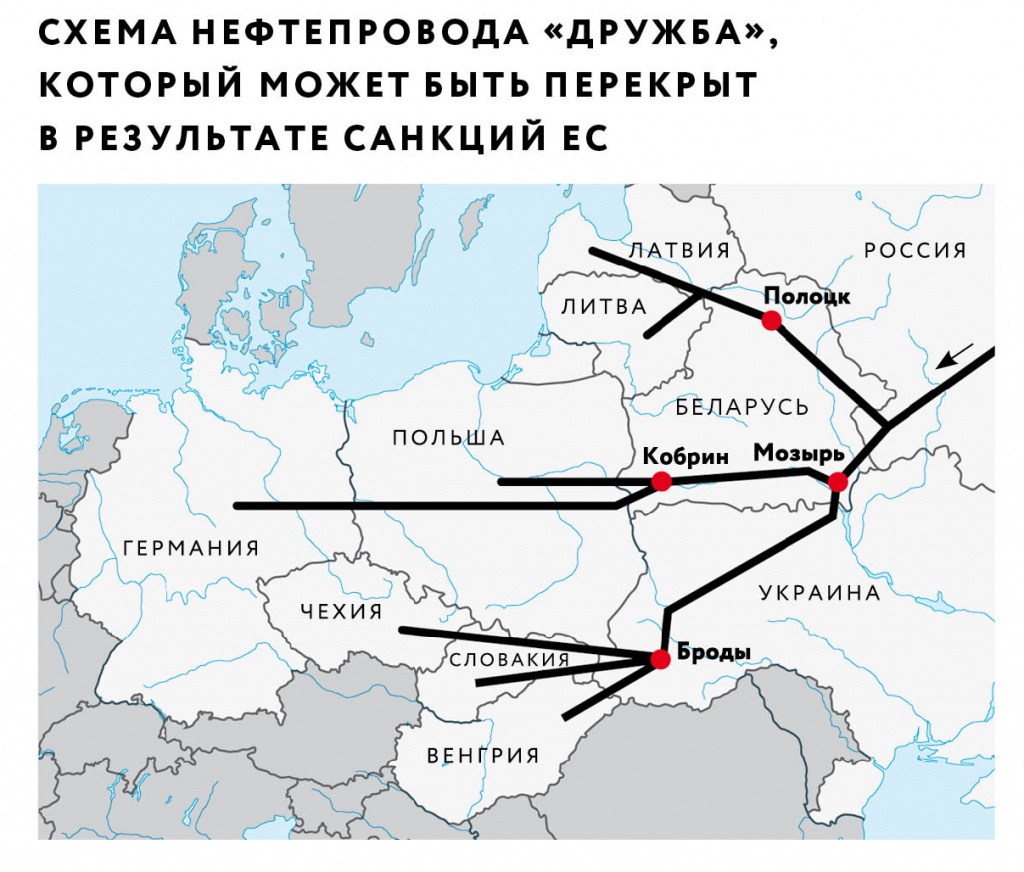

Druzhba oil pipeline scheme, which can be blocked as a result of EU sanctions
Mutual risks
Will Western sanctions hit, as Vladimir Putin, in the West itself, hinted at his press conference on March 4?
“Now Russia is manifested as a partner initiable for negotiations,” explains Sergey Dubinin, head of the VTB Supervisory Board. “They begin to evaluate it as a country with increased risks.” Nevertheless, the scenario of Russia's disconnection from the banking system and the oil pipe, in his opinion, is unlikely - "this is a big headache for everyone." The banker is sure: in the next seven years it will be difficult to do - after all, Europe will not be able to find a replacement for Russian oil and Gaza.
In the event of a sharp abandonment of Russian raw materials, Europeans will have to at least temporarily close a third of production on Russian gas. And in Germany, the share of such enterprises is 40%. According to the expert, no one is ready for such an economic war. Now we are talking only about “symbolic actions, and a political decision will be found that will exclude extreme scenarios,” says Sergey Dubinin.
But Oleg Vyugin is sure: the old light is ready to go to replacement from the principle - even a partial - Russian energy resources by other sources - for example, from the Middle East. How will this happen soon? “With such things as disconnecting from the oil pipeline, they are in no hurry,” explains the Vyugin. “This will require a preliminary warning-it will take a month or two.”
In turn, Maxim Osadchiy, the head of the analytical department of the Bank of Corporate Financing, doubts the possibility of the “oil conspiracy” of the United States with Saudi Arabia: “It is doubtful that the OPEC countries begin to reduce the cost of raw materials, as was the case in the 80s. Then Muslims punished Russia for Afghanistan, but today the United States themselves is not the best friend for Arabs and Venezuela, such a politician is not in their interests now, ”explains Osadchiy.
The exclusion of Russia from the international payment system is also unlikely. According to Oleg Vyugin, the SWIFT board will be ready to turn off Russia only if there are international resolutions - after all, in other case, this will reduce confidence in the organization itself. “Technically, this is done in an hour, in fact, a serious political will is needed here. After all, this is, in fact, a dull measure, when I don’t want to fight, but in theory it is necessary, ”the banker summarizes.
However, according to him, Russian banks may well “bypass the problem”, working through the correspondent accounts of banks not licensed in the USA and the EU. Finally, you can go to Chinese banks, if, however, Beijing agrees to this.
What will we answer?
What "pain" is capable of causing Russia to the West in response to its sanctions? This question caused difficulties for all the New Times of experts. Of course, Russia can also limit the issuance of visas to foreign officials. But if the Russian political establishment has obvious interests in the West - assets, real estate, children who study in Europe and the USA - then foreign officials do not store the most valuable in Russia.
In fact, we have only one pressure tool - raw material. Moscow can also limit the export of oil and gas to Europe or just raise prices. But this, as the economists indicate, will primarily hit the Russian budget itself, the reduction of which will lead to a reduction in pension, defense and salaries to state employees. And the population is unlikely to like it.
“In addition, summer will come soon, and a lot of gas, for example, Europe will not need. So they will not cry, and then they will set up gas from other sources, and after that we will be cold for the rest of their lives, ”Maxim Osadchiy jokes.
Vladimir Rozhankovsky from Nord Capital notes that, having cut off correspondent relations with Russian banks, the United States will lose the opportunity to export paper dollars to Russia: about 70% of the cash of the American currency is addressed in developing countries, and there is almost 30% of Russia there. “For Russia, it will, of course, be a shock situation. But she will seriously weaken the American currency, ”the expert is convinced.
Among the threats from the Russian side there was another measure - to impose sanctions against foreign companies that work in Russia. But the rector of the Russian Economic School Konstantin Sonin in his live magazine describes this option as ineffective: “Any sanctions against the company working in Russia are a blow to our citizens and firms because it raises prices.”
And our prices are already biting.

EU sanctions - against Russia
The first phase (since March 6)
- suspension of negotiations under agreements on facilitating and canceling the visa regime
- suspending the preparation of the G8 summit
The second phase (since March 17)
- Visa sanctions against individual Russian politicians and officials
- freezing of accounts and property of individual Russian politicians and officials in the EU
The third phase (date has not yet been agreed)
- embargo for business ties with individual Russian companies and banks
- embargo on the import of Russian hydrocarbons
- embargo for the supply of arms systems (in the Russian Federation) as part of the contracts of contracts
- double -purpose equipment for export (in the Russian Federation)
USA - against Russia
Introduced:
- Visa sanctions against individual Russian politicians and officials (the list is closed)
- suspension of military cooperation programs within the framework of the annual plan approved by the heads of the General Staff of the two countries
At the stage of discussion:
- Freezing of accounts and property of individual Russian politicians and officials in the United States with the simultaneous publication of the names of the defendants in the Black List
- Economic sanctions against individual Russian companies (coordinated with the EU)
- Economic sanctions against Russian banks, including the disconnection of part or all Russian banks from the SWIFT system (coordinated with the EU)
Russia - hoped the USA and the EU
At the stage of discussion:
- arrest of the assets of EU companies in the Russian Federation
- arrest of accounts and assets of US citizens, American companies and organizations in the Russian Federation
- suspension of inspections of nuclear weapons within the framework of obligations under the START
According to some reports, in the preliminary list of persons who may be prohibited to enter the European Union, there are:
The head of the FSB of the Russian Federation Alexander Bortnikov, presidential adviser Sergei Glazyev, Secretary of the Security Council Nikolai Patrushev, Minister of Defense Sergey Shoigu, Presidential Assistant Vladislav Surkov, Commander of the Black Sea Fleet Alexander Vitko, Chairman of the Council of the Federation Valentina Matvienko, Chairman of the State Duma Committee on International Affairs Alexei Pushkov, Deputy Chairman of the Government Dmitry Rogozin, deputy State Duma Vladimir Zhirinovsky, Head of the Chechen Republic Ramzan Kadyrov, Baykerov leader Alexander Zaldostanov, General Director of the Russian Investigative Committee Dmitry Kiselev, Chairman of the Board of Gazprom, Alexei Miller, President of Rosneft Igor Sechin and President of Russian Railways Vladimir Yakunin
Photo: Mikhail Postuev/ITAR-TASS