
Translated material
To the problem of publicity and openness of the vessels
These days, dozens, if not hundreds of people, it has the opportunity to feel how the domestic judicial system works on their own skin, and encounter flagrant violations. The detainees on inconsistent shares discover that no one is in a hurry and often does not want to tell them the most necessary information - where and when they have a court. (The OVD-INFO had to mention this line of the system in the instructions for independent protection in court.) Often in court they may report that the case will not be considered today, and then it turns out that it has already been considered in the absence of an “offender”. The consideration can be appointed in the morning, and start the meeting in the evening. Sites of courts are far from always and extremely irregularly and illogically posted information about the nearest meetings. Some things disappeared mysteriously. The decisions themselves to make a fine of a judge may not read aloud, but simply issue a secretary to take the interested parties to the signature. Difficulties arise with the issuance of a copy of the decision. The courts almost openly demonstrate the unwillingness not only to listen to witnesses to the defense, but also to invite a lawyer to the process, they can make a person abandon the lawyer and petitions.
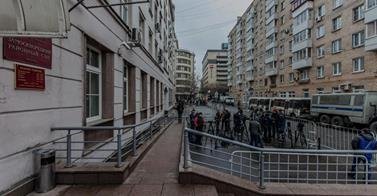
Thus, citizens already as participants in the process get acquainted with the manifestations of the same phenomenon, which in fact became one of the reasons for their detentions on February 21 and 24 near the Zamoskvoretsky court. As you know, many people who came to the verdict in the “case of eight” found that they were not allowed into a building surrounded by metal barriers and cordons of police and internal troops (moreover, passers -by, visitors to the clinic and local residents have arisen problems). The OTD-Info correspondent heard on February 24 in the morning, as a police officer explained to the passerby that Tatar street was blocked due to the fact that there was a closed lawsuit. The process in the “case of eight”, of course, was open, and neither the court nor anyone had the reason not to let people into the building, making an exception only for journalists and individual relatives of the accused.
By the way, problems with the passage to the meeting room for the Eight began with the moment the hearing was transferred to the Zamoskvoretsky court at the beginning of the year. In the lobby of the first floor, meetings are broadcast, but it has repeatedly happened that people did not get into the hall, while there were free places. In the end, journalists and relatives had to agree every time who would go to the hall.
All these are manifestations of a violation of one of the basic principles of legal proceedings, the principle of public court hearings, which involves, in particular, the equal access to everyone to the court building and the courtroom and free receipt of information about the cases under consideration. The events of February 24 gave the foundation for the Commissioner for Human Rights to Vladimir Lukin to make a statement that “it was not sufficiently ensured by the implementation of the constitutional principle of openness and publicity of legal proceedings, which implies a judicial consideration of cases in the premises that ensure the presence at the open court, not only directly interested in the outcome of the case, but all those who wish.”
OTD-Info begins a series of publications on this urgent problem in the work of the Russian judicial system.