
Translated material
Falling up
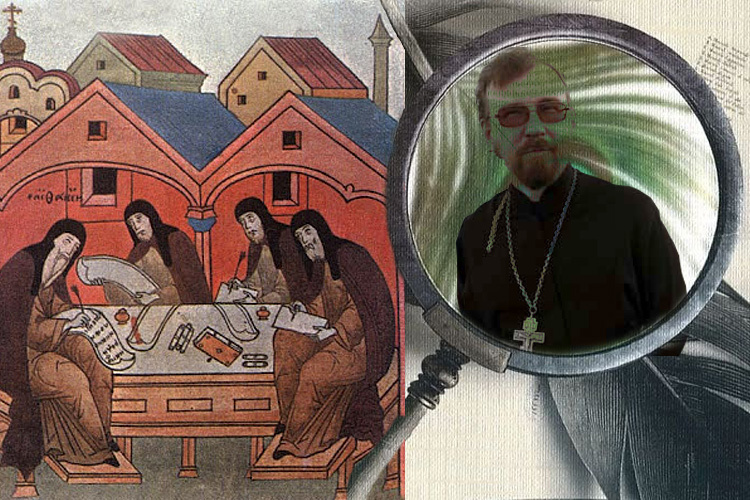
Nothing has been written about the prose of Sergei Kruglov, unlike his poems: “Bird Dvor” is his first book in this genre. The main features of the author’s biography are known to everyone: in 1999 he accepted the priest’s rank, did not write poetry for a long time, and then appeared on the literary sky with texts that are significantly different from his former literary practice. This applies not only to poetry, but also to prose.
Fragments of prose were also present in the first book of Kruglov’s poems (by and large, of course, there were poems in prose). They were written - using the expression of S. Kruglov himself - in the "style of free associations" [1] , turned to European myth and modernist poetics:
My companion remained at the gate, not daring to rise; I alone entered the borders of Al-Araf. The shadows of the trees swayed, and the shadows of Ibisov and Jukes darted to the side, and Al-Araf's stone water slowed down when I, alive, passed among the unspeakable haze and bonfires of the color of the glass, urging the prophet and covering my eyes with rosary [2] .
The new prose of Sergei Kruglov, partly inheriting the former, offers a completely different optics. It should be made in a reservation that many of the texts included in the Bird Dvor collection were published in Kruglov’s living magazine, where they impressed not self -sufficient prose, but rather some notes in the fields and carried not so much aesthetic as in a certain sense the instrumental function. The “Living Journal” of Father Sergius Kruglov-especially in the second half of the zero years-aroused very great interest to the public, because he proposed the opportunity to monitor life and communicate with a rare bird-a priest poet. Probably, many people who read this magazine also wanted a certain spiritual mentoring by Father Sergius, who, in turn, wrote posts for his Internet floors. In them, in them, in a bright, living language, combining church realities and signs of the daily life of a modern person, tried to make things related to religious experience. This goal also served as some of his prosaic fragments.
 © Argo-Risk
However, presented as a collection of prose, these texts make a completely different impression. All this is still the so-called prose of the poet-without any negative connotations. The inheritance of the modernist tradition is maintained, but the religious theme of texts focuses the gap between religion and poetry, "which have painfully dispersed (but did not rejected from each other!) Already in the work of Baudelaire" [3] . An attempt to overcome this gap, perhaps, makes it only more obvious. Here, an Orthodox church tradition is instilled in poetics, which was the home of the “damned”; To the legacy of early modernism - the Byzantine technique of weaving a word.
This “decorated” style with an overloaded, ornate, emotional, expressive syntax, with a lot of magnificent constructions, layering of epithets, ornamental knitting words really reminds of Byzantium.
Kruglov’s speech in places is pretentious, sophisticated, full of verbal tricks, solemnly ribbitant. The weave technique arose at the end of the XIV - beginning of the 15th century, she came to Rus' from Byzantium through Serbia and Bulgaria. At that time, scientists, immigrants from the Balkans and Byzantium rushed to Rus', the works of Dionysius Areopagita, John the Lygraper, and Gregory Palamas became widely known. Then the vitative pan -sisted style of weaving was assimilated, which arose as a continuation of the traditions of ancient rhetoric. One of the outstanding craftsmen of weaving was Epiphanius the Wise - the author of the “Life of Stefan Perm” and “Life of Sergius of Radonezh” (the word was mainly weaved in life). With the help of this technique, prosaic texts turn into poetic.
Modernity does not just get into the world of tradition: the tradition itself often deliberately decreases to let into a modern reader.
The similarity of the literary practice of the poet-priest with the ancient technique of weaving is not by chance, and the point is not only in the influence of this literary technology on the Orthodox tradition. Rather, here we need to ask about the deep sense of such an approach to the language. Why are these endless transfers, rhythmic organization of periods of text, rhetoricity? It is possible that behind all this excess and excess lies nothing more than a Ishast "silence" associated with the idea of the inexplicability of the essence of God in a word. So, in apophatic theology, all possible definitions of God as incommensurable to Him are consistently denied. An abundance of images, the most adorned speech, while associated with a religious message, poses us before the central question that it produces - about the attitude of the expressed and inexpressible. And the attempt of such a speech, striving for the maximum rhetorical expression, is possibly a kind of sophisticated meditation, when the images and jewelry are signs leading us into the secret void, indicating us to the inexpressible, which lies on the other side of the possible expression. You can recall here the famous aphorism of Wittgenstein: "What it is impossible to talk about, it should be silent." All this excessive, “decorated” speech, full of epithets, metaphors, transfers, paradoxically, as if intended to demonstrate this thesis.
And with the code all this cowls of overtones, discourse connects this variegated text and shows in it with an eidos, like the hats of Moyarina’s strands in the air flow, in the circles of his own circulation of our everyday life, giving a taste-sweetness-water from a puddle, causal of poultry aid, indistinguishable against the background of the day Shadow, as the beginning of the memory of the end. (S. 4)
The aesthetic effect that this speech makes on a modern reader is also caused by the contrast of the elaborate, book-church and modern, everyday. Bird wedges of saints in the light and glory, Palm Sunday and Path, Ampages-Sugrobes, Orthodox and Ortraksia, St. Seraphim and the Bear, work only next to the guy in a jacket with a skate under his arm, the plastic sea of the future and a “little night serenade”, which played on a mobile phone during the coil. Modernity does not just get into the world of tradition: the tradition itself often deliberately decreases to let into a modern reader. Biblical plots are reduced, become the basis for naive-prostyan, written in the conversational language. So Adam is yearning for paradise:
Oh house you are mine! Warm you are my bed! Oh my kitchen, oh, oh annual you are my tomorrow, sausages-yaishenka! .. oh Sotik you are my abandoned! .. Oh my shirts my washed, oh socks you are my posed! .. Yes, you are my lifeless life! .. (S. 41)
After this mention of the house, beds and sausages-yaishenka, apparently, even the most indifferent layman must understand what the longing for lost paradise is. So it is said that it is clear: paradise is a bad -time life. There is no vulgarity in this, there is a game - with readers, with a flock, as with young children, an explanation of spiritual concepts on simple, affordable examples. Which, of course, is fraught with substitutions. However, in this time, deliberate primitivization, paradoxically, gets off with complicated weaving, there is something from a folk fairy tale: for example, like a priest, a former blacksmith, got off with two Buddhist monks, overlooking the wheel of Samsara to the pole to heaven:
Buddhist monks were amazed for such a matter, they could not find something, worshiped Vakula’s ass, and just in case they proclaimed him invigorating. Well, then - they spat in the palm of your hand and climbed, of course, on the pole, where to go. And they still climb. And the Pop Vakula went to the hut of kvass to finish. (S. 60)
The combination of the eternal, represented by linguistic, related to religion and tradition, and modern, momentary, transitting in the literary practice of Kruglov, makes Kierkegaard's formulation: “The news of the day is the beginning of eternity!” [4] Kruglov constantly remembers the subjective, “temporary” side of religious truth, which depends on the readiness of a person to accept it. The junction of time and eternity in Kierkegaard is a moment, the moment (Øieblikket) . It is so crucial, because at that moment the eternal appeared in Genesis, which before it was not in it. The moment of time in Christian experience is connected with the appeal-capture: having accepted the moment in time as a condition of truth, the student changed the direction of his movement (earlier, being out of truth, he farther and farther away from it) to the exact opposite, that is, in the literal sense of the word, he turned. This transition can also be called the second birth. The news of the day is in the appearance of eternity, eternity is resolved at time.
In the prosaic fragment “Alice falls up”, Kruglov writes about believers who break into the void. Among such believers, he mentions Kierkegaard, Pascal, Buber, Levinas. Apparently, this is a circle of religious thinkers who is close to him. Tearing into the abyss (and not standing unshakable on the last basis of their faith, like ordinary believers), they eventually fall up - to the sky. This discourse seems to be trying to justify faith - by the fact that some believers did not be afraid of voids - in the face of philosophers, extremely honestly balancing "over an honest emptiness, on the thin pleu of chorea" [5] . And this is the forced ambiguity of the position of the priest-poet, one of the tasks of which is involuntarily representing faith in the face of an educated public. As a result, there, in the sky, where Kierkegaard was endlessly falling, there is a place for both Nietzsche and Mamardashvili. So everyone should be satisfied, places in the sky were enough for everyone, and everyone is recognized as capable of falling into the void: both believers and unbelievers.
From all of the above, it is clear that we are in front of us is a religious and expirational letter. In the texts of Kruglov there are solid existentials: life (life-Antarctica, to which there is no warm and there is no warm one who would squeeze and lay between the heart and life), death (“without a heart-death; death, whatever the distant times of the future that is now ...” (p. 6) Or “So you, death. We are afraid and hate you, calling darkness, in the depths of the soul, guessing that you are actually light. The uncompromising, inexorable, glowing light, highlighting the main thing, violently burning all this rubbish, all these small, precious, ugorovstvo, which are oscilo -nursed trifles, fragile, ridiculous, perishable ”(p. 22)). Through existential problems, Kruglov’s exit to a religious dimension, or vice versa - through religious concepts, the existential core of human life is revealed: death is light, and nostalgia is a secret garden of hell. And hell itself is, like rhymes, the garden. Just like paradise - a garden. And not always we can distinguish which garden we are in. You can recall here the poem by A. Tsvetkov "Garden":
here I am walking stepen in my garden
I pick up the gypsum nymph in the back
I support where the bush in trouble
how to understand in paradise or in hell
if there is no inscription anywhere [6] .
Cf. At Kruglov:
The semi-trained board in the fence around the protected kindergarten <...>, with a creak, turns it on the rusty axis of the nail and, looking around, will the watchman with a fiery sword appear, squeezes inside, and descends more deeply with loopy paths, launched statues ...
Given the “priestly” optics of the texts, the question remains the question to which the world of Sergei Kruglov is ready to let those who are alien to this treasure with all his priests and hieromonks, traditional holidays and biblical plots, water -bonded prayers, consistency, repentance, humility ... Is it easy to print out the existential meaning, printed in these vessels, or sealed in these vessels, or printed in these vessels, or sealed in these vessels, or printed in these vessels. Do the vessels themselves appear to be torn from life with exotic? But at least this is one of the possible worlds, and in the person of this book it is open to dialogue.
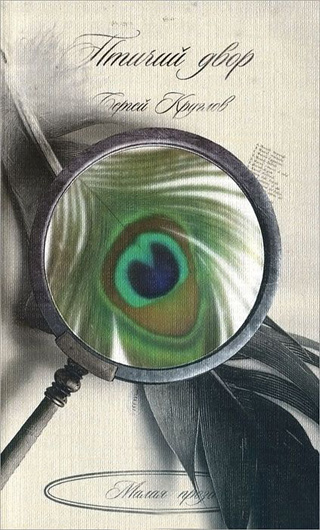
Kruglov S. Bird Yard. -M.: Book Review (Argo Risk), 2013.-80 p. (Book project of the magazine "Air": series "Malaya Prose", issue 12)
[1] Kruglov S. Removing the serpent from the cross. M., 2003. S. 100
[2] Kruglov S. Removing the serpent from the cross. M., 2003. S. 105
[3] Dubin B. Cellulose and saliva (preface to the book of S. Kruglov “Causion”). M., 2008. S. 6
[4] Kierkegaard S. Philosophical crumbs, or grains of wisdom. M., 2009. S. 64
[5] Kruglov S. Bird Yard. M., 2013. S. 33
[6] Tsvetkov A. A flat wind. New Publishing House, 2008. P. 39