
Translated material
Putin proclaims the accession of Crimea to Russia
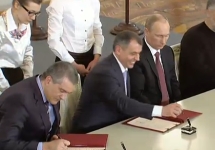
President Vladimir Putin will introduce a constitutional law to the Federal Assembly on the adoption of two new subjects of the Federation - the Republic of Crimea and the city of Sevastopol to Russia. He stated this, speaking in the Kremlin to the State Duma deputies, members of the Federation Council, heads of Russian regions and representatives of civil society.
At the same time, Putin emphasized that he did not want the section of Ukraine. "Do not believe those who scare you with Russia, shouting that other regions follow the Crimea. We do not want the Ukrainian section, we do not need this," the president said.
Crimea in the heart and consciousness of people was and remains an integral part of Russia, Putin said. Therefore, the results of the referendum, in his opinion, were completely predictable. The president called the decision on the transfer of Crimea to the Ukrainian SSR to the Ukrainian SSR, the president called the "Culuar" and "unconstitutional".
According to Putin, there is no legitimate executive branch in Ukraine. "They prepared a coup, they planned to seize power without stopping at anything. The pogroms, murders, terror were used, the main forces were nationalists, Russophobes and anti -Semites," the president said.
"Residents of Crimea and Sevastopol turned to Russia with a request to protect their rights and lives. We could not help but respond to their request, leave in trouble. Otherwise, it would be a betrayal," Putin said.
Putin fell up with a sharp criticism of Western countries, accusing them of the application of double standards. He noted that the Crimean authorities, appointing a referendum, relied on the UN Charter. By the way, the president emphasized, and Ukraine itself did the same, announcing its withdrawal from the USSR.
“Today it is necessary to stop the hysteria, refuse the rhetoric of the Cold War and admit that Russia has national interests that need to be taken into account and respected,” Putin said. “We are threatened with sanctions, but we already live in a number of restrictions. We have every reason to believe that the notorious policy of Russian deterrence continues today.”
Putin also noted that the injustice admitted to the Crimean Tatars was corrected. “It will be correct if there are three equal state language in Crimea: Russian, Ukrainian and Crimean Tatar,” the president said.
The decision to receive Crimea in Russia is based on the will of the majority of the absolute population of both Russia and Crimea, Putin emphasized.
After the completion of Putin’s speech, the Russian president and representatives of the Crimean authorities signed an agreement on the adoption of Crimea in Russia.
On Monday evening, Putin signed a decree on the recognition of the Republic of Crimea as an independent and sovereign state. Earlier, the Crimean parliament proclaimed the independence of the republic and approved the results of the referendum. According to the Crimean election commission, more than 96 percent of the voting participants spoke out for the accession of Crimea to Russia.
The Ukrainian authorities and the international community consider the referendum illegal - it contradicts the Constitution of Ukraine and was held in the conditions of occupation.
On Monday, sanctions against a number of Russian and Ukrainian officials were introduced by the United States, the European Union, as well as Canada. US President Barack Obama signed an order to block assets and introduce visa restrictions for 11 Russian and Ukrainian citizens who, according to Washington, for the actions of Russia in Crimea. American sanctions are subject to, in particular, to the assistants of President Sergei Glazyev and Vladislav Surkov, as well as to the deputy prime minister Dmitry Rogozin and the speaker of the Federation Council Valentin Matvienko.
The EU sanctions list includes the 21st name. Among the others, he fell into the State Duma from Fair Russia Sergey Mironov, who initiated the bill on simplifying the procedure for joining Russia new regions, deputy from United Russia Sergey Zheleznyak and members of the Federation Council Andrei Klishas, Nikolai Ryzhkov, Vladimir Dzhabarov, Yevgeny Bushmin, Alexander Totonov, deputy of the State Duma Leonid Slutsky, who supported the use of the Russian armed forces in Ukraine.