
Translated material
Double interpretation
The deputy from the LDPR faction Mikhail Degtyarev invited Crimean lawmakers to give his peninsula the second name, namely, to return the name of Tauris. According to the Russian deputy, in this way continuity will be restored between different periods of the history of Crimea.
“Crimea is the Earth with a unique history, where many nations side by side live and work peacefully. And once it was called the Tauride province, Tauris, and the Crimean region, so I believe that we need to use the unique chance that the Russian Constitution gives us to establish a double name. This will together connect the whole history of Crimea, ” said Mikhail Degtyarev.
Degtyarev’s proposal, even if taken from the ceiling, is deeply symbolic, as, indeed, any change in the name of the state, and the fifth article of the Russian Constitution calls the republic within the federation precisely states.
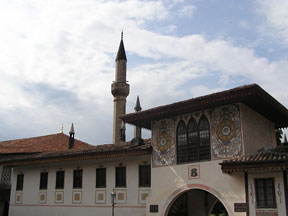 Bakhchisarai Palace
Prior to the arrival of the Tatars, the peninsula was called Tauride in Russian sources. Tavria is still called the Black Sea steppe on the left bank of the Dnieper. The brandy factory of the same name, for example, is located in the city of New Kakhovka, which is located not in the Crimea at all, but in the lower reaches of the Dnieper.
The name "Crimea" - Tatar origin. The genesis of this word is still incomprehensible to the end. Perhaps it came from the Mongolian "Haram" - a wall, a shaft. According to this version, this name first received the city of Solhat, surrounded by the walls, in which there was the residence of the governor of the Golden Horde. Another version of the origin of the name is the Turkic word "kyrym", which means a moat. According to this version, the peninsula first began to be called “Kyrym Adas”, “island behind the moat”, as it was separated from the mainland by the Perekop defensive moat. Over time, the name was reduced to the modern version - Crimea.
In the Manifesto on the accession of Crimea to Russia, Catherine II said that such a step-the inclusion of new lands in the empire-was forced to go due to constant conflicts among the Tatars and attempts by the Ottoman Empire to intervene in the domestic policy of the Crimean Khanate.
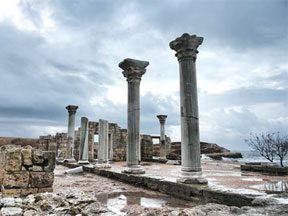 Ancient Chersonesos
However, the official ideology of the late XVIII century suggested that Russia does not conquer the Black Sea lands, but as the successor of the Byzantine and Greek civilization returns these territories. Hence the many Greek names that are given to Russian sowing in those parts - from Simferopol to Odessa.
In order to show initially the Greek, and not the Tatar, the essence of the peninsula, he became officially called Tauris, and the name of the Tauride province was entrenched in the administrative-territorial unit, which included the peninsula and the steppes between the Dnieper and the Black Sea coast.
However, despite the change of names, Crimea remained mainly Tatar. According to the All -Russian census of the population of 1897, the significant Ukrainian majority was in the "mainland" counties, that is, in those territories that are now not part of the Crimea.
On the peninsula itself, the Russian population prevailed only in cities - Simferopol, Sevastopol, Kerch, and Theodosia. In rural areas, the majority made up the Tatars, although in general, according to the Russian peninsula, there were still more Russians together with Ukrainians.
Changes to political geography were made according to the results of the revolution and the Civil War. The Government of the Ukrainian People’s Republic in 1918 announced the accession of North Tavria - the mainland of the Tauride province, in which mainly Ukrainians lived. The Soviet government, which in those parts was established only in the early 1920s, did not dispute this decision.
In the remaining territory of the Tauride province, that is, in fact on the peninsula, the autonomous Crimean Socialist Soviet Republic was founded as part of the RSFSR.
The logic of the country's administrative-territorial division in the Soviet years assumed that territories that were inhabited mainly by representatives of title nationality became areas, and the lands where a different nation dominated became autonomous republics.
On the territory of the Crimean peninsula there were too many Tatars to consider it an ordinary Russian region, so that the Crimean Autonomous Soviet Socialist Republic was, in fact, the Tatar, and therefore the name from the Greek Tauris to the Tatar Crimea was replaced.
The Tatar nature of the Crimean autonomy also speak of the formal leaders of the region in the Soviet years-the CEC, and then the Supreme Council of the Autonomous Soviet Socialist Republic was consistently headed by Ibraimov, Memet Ismail Kubaev, Ilyas Tarhan, Abdul-Delil Khairulla Menberiev.
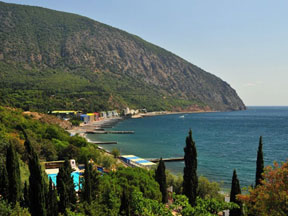 Crimea. View of Artek
Crimean autonomy was abolished in 1946, after the deportation of the Crimean Tatars. The Crimean Autonomous Soviet Socialist Republic was logically transformed into the Crimean region-after sending the Tatars, the population became mainly Russian, which means it did not make sense to somehow specifically distinguish the status of the region. The pre -revolutionary name, however, did not return, by that time the word Crimea was strengthened in the Russian language.
But the military district, which was formed in 1945 on the territory of the peninsula, as well as the Zaporizhzhya and Kherson regions of Ukraine, was called Tauride. This military-administrative education lasted until 1956.
Thus, if the Republic of Crimea as part of Russia received an additional name of Tauris, this would once again emphasize that, despite the fixed status of the Crimean Tatars, this nation would not be on the “titular” peninsula.