
Translated material
Horse history
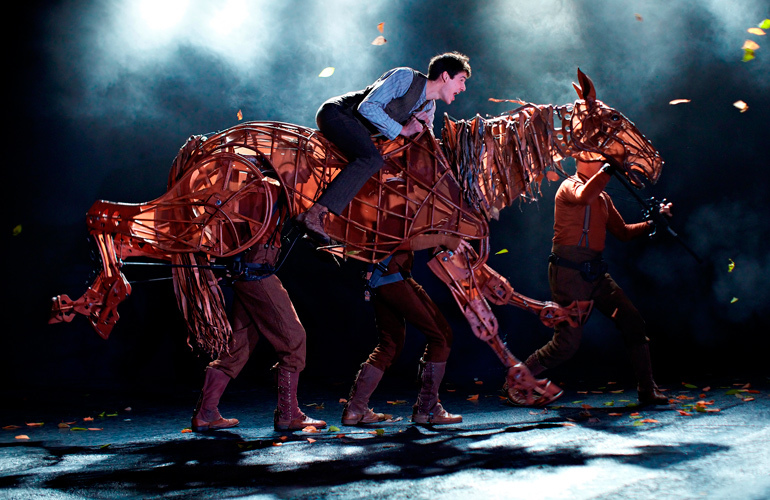
The play "Battle Horse" based on the novel of the same name Michael Morpurgo was released in the London National Theater back in 2007. The premiere was marvelous, the performance has been going on for a long time, since then resumed in the West End and Broadway-and finally in the record (made during the last London resumption, with another cast and already on another stage) reached Russian cinemas.
The success of the “battle horse” in NT is completely explained - this is a universal total sight with a humanistic message and a small amount of text. The story of friendship of a beautiful horse named Joe and the good boy Albert, who passed separately through the First World War and reunited after its end, is so humanly and touching that ticket prices, in principle, can even be made not very high: everything will pay off. Steven Spielberg understood this right away - as you know, he was inspired by a not -known novel to shoot the film of the same name, namely the performance NT (and enthusiastic reviews are not in earnest of the aroused spectators, among whom were the wives of “responsible Hollywood workers”). However, Spielberg, without particular effort, calculating the commercial potential of the project, made one significant mistake: he decided that a living horse is better than a toy.
In the English theater they do not make such mistakes. On the side of the creators of the stage “combat horse” is not only the classical tradition of bourgeois art (with the “telling stories” by the manner of the manner of the manner of the manner of the manner of the manner), but, for example, such a purely British phenomenon as a voluntary society for the protection and repatriation of lost children's toys (recently perfectly proven the owner of the old wound Plush bear - in twenty years, it seems). To be sentimental - this must also be able to.
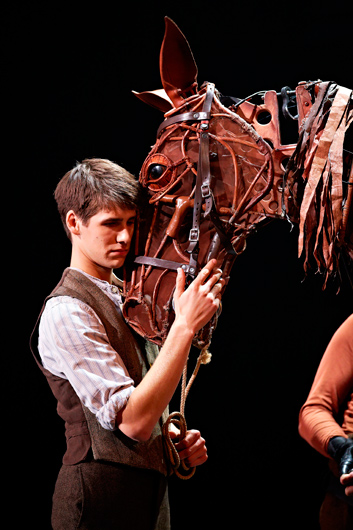 © "National Theatre Live"
From the "combat horse" were not going to make a military version of the "black handsome". The elegance of scenography Ray Smith immediately cancels any questions regarding the taste. On the backdrop above the empty scene from the edge to the edge - a fragment of the page from the album of Captain Nicholson, the “gentleman of the exalted passion”, carried away by drawing. On a “strip of paper” with uneven, torn edges gradually due to animation effects, pencil sketches of rural species, marine expeditions and battlefields occur. At the height of the war - after the death of the drawingman - the technique will change: “amateur” drawings will give up the place of expressive motifs of Paul Nash, and at a catastrophic moment the black strokes on paper will turn into real structures falling from the sky.
Nevertheless, the best that is in a “combat horse” is horses. It seems that in the creations of the South African Handspring Puppet Company there are much more “horse” than in the animals themselves. And the point is not only about the delightful subtleties of the work of puppeteers or the incomparable skill of actors to plan their complex characters. Although in this too: the details and thoroughness with which the animators work, forcing the horses to shine sensitively into every sound (gallop and lynx there are not a problem at all), make the illusion almost complete. No wonder everyone's beloved Joey was able to leave theatrical stages and take part in the military parade in Scotland. (It seems that no one here believes that playing the “Hind legs of the skate of the humpbacked” is the collapse of an acting career.)
To be sentimental - this must also be able to.
But the illusion is deliberately left incomplete. Probably, the masters could make the dolls much more “entrusted” - however, they preferred that their horses remained translucent, composed of many visible individual parts, moving croak, formed by thin, flexible plates. Actors who control dolls are not hidden from the audience eyes, they are part of the action. Their own energy is another component of the process known as "making the living even more alive." This is exactly what the “combat horse” manages: the emphasized skill of execution - and not at all the life nature - ensures the fact of art. The horse becomes a miracle.
The suffering, which fell to the share of the noble animals in the film Spielberg, is no less terrible, but the meaning of them is immeasurably less. And in the performance of Marienn Elliot and Tom Morris, the image (or even “Aidos”) of the horse is unusually significant, really capable of telling something important about the tragedy of the First World War. And this happens precisely thanks to the “difficulty of admission”, every minute forcing the viewer to turn the doll into a living creature, at the same time enjoying the skill of performers.
The touching foal rearranges the stiff legs and reaches for the bucket of oats. He uncertainly tries to stand on his hind legs - and a luxurious trick (the light in the play is exhibited excellently) in an instant turns into an adult bay stallion, triumphantly rising above the stage. “Microchudo” is enclosed in each movement, the substance of life belongs to the doll, and at the same time exists separately from it, quite independently. Therefore, when “a frantic regiment goes on the first sign on the guns on the attack”, the condensed horses and riders seem to be especially tragically fragile and frightening: “through-secret-death” riding a horse’s skeleton-the image is almost Durerovsky. Not people and animals die - life itself: “corpses” of horses, dolls abandoned by actors - there are not even metaphors, a simple and effective physical effect.
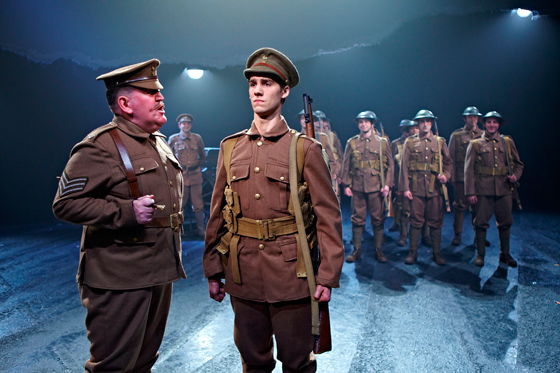 © "National Theatre Live"
Calculating in the means, technically impeccable, excellently controlled with stage space and time, but perhaps excessively simple -minded directing allows actors to issue pathetic roules from time to time. If in the entire “man-made” history of the “combat horse” there is something mechanical, then these are just the moments of sentimental acting solo. The fact that the British and the French, and the Germans are “people”, and all together and separately passionately love animals, has been proved by all the ways available to the decent Tyuz. But do not forget that the performance, now going in London, is the “grandson” of the first “battle horse” (and the production in Ireland, Australia and Germany are completely distant relatives). Luke Treedue (who recently received the Olivier Award for the “mysterious night murder of a dog” by the same Marienn Elliot) was replaced by Kit John Snow Harington, and now Sean Daniel Young plays in the London New Theater of Albert.
The horses are still fresh (taking into account foreign projects of such horses, there is already a whole herd), among the riders there are a lot of recruits. The current renewal of the "combat horse" is special. In the year, when Europe will celebrate (in Russia, perhaps, they would habitually mention: celebrate) the centenary of the First World War, the History of the Horse can gain new popularity. A light cavalry is ready for another attack.