
Translated material
The West went v-bank
How America and Europe take revenge on Russia for Crimea
The United States and the European Union increase pressure on Russia after the annexation of Crimea. The black list of Brussels included Russian politicians, the military and even the head of the Russian Agency Today Dmitry Kiselev. Washington went even further, imposing the sanctions by the immediate environment of Vladimir Putin
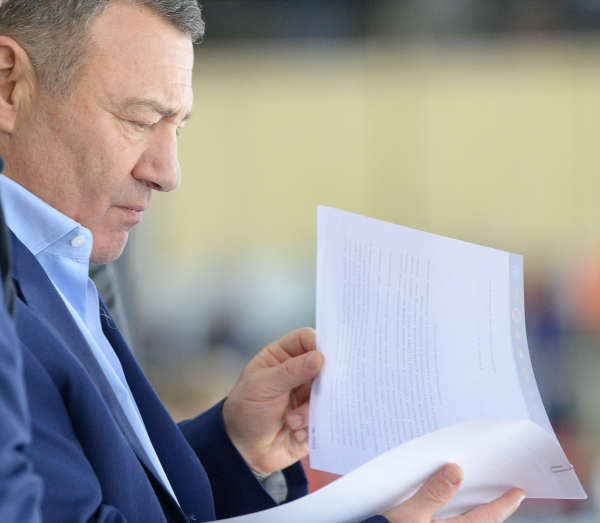
At the Sochi Olympics, Arkady Rotenberg (in the photo) and his brother Boris earned $ 2.5 billion, but Western sanctions can shake their financial situation
On March 21, hundreds of thousands of Russians first felt the consequences of the annexation of Crimea. Clients of the Russian AKB, included in the Black List of the United States, as well as Sobinbank, investkalbank, SMP-bank, Finervice Bank, related to the defendants of the same list, could not use their plastic cards-they are available only to withdraw cash at ATMs of the “native” bank. Reason: VISA and MasterCard international payment systems stopped serving these banks, guided by the decision of the US Treasury.
Meanwhile, a serious battal unfolded in Brussels. According to the source of The New Times in European diplomatic circles, the UK and the Baltic countries insisted on further hard steps against Russia, including the introduction of an embargo for the supply of hydrocarbons and sanctions against Russian banks. Germany proposed limiting herself to the expansion of the black list of Russian politicians; Spain and Italy assured that there was enough existing list: they say, while the fragile status quo has been established, you will not decide anything with sanctions and there is no need to put the already fragile European economy; France argued with representatives of the Scandinavian countries about whether it was necessary to take a ban on the sale of weapons for Russia (a contract for the supply of Mistral helicopter carriers worth € 1.2 billion).
As a result, Europe did not reach the strict economic measures, but the names of 33 Russian officials are now in the expanded Brussels list, including the speakers of the Federation Council and State Duma - Valentina Matvienko and Sergey Naryshkin, presidential adviser Sergei Glazyev and assistant Vladislav Surkov, deputy Elena Mizulina and others - in general, the list resembles the first US sanctions of March 17. About the same names in the black list of Canada, Japan has so far announced the suspension of negotiations to facilitate the visa regime, and Switzerland completely disowned the sanctions: the president of the Confederation of Didier Burkhalter said in an interview with the newspaper Neyue Zurher Tsaitung, which Bern was always friends with everyone: with China, and with the US EU.
Financial signal
As it became known to The New Times from the source in the US Congress, the stormy discussions of the defendants in the black list also unfolded in Washington. As during the adoption of the Magnitsky Law in 2012, the US presidential administration discussed every candidate: the list of March 17 included seven famous Russian politicians who, however, are not included in the “close circle of President Putin-among them Valentina Matvienko, Vladislav Surkov, Deputy Prime Minister Dmitry Rogozin. “The task of the first list was, on the one hand, to show a large fist, and on the other, not to include anyone who has a serious political weight in Russia,” the interlocutor of the magazine explains.
The Americans had no illusions about the possible property of defendants in the United States: “It is clear to everyone that no one in the States has nothing, and if something was, it has long been bred. The first list was a purely political signal. ”
It is also interesting that, unlike the Magnitsky List, which has the power of the law, since it was conducted through the Congress, the “Ukrainian list” is adopted by the president’s simple decree: “Washington usually leaves the door open. If Russia showed that it was ready for a dialogue, if I had not continued to continue the line outlined to join the Crimea, the sanctions would simply be canceled quietly. ”
"
“Everyone understands that no one in the States has nothing, and if something was, it has long been bred. The first list was a purely political signal "
"
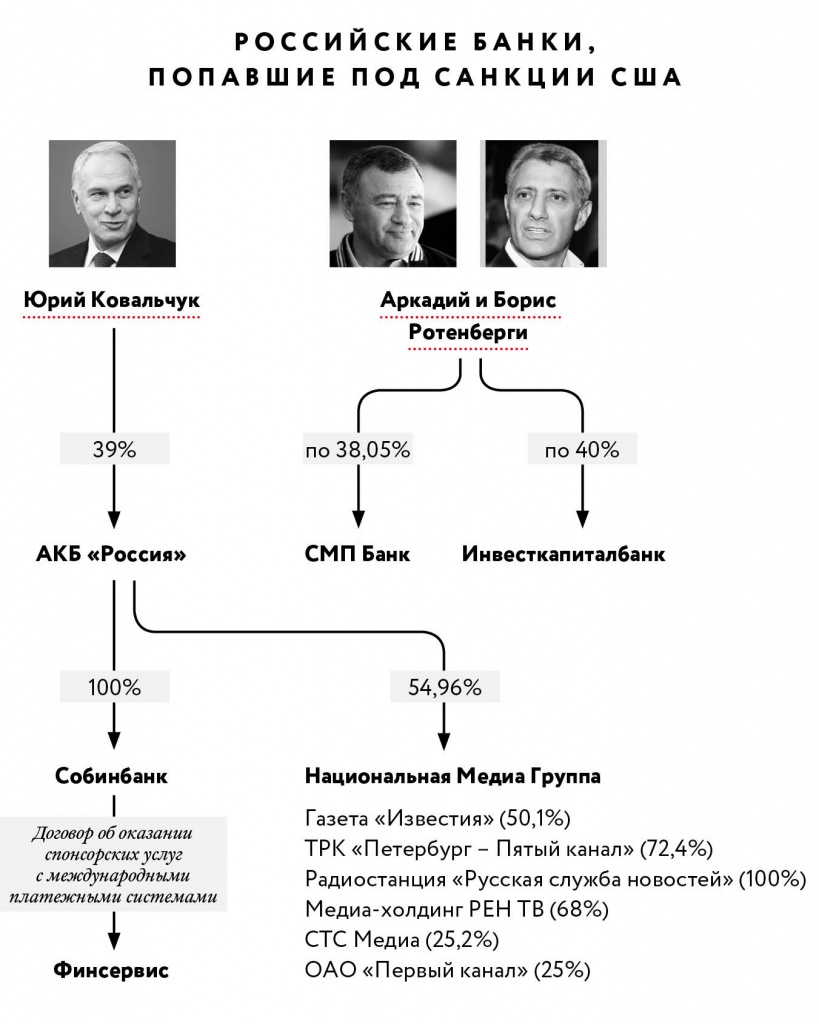
But Moscow did not back down, the speech of Vladimir Putin before the Federal Assembly on March 18 showed the Americans: it is time to move on. As a result, Washington included in the list of those who, not directly related to the Crimean campaign, was a confidant of the Russian president. Moreover, the US Ministry of Finance immediately released a press release that explained: Gennady Timchenko is one of the founders of Gunvor, which, perhaps, has investments by Vladimir Putin; Arkady and Boris Rotenbergs carried out contracts in the framework of the preparation of the Sochi Olympics, so their fortune over the past two years has increased by $ 2.5 billion; Yuri Kovalchuk is a close adviser to Putin, who is even called the “presidential cashier”, the chief shareholder (39 %) of the AKB “Russia” - “Personal Bank of high -ranking Russian officials”.
“There is no, say, the head of the Foreign Ministry of Lavrov,” says the interlocutor of the magazine in Congress. - But Putin’s closest friends, Putin's “conditional accountant” and Putin's “Conditioner”. The signal is simple: we will beat the dollar. "
"They are in line"
Another Washington source close to the American Ministry of Finance, The New Times asked why neither the American nor in the European lists nor the President of Rosneft Igor Sechin, who used the Hawk of the “Hawk” of the Secretary of the Council of People's Commissars, Nikolai Patrushev, nor the head of Gazprom, Alexei Miller. The answer was short: "They are in line."
According to the interlocutor of the magazine, in the administration of the US president there is a certain “big list”, the surnames from which will gradually be brought to the world. “There is a simple rule: you can’t spend the entire clip at once,” explained the situation by Freedom House, a former adviser to US Secretary of State David Craimer. The information about the inevitable “third wave” of The New Times confirmed the high -ranking insider in the Russian government, adding: “Putin understands this perfectly.”
However, it is not worth expecting the appearance on the list of the Russian president himself, because even the odious ex-president of Iran Mahmud Akhmadinejad every now and then came to the United States, speaking at the UN sessions or to the students of the Columbia University at the very time, the UN strict sanctions were acting against Iran.
"
“There is no USA, say, the head of the Foreign Ministry Lavrov. But there are closest friends of Putin, Putin's “conditional accountant” and Putin's “wallet” ”
"
What is expected from Moscow if it is already clear that no one is going to return Crimea to Kyiv? “The West is concerned about the fate of Eastern Ukraine,” says David Craimer. - Nobody believes Putin that he is not going to occupy Lugansk and Kharkov, because on March 4 he said the same thing about Crimea. Russian troops are still focused on the border with Ukraine: this is what we see from Washington. ”
The logic of sanctions is simple: to cause a split among Russian elites, which will understand that they lose money because of Putin. “It is necessary that they come to him and say:“ You must provide us with stability, business growth and security. If there is none of this, then why do we need you? " - explains the source of the magazine in Washington.
Meanwhile, in European sidelines, they are seriously talking about the embargo of Russian hydrocarbons: “Europeans should be prepared to freeze a little without Russian gas, the main thing is to stop Vladimir Putin now,” said the deputy of the European Parliament, a member of the Committee on International Affairs Kristina Owland in an interview. The Euro-deputy recalls how, after the Russian-Georgian War of 2008, the West quickly calmed down, but six years passed, and Putin again violated the norms of international law. “He has imperial thinking, if he does not stop him now with the most decisive measures, a couple of years later, if not earlier, we will see another annexation somewhere,” said Ms. Ouland.
The zone of alienation
The defendants in black lists are prohibited from entering the territory of the countries that have applied sanctions, in addition, banks and financial institutions are required to arrest their accounts and notify local regulators about this. At the same time, banks are not entitled to violate the legislation on banking secrets. But regulators can transfer information to the press. However, two sources in Washington and in Moscow immediately informed the magazine: it is possible that soon in the Western press, leaks of info -swimming on corruption in the highest echelons of the Russian authorities will be organized, about Russian dignitaries of foreign companies and accounts.
"
"He has imperial thinking, if you do not stop him now, in a couple of years we will see another annexation"
"
In Europe, it is not yet about the arrest of real estate - only about financial instruments. Washington, on the other hand, arrested any property ownership in the territory of the Black List, and also forbidden to cooperate with them to American citizens and companies (which is why Visa and MasterCard, based in the United States, suspended work with dough banks).
By the way, not only persons or companies themselves fall under sanctions, but also firms that they either control or own more than 50% of the shares. But the state institutions that represent the defendants do not apply to the state -owned company: for example, the presence in the list of Russian Railways Vladimir Yakunin will not affect the activities of Russian Railways.
It is interesting that we can talk not only about accounts and shares located in American and European banks, but also about the shares of American and European companies lying on the balance of Russian financial institutions. “During the meetings of shareholders, issuers send letters to banks whose customers hold their shares with a demand to disclose information about the final owners,” the partner of Hermitage Capital explained to The New Times. “Russian nominal owners (banks) can, of course, conceal this information, but they risk themselves to run into fines or even lose the licenses issued to them by foreign regulators.”
Feeling something was wrong, Russian businessmen hastened to get rid of American assets: on March 18 it became known that billionaire Alisher Usman sold his Facebook and Apple shares. Gunvor and Gennady Timchenko got rid of his share on March 21, on the day of publication of the expanded American list, the executive director of the company Torbjorn Tinkvist (the transaction was framed by the 19th number).
Freezing "Russia"
The same restrictions concern Bank "Russia". Created back in 1990, this bank really grew up only after Vladimir Putin became president. In the early 2000s, through Russia, the purchases of medical equipment for St. Petersburg were purchased-the Petromed company, which was headed by Putin’s long-standing City Hall and KGB, Dmitry Gorelov, was responsible for them, and Russian oligarchs often gave money. For example, Roman Abramovich transferred $ 180 million in 2001 (The New Times No. 7 dated 02.27.2012). But that was only the beginning. In 2004, Russia buys 51% of Sogaz from Gazprom from Gazprom, and in 2006, through a network of acquisitions, it establishes control over Gazprombank, at that time the third bank in the country in terms of loans issued. It was then that the press began to appear in the press that through the battery “Russia” the domestic elite brought to offshore jurisdictions income from the sale of gas. The Bank Kolesnikov partner, who fled abroad, told The New Times that the presidential projects in Russia, in particular, Putin’s palace in Gelendzhik, were also financed through the bank.
"
At the state -owned company and state institutions that represent the defendants, the sanctions do not apply: for example, the presence of Russian Railways Vladimir Yakunin in the list of Russian Railways will not affect the list of Russian Railways
"
The “Russia” accounts in US banks will now be frozen, American securities belonging to the bank are arrested. In addition, the Bank of Kovalchuk will not be able to now make settlements in dollars, because all dollar payments pass through the corses in the United States. And according to the quarterly reports of Russia, he has accounts in three American banks: The Bank of New York Mellon, Jpmorgan Chase Bank and Deutsche Bank Trust Company Americas.
However, according to the bank’s reports for 2012, only 1 billion rubles were in the United States, but in Europe 40 billion. Today, non -residents are 22% of all bank assets (455 billion rubles as of March 1, 2014), but it is logical to assume that most of them are in Europe. Here, in addition to the European “daughters” of Russian banks (VTB Bank in France and Gazprombank in Switzerland), the Russian accounts have RAIFFEISEN Bank International (Austria), Commerzbank and Deutsche Bank (Germany) - all of them are likely to ask unreliable customers to cover Accounts from sin are away without waiting for sanctions.
Elite’s blow
European financial institutions usually work with an eye on American black lists. This means that European banks, most likely, on their own initiative, will refuse to work not only with Russia, but also with its clients - they will have to look for a new bank for international transactions (among customers - Russian Railways, FSUE Russian Post, Vimpelcom, Rostelecom, etc.). The same, by the way, applies to businesses and other persons involved in the list: even without entering sanctions by the EU, most banks around the world will refuse to work with them or ask to close existing accounts.
However, not only specific banks and entrepreneurs will suffer damage - the effect of sanctions may soon feel very many. Fitch and Standard & Poors agencies reduced the Russian credit rating, so it will be increasingly difficult for Russian companies to look for money in the West, and the head of the Institute of Modern Development (Incor) Igor Jurgens generally stated that the EU and the United States can prohibit their banks with Russian business. The Russian establishment in response is awake: the Minister of Finance Anton Siluanov stated on March 21 that Russia could completely abandon external loans, and Natalya Burykin threatened the State Duma Committee on the financial market and Mastercard “Russia's refusal from their services”.
“This will be a colossal blow not only throughout the banking system, but also on medium -sized businesses, as well as the elite,” comments Burykina’s words in the Russian financial sector, who wished to remain unnamed. According to him, now all Russian banks are sitting on needles and wondering if the sanctions will also affect them too: "If Putin does not change his mind, we will regret it all."
The return black list of the Russian Foreign Ministry:
Deputy Assistant of the US President for National Security Karoline Atkinson
US Assistant Daniel Pfeiffer
US President Benjamin Rhodes Assistant
The leader of the majority faction in the Senate Harry Reed
Speaker of the House of Representatives of the US Congress John Bainer
Chairman of the Senate Committee on Foreign Affairs Robert Menendes
Senators Mary Landry, John McCain and Daniel Cow