
Translated material
Connecting technology
How Russia will grow
On March 21, Vladimir Putin signed the law on the joining of Crimea to Russia. How this merger will occur and what problems in similar cases came across abroad - the New Times sorted out
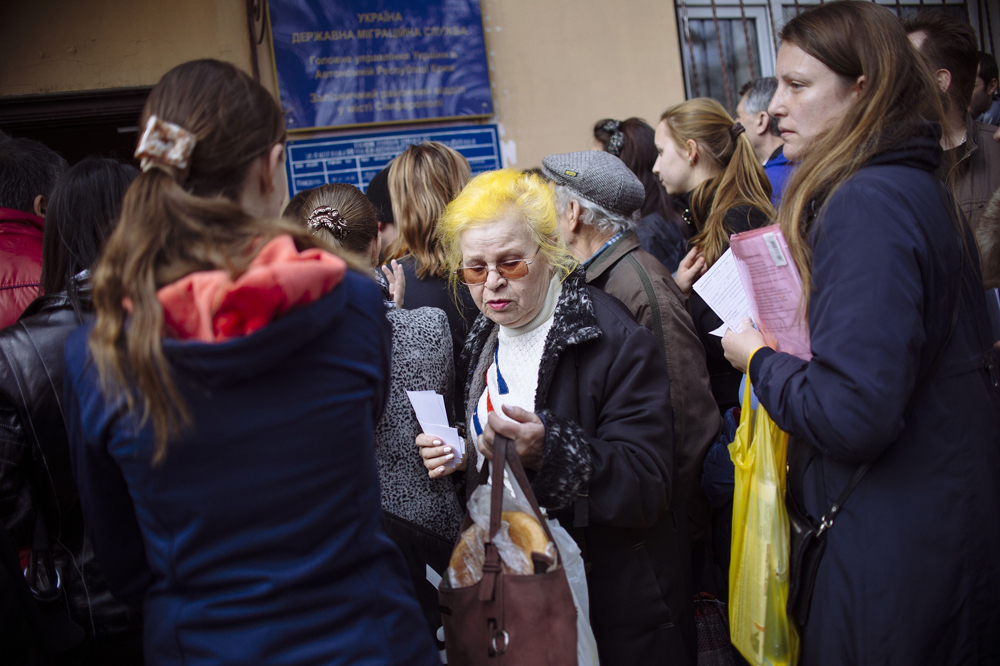
The queue for submitting an application to receive a Russian passport. Simferopol, March 19, 2014
“Let our beloved government think over and tell us what to do. We are people in uniform: we are told-we perform ”-this is how the press service of the Russian Ministry of Internal Affairs responded to the New Times, how their department will integrate the Crimean law enforcement agencies into their composition. Approximately the same answers came to official requests from most other federal ministries. Therefore, the upcoming merger had to learn about the underwater stones mainly among independent experts.
State
The easiest way was to resolve the issue of citizenship. According to the law, all residents of Crimea are automatically declared by the Russians, but they will have another month to decide whether they want to remain citizens of Ukraine - for this it is necessary to personally come to the FMS department and declare the abandonment of the Russian passport. True, in this case, Crimeans will be amazed in rights: in particular, they will lose their right to replace the positions in the state or municipal service.
Everything is clear with state authorities: the elections of the new composition of the Crimean deputies will be held on September 13, 2015, and until that moment the current state council will remain the main legislative body. During the transition period, Crimean legislation should be brought into line with the Russian, and former laws will act only on the condition that they do not contradict the Constitution of the Russian Federation.
In the same federal law, a new section of the state border is defined: such a “border of the Republic of Crimea on land, associated with the territory of Ukraine, is announced. However, its actual arrangement will take time.
"
"To close the border with Ukraine, you need to install a demarcation line and checkpoints on the Perekop Isthmus"
"
“The border consists of a demarcation line and checkpoints that provide customs control,” the rector of the CIS Institute Mikhail Frolov explains The New Times. - In order to close the border with Ukraine, you need to install a demarcation line and checkpoints on the Perekop Isthmus, which must appear on two roads (from Melitopol and Kherson) and on the railway. But this requires an international agreement. ” There will be no problems with personnel, as the expert believes: “Russia has enough strength there: this is both the Black Sea Fleet and the military who crossed the side of Russia.”
Moscow has already taken care of the painless integration of the latter into the Russian army and other law enforcement agencies: according to the law, the Ukrainian military and law enforcement officers will receive a pre -emptive right to enter the Armed Forces of the Russian Federation and other law enforcement agencies “if they have citizenship of the Russian Federation and subject to their compliance with other requirements for the legislation of the Russian Federation”. As for the Crimean draftees, until 2016 they will serve only on the territory of the peninsula, and the current spring draft in the army in the Crimea is canceled. In addition, the local military registration and enlistment offices intend to get the return of 913 soldiers serving in Ukraine with the exchange of them for Ukrainian conscripts serving in Crimea.
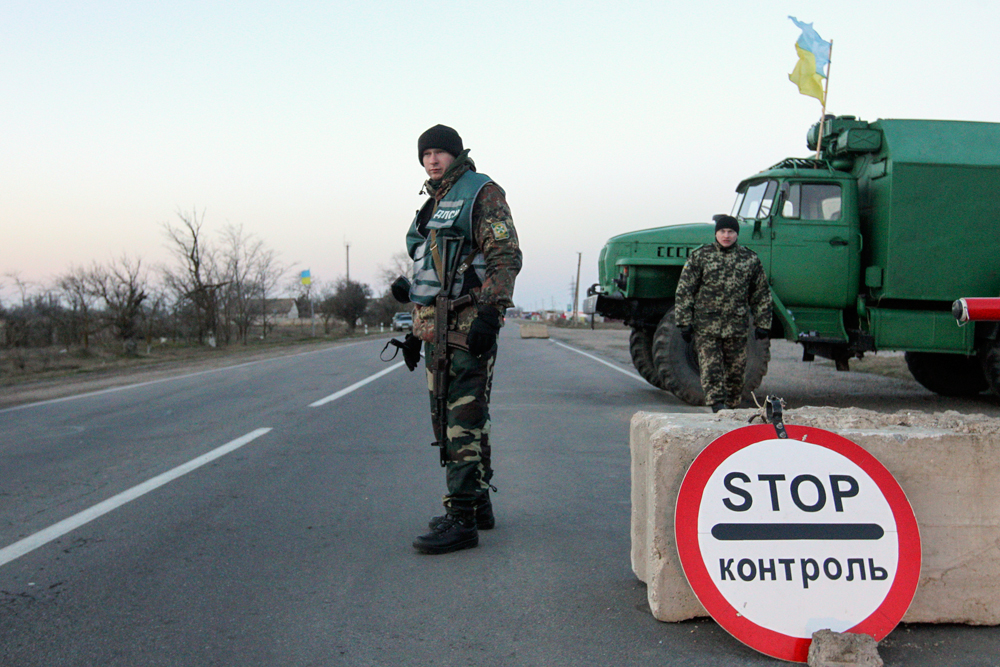
Ukrainian soldiers at a checkpoint near the village of Chongar of the Kherson region near the Crimean border. March 10, 2014
Finance
Although many Crimeans are afraid for the fate of their bank deposits, experts say that they have nothing to worry about.
“The guarantees of both Ukrainian insurance and Russian are extended to the depositors, regardless of whether it is a resident or not and in what structure of the bank a deposit was made,” says Maxim Osadchiy, the head of the analytical department of the BCF bank. “So far I have not heard Ukraine refused to serve Crimean investors, and during the transitional period banks will generally work on Ukrainian licenses.”
At the same time, according to the rumors circulating in the banking sector, the network of the largest Privatbank in Crimea will move to Sberbank. “In Crimea, about 900-1000 structural banking units, and mostly the points of Privatbank are mainly presented there. Its corporate color is green, so you will not even need to repaint if rumors are still confirmed, ”adds Osadchiy.
One of the first tasks of the reformed banking system will be the timely payment of pensions, which should also be promptly increased to the Russian level. According to the Minister of Labor and Social Protection of the Russian Federation Maxim Topilin, the average size of pensions in Crimea is 5570 rubles, in Sevastopol-6,200 rubles, and in Russia more than 10 thousand, according to the calculations of the Deputy Prime Minister of the Russian Federation, Olga Golodets, a total of 36 billion rubles a year on the Crimean pensioners. However, experts give other numbers.
“On gross estimates, this issue costs 80 billion rubles a year, there are about 600 thousand pensioners in Crimea,” says Nikita Maslennikov, an adviser to the Institute of Modern Development. “But these additional expenses have already been provided for in the budget.” According to him, the budget reserve is about 243 billion. But there are also unresolved issues.
“It is not known, for example, what to do with the difference in retirement age (in Ukraine, women, like men, retire at 60, and in Russia at 55. - The New Times), as well as with the recount of insurance premiums, which in Ukraine are 37–40 %,” the expert explains. The question remains open with raising salaries to state employees: “If a couple of weeks ago the Ministry of Finance spoke about the cost of 30–35 billion rubles, then on March 21, the figure of 55 billion rubles was named, and it is sure that not the last.”
Taxes and property
“After the announcement of the referendum, the organizations and entrepreneurs began to pay taxes to the budget of the Republic of Crimea and the city of Sevastopol. Work is carried out to establish electronic information exchange with the treasury about the amounts of taxes and fees received, ”they cheerfully reported to the Federal Tax Service of Russia in response to the New Times. At the same time, there are no clear plans for the Crimea in the Russian Ministry of Finance: in any case, to say exactly how the transition to Russian tax legislation will be carried out and whether the special tax regime will be introduced for the republic, and the department is at a loss.
Obtainable for many Crimeans will be property issues. “Most likely, the process of renewal of Crimean real estate will be different for individuals and legal entities, and a completely different story will turn out with state property,” says Sergey Shloma, director of the secondary housing department of the Incom-Real Estate. “The current state property of Ukraine will obviously be nationalized: accordingly, the notorious Dacha Yanukovych, and the building of the headquarters of the Naval Forces of Ukraine in Sevastopol, and all other objects that the Ukrainian state now owns.”
Obviously, the notorious cottage of Yanukovych and the building of the headquarters of the naval forces of Ukraine in Sevastopol will be transferred to the property of the Russian Federation
"
As for individuals, people who own apartments, cottages, land in Crimea will continue to own them under the same conditions and on the basis of the same documents as before. “At one time, the bodies and rules for registering real estate changed in Moscow, but in fact, this did not affect the owners of Moscow apartments,” the expert recalled. “Many still continue to own housing on the basis of certificates from the BTI issued in 1991, and information on them has not yet been entered into a single state register.” Therefore, only those Crimeans who want to somehow officially dispose of this property will somehow officially dispose of the documents according to the Russian rules-to sell, give, bequeath.
Foreign experience
Similar problems with integration into its composition of another state or its part in the last quarter century had to be solved by Germany and China.
To unite Germany and the GDR on October 3, 1990, no special laws had to be adopted: the territory of East Germany was simply included in the Western by the decision of the GDR parliament. At the same time, new legal norms entered into force immediately: the GDR abolished the current Constitution and other laws, at once replacing them with West German. Even earlier - from July 1, 1990 - the West German brand became the official currency of the GDR.
According to the association agreement, the property and debts of the Eastern Germans crossed the Federal Republic of Germany. The GDR eliminated the German emission bank, but the land banks were recreated as branches of the West German Bundesbank. Then the People’s Chamber (parliament), the government, the Supreme Court and the Supreme Prosecutor's Office were liquidated. The National People’s Army with the People’s Fleet was also abolished, having re -registered the military to serve in Bundeswehr and Bundesmarin.
However, the Western Germans had to pay for such lightness: a new “solidarity tax” in the amount of 5.5 % of the amount of the current income tax was introduced to cover the costs of unit in the western part of Germany. The tax is still valid and applies to both enterprises and individuals.
The reunification of Hong Kong with China officially took place on July 1, 1997-after the end of its 99-year lease, Great Britain.
The return of the former British colony under the sovereignty of China was preceded by complex many years of negotiations. Prime Minister Margaret Thatcher tried to get from the then leader of the PRC Dan Xiaopin so that only those territories that were part of the colony were returned to Beijing. However, Dan Xiaopin achieved the return of all Hong Kong. On the basis of the concept “one state - two systems”, a joint declaration was signed, which said that Hong Kong (Xiangan) was returning “to the bosom of the homeland”.
True, not everyone believed in a happy reunion: many residents of Hong Kong decided, just in case, to get British passports, for which they defended the kilometer lines formed a few weeks before the end of the colonial rule. For the rest, the issue of citizenship is resolved on a mutual basis: the PRC recognizes Hong Kong all ethnic Chinese, and he, in turn, recognizes his citizens all immigrants from China, who have been living in Hong Kong for more than 7 years (there are different passports in the PRC and Hong Kong).
According to the Sino-British Declaration and the Hong Kong Law adopted on its basis, a wide autonomy was provided for a period of 50 years after the transfer of sovereignty. During this period, the Central People’s Government of the PRC resides a solution to issues of defense and foreign policy, and control over the legislation, the police, the judicial and financial system is carried out by Hong Kong itself.
At the same time, the local leader is elected by a special collegium, which is perceived by the population as an actual purpose from Beijing. In addition, half of the local deputies are also elected in indirect elections. Therefore, many residents of Hong Kong advocate the reform of the entire system of power and for the introduction of direct elections of both the head of the local administration and the entire deputy corps.
Photos: Valentin Ogirenko/Reuters, Dimitar Dilkoff/AFP/East News