
Translated material
Sergey Guriev: Putin's personal risks are now very high
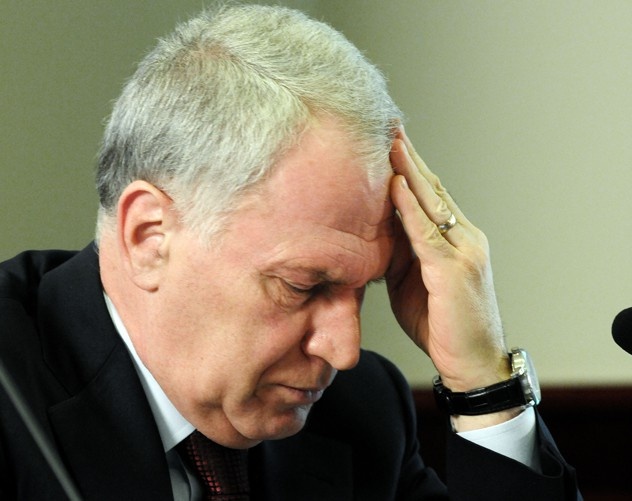
Economist Sergey Guriev on March 20 at Pushkin House in London with a lecture on the future of the Russian economy. Slon publishes questions and answers that were asked by Guriev after the performance.
- What Western sanctions are most strongly hit by the Russian economy and most upset Russia?
- Today's sanctions, unlike the previous ones, are much more serious, because they strike people who do not formally participate in decision -making, but - according to rumors - have a huge impact on Vladimir Putin in reality.
Among these sanctions, the mention of the Bank "Russia" is mentioned. The point is not only that this is part of the business group of Yuri Kovalchuk, who is directly related to important assets. The fact is that this is a precedent of actions not against a private person, but against the bank. For people who control banks (as for their investors), sanctions against the Bank of Russia are an important signal, they will begin to get nervous. So far, no one forbids doing business with Russia, but it will now be much more difficult for banks and Russian companies to get Western financing and loans. Just because no one now understands how the situation will develop, what will be the response of Russia, whether other banks will include in the new round of sanctions.
There is a set of sanctions that has not yet been adopted, but is discussed. And against Russia, it is possible to introduce sanctions on the Iranian version from the oil and gas embargo and restrictions for all financial transactions. The introduction of such sanctions would be very expensive primarily to European countries and primarily Germany.
But this is what would be perceived by the Russian government as a serious measure. Russia will begin to take sanctions seriously precisely when it sees that American and European leaders are ready to step on their own interests.
To exclude Russia from the OECR, there is no courage - after all, this does not entail any internal political costs. The Russian leadership understands how a strong step is only that which causes not only Russia, but also your own economy and your rating within the country. The more Americans advance on their own interests in order to damage the interests of Russia, the more serious the signal they send. And what the Americans have done today will harm the interests of American companies and American business. That is why today's step is so painful for Russia.
-Will there be any consequences of these sanctions for Putin’s popularity and his ability to control the situation in the country?
- First, the country will rally around the leader. Russians will say that everything is in order with the economy, show on TV that there is no stagnation, but there are only temporary problems. You can even show that in Europe the situation is very unstable, Europe is falling apart. But as soon as the Russians see that the ruble is weakening in relation to the euro, they will immediately understand.
For Russians, a weakening ruble immediately returns memories of the nineties. And the myth of "stability" is dispelled in the air.
Russians will continue to believe Putin that there is a global conspiracy against Russia in the world, but they will no longer believe that everything is in order with the economy. At the same time, the matter is not only in the ruble. Reducing the ruble will lead to the rise in price of imported goods. In addition, prices and Russian manufacturers will raise after this.
- Do you agree that Putin made a decision on the Crimea, not taking into account the interests of his close environment, which he sympathizes and miscalculated? Did he deliberately attend them or was it a mistake?
- The decision in the Crimea will lead to catastrophic consequences for these people. But in the end, this can be very dangerous for Putin himself. He took a step that I would not advise anyone to take. It's not about whether I like or you for the Crimea. The fact is that now Putin’s personal risks are very high. When you threaten the property and freedom of very rich and powerful people (even if they owe you with their wealth), then you become a problem of life and death for them. This situation will not last long. She became too dangerous for Putin and his personal environment. And it was in this that there was a strategic mistake with Ukraine.
- What role will the 2018 World Cup play, given that we try to perceive this competition as an opportunity for business?
- When Russia received the right to hold the 2018 World Cup, one representative of the Russian elite told me literally the following: “This is very good. This means that until 2018 we take the obligation, that we will not attack anyone. ” Indeed, Putin began the war with Ukraine as soon as the Olympic Games ended - it would not be possible to conduct them otherwise.
As for 2018, we do not know what will happen. Either Vladimir Putin is right, and by 2018 the West will forget the events of 2014 and forgive him. And I think this is exactly what he is counting on. Either he is mistaken, and then by 2018 in Russia there will be another government. Both options are possible, and after today's sanctions, I would say that the second script is more likely than the first.
Such a development of events only seems incredible. Try to return two months ago and imagine sanctions against Gennady Timchenko. Timchenko is not even a citizen of Russia. He was recently given the Order of the Honorary Legion in France, his Novatek company is a key partner of Total. However, Dmitry Firtash is a Cambridge donor. Think about it. Everything changes, and what used to seem impossible today is happening. In this sense, the new government until 2018 does not seem to me such an impossible script.
- How could the events in Ukraine be de -escorted if Putin decided to retreat?
- I think the best option that you can hope for today, that Ukraine will not continue to lose its territory. This is the best of the possible scenarios of de -escalation.
Putin would be dissatisfied if Ukraine had joined NATO. He may be demanding such a promise from Ukraine. But it is unlikely that Ukrainians will be able to fulfill such a promise. As soon as you lose part of your territory, you immediately begin to think about the advantages of NATO membership. The Baltic countries think about this today, and Poland, and even Finland, which for Ukraine served as an example, and now thinks that only NATO can guarantee the inviolability of borders.
Descaling the situation will not be easy. But the most important question is now whether Eastern Ukraine will remain in the country.
There is no script in which Vladimir Putin will decide to return Crimea. This would not be just a sign of weakness - this would be a recognition of the fallacy of his calculations. This, in turn, would cause great damage to his reputation as a visionary policy within the country. This is obvious to us, but not obvious to many European leaders who seriously think that there are scenarios of the return of Crimea.
If the West recognizes the defeat, then the best scenario will be the one that Eastern Ukraine will enter a protracted crisis. In the worst case, it will cease to be part of Ukraine. And this is exactly what is now on the agenda.
- Russian history teaches us that leaders are changing suddenly and the change is very fast. Do you think that it can be the last weeks or months of Putin? And if so, how will events develop further?
- The history of Russia and countries, similar to it, teaches us that we do not know what will happen next. In the United States, leaders are changing every four years, in France every five years. Rules are rules, and democracy is predictable. The theory says that undemocratic regimes, on the contrary, develop and change an unpredictable way. And in this sense, the regime can change in one night, but there is a scenario in which it will not change until 2018. If everything changes in one day, the question will arise, and then what? Then there will be a person who is trusted by Putin, and the people around him, and the opposition. He will stand at the head of the Provisional Government, guarantees the safety of the outgoing elite and hold democratic elections. But who will be, I can't say now.
- What can be historical parallels, what model can Russia transform into a developed democratic country take place?
-All countries that we call today are once, were not such. But most of them are Western countries. There are exceptions - Korea or Chile, say; There are examples of Brazil and Mexico, which have not yet become developed, but, obviously, go along this path.
The peculiarity of Russia is that it will become the richest undemocratic country, turning to democracy. Therefore, this democratization will be special in any case. (Unless, of course, Saudi Arabia does not begin this transformation process before.) Russia is so rich and so undemocratic that this dissonance itself creates a huge problem for management. Do not think that managing such a rich and such educated country in a non -democratic regime is simple. It is not necessary to envy the Russian president - his work is complex and very dangerous.
- I would like to ask about Putin’s anti -corruption campaign and the elite nationalization campaign. Why at some point she transformed into nationalist, what caused?
- Russia is leaving the postmodern dictatorship, in which there was no ideology, but only opportunism, to the search for a new social contract. In Russia, different people and different views. Someone to the left of Putin, someone to the right. Someone loves the West, someone hates him much more than Vladimir Vladimirovich. What unites all Russians is that nobody likes corruption. And at this moment it ceases to be simply an economic factor that is now the most threatening regime, but it also becomes a factor in politics. And Putin is important to demonstrate that he, like all Russians, does not like corruption. Therefore, he began a campaign to nationalize elites. But this rhetoric, fortunately or unfortunately, is of a postmodern character. Someone repatriated their assets, someone simply changed their names on them, someone left everything as it was. The real fight against corruption has not yet happened.
But as the sanctions are imposed, we will learn a lot of new things. Those who were proud that they were included in the list will be owners of apartments in Switzerland and Paris. Those who say that they are not afraid of sanctions today still do not want to live in North Korea. They want to rule the country, maintain posts, have power, like Stalin’s, but live in Europe. We know that all these people, including the highest-ranking representatives of the Russian elite, still have interests outside of Russia.
In response to sanctions, Putin can always say that he has long called and demanded nationalization of the elite and repatriation of its assets. But this is a distinctive feature of the current regime. In this sense, he is very postmodernist, but not at all Orwell. According to Orwell, if you say that it contradicts what you said yesterday, you will destroy yesterday's newspapers. The Russian regime is amazing that you can say and do something today that completely contradicts what you said and did yesterday, and this does not harm you at all - and at the same time all the statements are in the public domain. And you need to understand how much talent you need to possess in order to rule such a country in this way.
- I wonder how the Russians perceive Putin. Is he the Savior?
- He is very popular. He is the Savior from the "chaos of the nineties." But as soon as the ruble weakens, people will begin to ask questions about corrupt officials. And these sanctions also give birth to some questions in the minds of Russians. What about these people from Putin’s near circle, why suddenly the Americans include them in the list if they do not have foreign assets? And why is the head of a state -owned company, which never had private business, falls on the list of American sanctions, why is it so rich? All these questions will begin to arise with the fall of the ruble. And this will happen quickly.
But Russian political leaders are extraordinary people. They use several tools at once. Some people who really like money are not subjected to repression - their loyalty is bought. Some people, less informed, fall under the influence of propaganda. With some, you have to use repression. These three tools - bribery, brainwashing and repression - Russian power and holds a complex balance. The only problem is that her money is running out. This, in particular, means that in the near future we will see more propaganda and more repression.