
Translated material
Vice on the expo

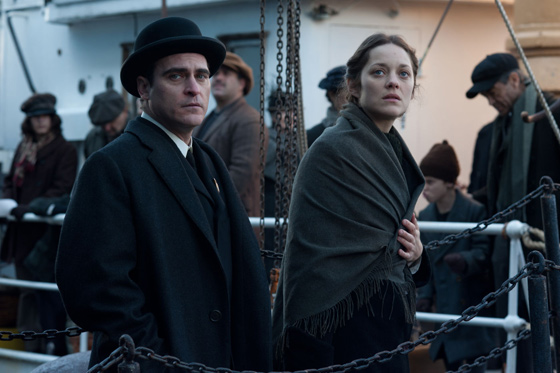
1921. The sisters Eve and Magda Tsibulsky, running from Poland from some conditional war (flashbacks show a Cossack with a saber), leave the ship on the island of Alice (New York on the horizon) and immediately fall into the Kafkian hell. People in the uniform immediately send a quarantine, Eve (Marion Cotillard), unjustly accused of unworthy behavior on the ship, prepare for immediate deportation-but she meets Mr. Weiss (Joaquin Fenix), the middle-abener of the middle-handed, which supplies the girls to Manhertensky. Kabaret and Brooklyn tailor. His custody immediately pushes Eve to the panel (literally-the rapidly dropping Bruno Weiss will very soon trade girls in the underpass), and such a victim is justified by a sky-high price (in dollars), which will have to be paid for the release of magda from a fifth-fiber. A second American man met by Eva, who reminiscent of Harry Gudini, the magician Orlando (Jeremy Renner), according to the evil author’s intent, is some hope for salvation - Bruno's cousin. He also has money, but he earns it, without resorting to operation. The love triangle is allowed quite in the Shakespearean spirit: the virtue is trampled, the vice, too, is bad for everyone, the tearful Kotiyar hugs its defeated tormentor against the backdrop of dusty workbenches. A typical Greyevsky climax, as in the scene of the commemoration of the Yard, where the mother of the deceased, frozen in the mourning Catatonia, presses her son to her chest and reaches out her hand to her nephew (Mark Walberg).
 © The Weinstein Company
“Immigrant” (in the Russian rental - “fatal passion”) seems to stretch this pathetic and somewhat awkward moment for two hours. A film in which hyperrealism turns into an extreme degree of conventionality and schematism (it is appropriate to give a recent case with a Cannes review The Guardian for the film is a documented episode of Caruso’s performance before the immigrants in a quarantine receiver on the island of Elis, the observer Peter Bradshaw considered it an extremely unrealistic fiction), serves as a detailed explanation of why we call Gray the classicist. His paintings, whose drama is almost always based on the sequence of impossible, unlikely cases and extremely voluntarist scenarios, are neither an artistic representation of human life, nor her, life, metaphor. Gray theme is exclusively a struggle. The struggle in all its forms - from a hopeless challenge through a conflict of duty and feelings to the Marxist struggle of the old and new, logic of capitalism and traditions, emotions, affection. All these antagonisms are present in Gray’s films at a time, making any correct choice with a purely situational output. What works in one film is discredited in another. There is no that power, the loyalty of which would be an unconditional virtue: family (“yards”), a social group (“owners of the night”), love, finally (“lovers”) - all this can be devoted. For the sake of money, of course.
 © The Weinstein Company
"Immigrant" is entirely subordinated to this logic of capital, eroding any straps, communities, gabitus. The new world consistently knocks out all the Eve immigrants all support-identity: family ties, moral and religious principles, honor-everything is torn, melting, disappearing, depriving the heroine of subjectivity. The film constantly raises the question: "Am I someone or no one?" (Hello Rodion Romanovich) - and, of course, the one who accepted the logic of the new becomes nobody, thinking that he is everything. An alternative position, however, is impossible: Gray orders Eve to desperately grab the only thing that connects her with the old light - for his sister. But Magda, clearly doomed to death from tuberculosis, disappearing literally immediately after appearing on the screen, is more like a mental construct, an argument, and a trick. The debt to the sister, as it were, derives Eve from the logic of the relations in which her body is involved. Even the love triangle here ceases to be a love - a woman evaluates two men, based primarily from their creditworthiness; The ghostly figure of the sister elevates this choice to painful and tragic.
 © The Weinstein Company
Too tragic. Sentimentality is a weak place in Gray, and the name invented by Russian distributors perfectly reflects the poetics of the film. The monotonously mournful face of Kotiyar, dull gas light, a relatively happy finale (Magda is bought out, sisters set off from the island in a fragile boat, a villain Weiss, staggering, leaving for death). By the moment, this, by golly, looks like a potpourri from the plots of Russian literature, played out by girls from the cabaret, to the series "Yama". World sorrow in the Immigrant is cleansed of unnecessary impurities like psychologism, becomes a topic for a slaughter pop number, turns into a genre, or that television people call “format”. The formats strive for expansion - and for sure, soon the “blood ties” of Guillaume Kane go out to the rental: the American adaptation of the French film, which adopts his nihilistic sentimentalism just as a technique. Throwing the space of the universal struggle of everyone against everyone in the “immigrant”, Gray does not notice how it collapses at all, leaving punishments without crimes and turning metaphysics into a verse, into a salad dressing ready for use.