
Translated material
How much will Russia cost Crimea?
Around Russia
 How much will Russia cost Crimea?
March 25, 2014 Julia Latynina
How much will Russia cost Crimea? Not in a geopolitical sense, but purely financial. How much money will he bring to the budget, and how much will he take from there?
Crimean pensions, taking into account the number of military pensioners, will cost about 80 billion rubles. In the year, this is more than a third of the pension fund deficit, for which last year, the ICP deductions were doubled (which led to the liquidation of 720 thousand). At least 200 thousand Crimean state employees and law enforcement officers will cost a comparable amount.
However, state employees are a penny. The main money in the Crimea will be needed for infrastructure. The one that is is closed to Ukraine. Electricity, communication, road and railway, and most importantly, water - all this comes to the peninsula from the mainland. All this is Ukraine either to block or breaking crazy prices. All this will have to be built again. And if the cost of the bridge through the Kerch Strait, even with the appetites of the Rotenberg brothers, can at least be calculated approximately, then how to solve the problem of supplying the peninsula with water in a short time and how much it will cost, it is simply impossible to imagine.
Again, there is no trouble in the construction of infrastructure. It is important that it costs not how much it costs, but how many jobs this construction creates and how the created infrastructure then helps business. In the end, all over the world in all eras - starting from the Athens of Pericles and ending with the United States of Roosevelt - temples, palaces and roads built exactly then to provide the work of citizens and raise the city's economy.
Unfortunately, Russia in this sense differs both from Athens of the times of Pericles and the United States from Roosevelt. According to Sochi experience, we know that large -scale construction projects: a) are carried out by migrant workers, that is, the local population does not receive jobs; b) they do not even bring money to subcontractors who are building in debt and ruin. They bring money - and huge - only the top close to Putin. And from the experience of South Ossetia, we know that in the region, controlled by crime, money can generally disappear without a trace.
It is hard to imagine that in the Crimea, led by the prime minister named Goblin, the development of funds for infrastructure was very different from the development of South Ossetia or at least Sochi.
How will this money beat off and what can the population of Crimea be earned on?
Crimea is, first of all, a resort. Russian enterprises have the right to subtract from the deductions entering the Social Insurance Fund, money spent on tickets for employees, if employees were sent to a boarding house in Russia. I have no doubt that this year everyone will be obliged to send employees to Crimea, and the Crimean health resorts will be full of miners from Kemerovo and metallurgists from Magnitogorsk.
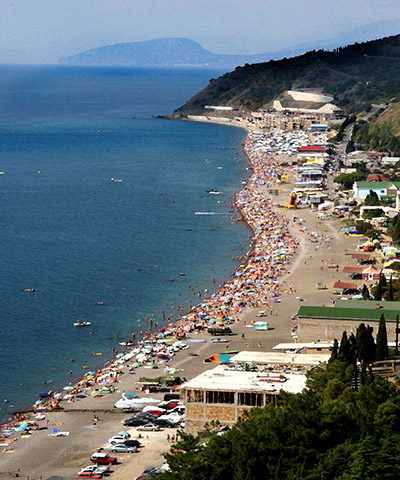
However, health resorts are not all. In Crimea, tens of thousands of people in the summer season pass their private lups. At the same time, in recent years, 25% of vacationers came from Russia, and 75% from Ukraine and other CIS countries. These 75% will be lost.
Crimea is the south and paradise of the climate of Russia, the All -Union health resort in Soviet times. But now is not Soviet time. Now - the market. And tourism, with a few exceptions, is a purely market industry.
Crimea will have to compete in the tourist market not with the Lastochka boarding house near Moscow. And with Bulgaria, Cyprom, Bali, the Maldives and five -star hotels in Egypt and Turkey, where the fantastic quality of the immaculate servants is offered at a very low price.
Can I compete? Can.
There should be several things for this. Firstly, high birth rate and no social payments. Then, as in Antalya: you come to the hotel and you are greeted by a stewed personnel who trembles not to lose their place. It is difficult to imagine that the lumpenized population of Crimea, especially excited by freshly reliced manuals and the Ukrainian property, could ensure comparable quality service.
Secondly, the coastal strip of Crimea is currently a series of dilapidated, gangsters of privatized Soviet boarding houses and new cafes, built approximately using the same technology according to which the Favelles are being built in Brazil. At night, music rattles from these cafes, from which beds are shaking in neighboring hotels. Either a state employee or a homeless person can relax in this situation. To bring there a market vacationer, you need to demolish everything there and build a “Hilton”. Both are difficult. Firstly, Hilton will not be built in Crimea, and secondly, a cafe in the style of Favella and the ruins of boarding houses belong to those bandits who are now resurrected from the non-existence of the 90s and lead the Crimea in the person of the prime minister named Goblin.
Thirdly, part of the coastline of Crimea is occupied by the luxurious bar's estates of the Ukrainian elite, just like Sochi is occupied by the estates of President Putin, Governor Tkachev, Patriarch Kirill, etc. It is obvious that these estates will be transferred to the new owners, but will be preserved as a class. Putin will probably build a residence in the Crimea-27th in a row. (In general, I think that the desire to have a residence in Crimea was an important motive for all these events. We think about geopolitics here, and maybe Putin was just tired of the Red Polyana and he wants the Livadian palace?)
The problem is that such estates are incompatible with a market resort. The market resort requires a continuous coastline and the absence of machine gunners and barbed wire. If anyone was in Monaco and Nice, he remembers that although the villas there standing close to the shore, along the coast, between villas and the sea, there is a concrete path. On which you can walk. And this is the most important part of the infrastructure. The resort is not without public space. The owners of very expensive mansions for the most part cannot go naked to the sea, because between them and the sea - the path. It is clear that the estates, unlike a public resort, are built with a direct access to the sea. And those who try to get to the sea as an ecologist Vitishko will be imprisoned.
That is, Crimea will, like Sochi, will reflect the social structure of modern Russia. From above-estates for supernature, Kovalchuk-Rotenbergs (especially since they can’t rest in Courchelly), with access to the sea, with helicopter sites, barbed wire and “polite green men”, protecting them. Below - collapsed boarding houses and cafes with hellish music for state employees and lumpen. For his money, a person will not rest there. Only for the state resource or for the money of the enterprise.
In other words, the annexation of Crimea will cost Russia giant annual money, but in the socio-economic conditions existing in Russia, it will not bring anything to the budget and, moreover, will not create additional sources of earnings for the local population (earnings, not freebies at the expense of the Russian budget)
This, in fact, is the main difference between wars in the past and wars in the present, and the reason why reasonable states ceased to wage wars. Not because it is immoral, but because it is unprofitable.
When we say “war”, we do not think that 1000 years ago and now this word was called the processes economically diametrically opposed. So different that in addition to the act of murder itself - as the supreme argument of rightness - nothing connects them.
The war in antiquity and in the Middle Ages was, first of all, by profit. It was also good to get the territory, because it was a way of long -term profit. Imagine, Atille or Karl Great would say: “Hey, man, you won Crimea, now you will have to pay pensions.” What are the pensions? I won Crimea, I cut all the men, cut all the old people, the women sold in the market, except for those whom I left for entertainment. I now have a lot of slaves, and some kind of gold that I went with severed fingers. What are the pensions? To whom? The slave sold in the market?
Not so long ago, the war was a capitalist enterprise in order to make profit. You invest in armor and tools for the production of victory, i.e. Warriors, and they bring you additional profit. You get the fruits of robbery, loyal people who owe you a profit, plus a territory that brings money.
Even when Catherine won Crimea, it was a strategically profitable enterprise. Firstly, the danger of raids was eliminated, and secondly, the path to Constantinople was laid, which was to master the main dream of the Russian crown. Thirdly, everything is very simple: the wealth of the country streamed from the amount of land suitable for agriculture. The more such land, the more the population. The larger the population, the more wealth.
What is the profit from the Crimea now?
Photo by ITAR-TASS
Please save this information and share with your friends!
Support blocked sites!
City.ru , daily magazine , Kasparov.ru , blog Alexei Navalny