
Translated material
Novelty of the season: "National Distributors"
Mikhail Yampolsky - about the new language of power
About the language of power
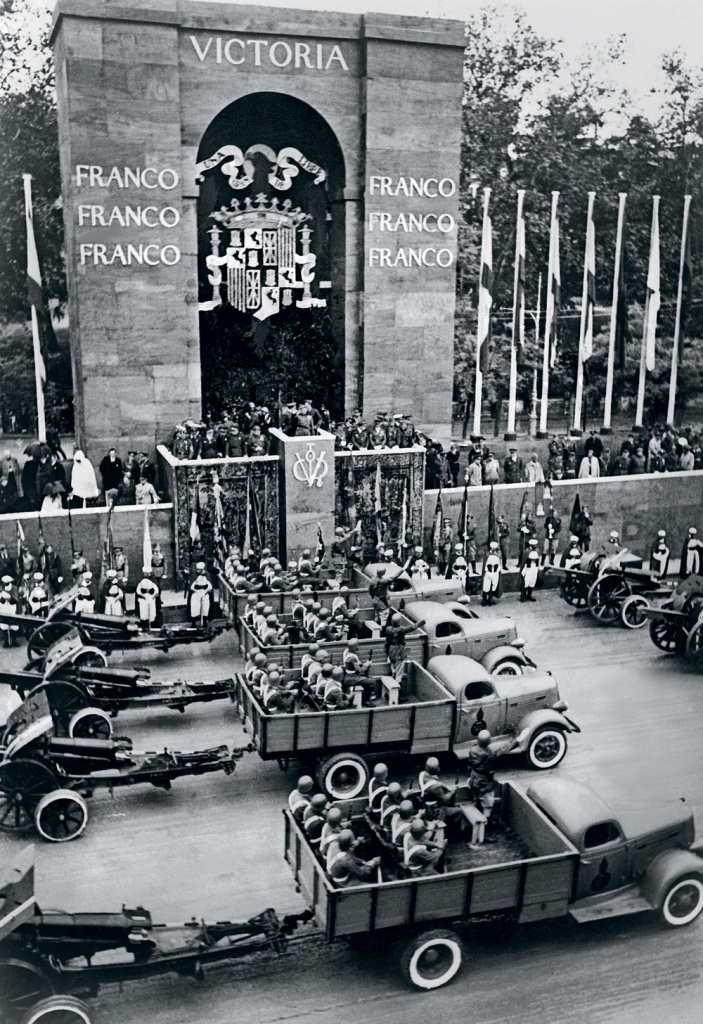 |
| Generalissimo Franco commands a military parade after the end of the Civil War in Spain. Madrid, May 19, 1939 |
Putin’s “Crimean speech”, which he said on March 18 in connection with the signing of an accession agreement* is indicative. It is not that it was a completely new sample of rhetoric, but in it the rhetoric of recent times is cast in formulas, which still have repeated replication.
| *Read more about this speech, see the material “Explanation of the sent”. |
The opposition intelligentsia was especially embarrassed by one of the final passages of speech, in which she, not without reason, saw a hint of herself: “Some Western politicians already suffer from us not only sanctions, but also the prospect of exacerbation of internal problems. I would like to know what they mean: the actions of a fifth column-various kinds of “national traitors”-or expect that they can worsen the socio-economic situation of Russia and thereby provoke people's discontent. We consider such statements as irresponsible and clearly aggressive and we will react accordingly to this. ”
“National Distributions”, unlike the “fifth column”, is a new season. To understand the meaning of these terms, a few words should be said about the context of their occurrence.
The history of the issue
The expression “The Fifth Column” belongs to the Franksist General Emilio Mola, who, in 1936, during the Civil War in Spain, told the journalist that four columns of his troops were moving towards the Republican Madrid, and the fifth was waiting for a signal for the city itself. The fifth column in the expanded sense of the word is a group of provocateurs, militants or distributors of panic moods, ready to raise a rebellion against legal authority. This concept could be applied without stretching to the “polite green people” in the Crimea or to Russian pogroms, which were sent to the east of Ukraine. Instead, it turns to supporters of the world opposing all violence. The calls to the world in this way are equated with armed provocations or even rebellion.
| ** The term “national traitor” appeared in Weimar Germany: this was called Matthias Erzberger, Philip Shaideman and other members of the German delegation who signed the compievan truce of 1918 and the Versailles Peace Treaty of the 1919th. |
The same can be said about the notorious "national prescriptions." The meaning of this expression is simple: the so -called collaborators, that is, people who work with the occupation regime. This term was applied to the followers of Peten in France or to the Vlasovites in Russia **. It would probably be appropriate for Prime Minister Aksyonov in Crimea. But what invaders do the pacifists in Russia cooperate with? If we are talking about the Americans, then it should be recognized that Russia has already been occupied by them.
Ideas for the crowd
This inadequacy of the words of real reality is increasingly characterized by the modern Russian official and official discourse. The displacement of meanings begins to resemble a phenomenon known to historians and philologists as “totalitarian speech”. The foundations for its study were laid down by the German philologist of Jewish descent, Viktor Clemperer, who carefully monitored the evolution of official discourse in the Third Reich.
The clipper considered one of the important figures of totalitarian speech to turning the relations of the subject and predicate, when, for example, the victim becomes an executioner, the Nazis defend themselves from aggression and fight for the world. In addition, totalitarian speech is characterized by the assimilation of “new” terms, the meaning of which is only vaguely understandable, and filling them with a completely opposite initial meaning. The fundamental here is the separation of the “signifier” from the “signified”, the extreme simplification of the concept and the final loss of intelligible meaning to them. Instead of historical content, a vague image appears to the forefront, filled with some emotional overtones, as, for example, in the expression “national traitor”. Here, an understandable and purely negative in meaning, the word “traitor” is associated with the idea of a nation and Nazism at the same time. But this is the goal of such a usage.
"
Totalitarian speech is characterized by the assimilation of "new" terms, the meaning of which is only vaguely understandable
"
Gustav Lebon in his “psychology of peoples and masses” (1895), highly appreciated by Goebbels and studied by Lenin, wrote: “Whatever ideas inspired by the crowd, they can become predominant only, provided that they be clothed in the most categorical and simple form. In this case, these ideas are presented in the form of images, and only in this form they are available to the crowd. Such ideas-images are not interconnected by any logical connection of the analogy or sequence and can replace one another in a completely way as in a magic lantern one glass is replaced by the other hand of a magician taking them out of the box where they were folded together. That is why the ideas of the most contradictory nature are held in the crowd. In accordance with the accidents of the minute, the crowd falls under the influence of one of the diverse ideas available in her reserve, and therefore can perform the most opposite actions; The lack of critical ability prevents her from noticing these contradictions. ”
This logical discretion is perhaps the main feature of Putin’s speech. On the one hand, this speech is a declaration of annexation of part of Ukraine, on the other hand, it contains completely incompatible with the reason for its pronunciation of assurances: “We want friendship with Ukraine, we want it to be a strong, sovereign, self -sufficient state. <...> And most importantly: we want peace and consent to come to the land of Ukraine, and together with other countries are ready to provide all assistance and support for this. But I repeat: only the citizens of Ukraine themselves are able to restore order in their own house. ” But if we are so advancing for the sovereignty of Ukraine, why did we drag the Crimea from her? It turns out that Russia did not annex Crimea, but saved it from annexation by someone else: “We always respected the territorial integrity of the Ukrainian power, by the way, from those who sacrificed the unity of Ukraine to their political ambitions. They flaunt the slogans about the great Ukraine, but it was they who did everything to split the country. ” But if someone encroaches on the integrity of our neighbor, why is the Crimea it turns out with us? “This strategic territory should be under a strong, sustainable sovereignty, which in fact can only be Russian today. Otherwise, dear friends - I turn to Ukraine and Russia - you and I - both Russians and Ukrainians - can even lose Crimea, and in a near historical perspective. ” It turns out that Russia is annexing Crimea so that someone is not annexed by someone to save him for Ukrainians. And then soon the peninsula can generally abuse and get lost in the darkness.
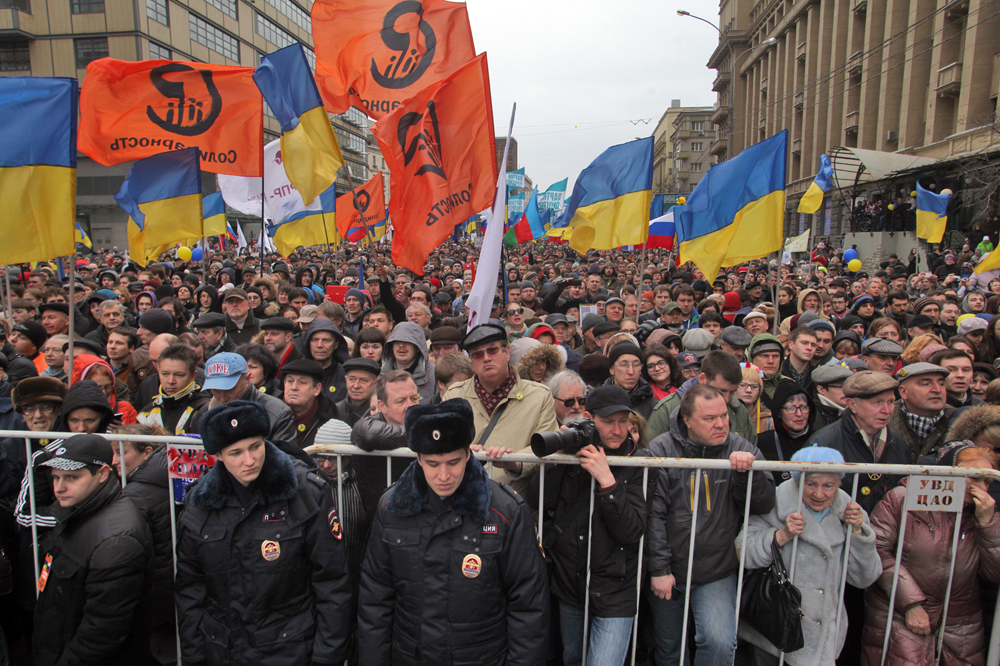
Participants in the "march of the world" are now called the "fifth column." Sakharov Avenue, Moscow, March 15, 2014
Destruction of meanings
This kind of discourse layers one contradiction to another and becomes incomprehensible if you read it in search of clear content. Hitler once called himself "the most conservative revolutionary in the world." And this meaningless Oxymoron, due to repetitions, began to acquire a semblance of meaning. But it is the destruction of the meaning that is the goal of totalitarian discourse, which at the same time constantly affirms its almost metaphysical commitment to truth and directness: “They constantly try to drive us to some corner for the fact that we have an independent position, because we are defending it, for calling a spade a spade and not hypocrite.”
With repeated use and setting the pointless cliches, referring to an indefinite enemy, speech loses its significance. She breaks away from reality and begins to build a “second” verbal reality like the one that was created by newspapers and television in Soviet times. It was in those days that the people and the party were united and our goal was communism. Such a gap of speech from reality allows you to apply “images” to anything. Words mean nothing. Anyone can be branded as a fascist, a bandit, a militant, etc.
The French researcher of totalitarian speech Jean-Pierre Fay wrote that she massagedly invades German reality at the time of a severe economic crisis and itself is a speech crisis. Her first task is to separate the speech from reality. And she successfully copes with this. Such isolation of meanings from reality is primarily necessary to carry out the total mobilization of a society, often arising in response to a crisis. In his new version, Putin ceased to be an apologist for stability and suddenly turned into a destabilization agent, without which, like without the image of the enemy, total mobilization is impossible. Within the framework of this mobilization, it is necessary to drown out the mind, to translate speech into modality of emotional inflection, always implying an unclear meaning. The mass cannot develop until the meanings are destroyed in the name of simple emotional symbols. But the most effective procedure for the destruction of meaning is the war - the source of all total mobilization.
To be effective, totalitarian discourse must fully dominate the media
"
The theoretician of total mobilization, Ernst Junger wrote that it can only reach its extreme form “if the image of the war has already been inscribed in the order of peacetime. <...> Here we can mention such a phenomenon as an increasing cutting of individual freedom, that is, those claims that have actually have long been doubtful. This is an intervention, the meaning of which consists in the destruction of everything that cannot be understood as the function of the state, we first meet in Russia and Italy, and then at our house, and we can foresee that all countries in which world -class claims are still alive in order to comply with the new forces that have torn to freedom. ”
Mystical unity
Mobilization as a form of leadership management of the mass of the masses puts on the idea of an almost mystical national unity that sounded in Putin’s speech: “These days we were more close than ever, supported each other. These were sincere feelings of solidarity. It is in such turning point in historical moments that the maturity and strength of the spirit of the nation is checked. The individual disappears to the mass and loses all critical consciousness. At the same time, the idea of a special “turning point in the historical moment”, which passes, as the clipper, is also unfolding, through the entire layer of totalitarian discourse, tended to amplifying any event to historical or world-historical significance (the clipper called this phenomenon “intensification”).
To be effective, totalitarian discourse must fully dominate the media and drown out all other voices. Only then will he be able to dive the masses to the complete indistinguishability of individuals. It is ideally built for television, synchronizing millions of crowds in front of the screen and at the same time pushing the same thing into minds. Fortunately, however, today we do not live in Nazi Germany and not in the USSR. It is no longer possible to organize a total stripping of a media field for this kind of discourse. The Fifth Column, which Putin and Kiselevs say, is, after all, as we all understand, are the inhabitants of the Internet that undermines the effectiveness of propaganda with a variety of points of view and information channels. The fact that not all Russian society today welcomes the annexation of Crimea out of love for Ukrainian territorial integrity and contrary to the occupation of the West and Bandera, is a sign of a changed media situation. Five to ten years will pass, and totalitarian discourse, in which the power practices today, will become completely impossible. I think that a large Eurasian project will end simultaneously with the dominance of television.
Photos: AFP/East News, Elena Palm/Interpress