
Translated material
Almost about sex
I thought about the need to write a text about the problem of earnings of artists working with video and other intangible media, last fall, when the editor of Snoba contacted me with a proposal to post my new video in one of the headings on their website. My question about the fee for publication caused amazement and shock - as something that is impossible to think about. Hints that the publication is quite commercial and it would be worth paying for the content (plus that such an open publication is not very good for the festival fate of the film), met with the arguments from our colleague Nikita Pavlov’s photographic youth of the early 2000s, when someone-both a rich man and a suspicious person-offered to shoot you and will see you and find out, and they will see you sometimes, and even sometimes they will see you. We were ready for food.
 © Claude Virgin Helmut Newton with wife June, on Piccadilly, 1956
This story was superimposed on the summer adventure with the Festival “Arch of Arch”, where we were invited with a video program, and here, on my part, an annoying misunderstanding occurred: if it seemed to me for the granted that the commercial festival would somehow pay for the work done, then in practice not only the fee was not implied, but not only the artists were settled in a protruding tent, and opening and opening It was marked by a frank segregation on VIP artists and filler artists (the filmmakers did not think for a meeting with artistic reality and the player did not think to give for the film order).
It is important to indicate that in the general case, I am for the free dissemination of information and the availability of artists (so, all the videos of the “Up!” Association for free and with the possibility of free use are transmitted to the Fedorov Museum), but the above approach not only recreates the usual, inappropriate myth of the hungry and at the same time longing for the artist’s recognition, but also proaches the frivolous attitude to the media and artists, working with him, working with him, working with him, working with him. What is already reflected in the quality of the statement - through the problem of the quality of production and representation, and perception.
This, in principle, is a rather interesting feature of our society: everyone as it would be criticized by power, but quickly and joyfully adopt its principles, in this case - the robbery of the poor. And this affects not only the tenants and owners of the exhibition spaces, ready to lower solid amounts to the buffet, but to lie for the extra DVD player, but even the left -wing curators close to the artists (I watched this precedent during the Moscow Audience), finding himself in the employer’s position, there are no mind to throw workers with payment, which, of course, can be understood: after all, it is possible: Socialists should, of course, have all the best, and the workers' fees have long been lowered into whiskey.
When German and Estonian artists are invited to participate in the exhibition, the first one immediately asks what the fee is, the second - how much to pay for the hall.
Such a perception of video - as cheap content - becomes an invitation to humiliation. But many authors, of course, manage to fight this, and there are several ways: unity with capital (glory to the AES+F group), access to adjacent territories (cinema, theater, combining video with the production of objects, installations) or complete ignoring the situation and swing in their pixels, despite the discovery of income in the spaces of others, up to grocery travelers (preserved also such shaggy).
All this sadness filled my unstable soul in the fall, I wanted to write manifestos, create trade unions, call for boycotts and other activity, but suffocating political reality left any possibility of speaking and discussing such “trifles”, leaving only for personal action. And now, to return to this topic and the text, I was prompted by financial need, and not the desire to transform the environment, because the changes are required systemic ones.
In filing with virtual letters of consciousness, so as not to dwell on unfounded accusations, but to give scientificity, I conducted a small survey among artists working with the video and received interesting results. The first of which was that among young artists, for the most part, talking about money is the area as forbidden as talking about sex in society as a whole. Europeans, especially the northern ones, willingly breed conversations about the financial component (and there are many interesting things in the structures of artistic existence and policies of various states - the topic for a separate study), representatives of the southern states are non -notostable in the discussion of sexual vicissitudes (“Sex of artists of the South” - an incomplete study of one touching Scandinava). Over Russia, the air is so transparent and fresh that only the conversation about the spiritual does not dissolve in it and even spreads echoing. The artist of the Triumph Gallery Antonina Baver writes: “It seems to me that the artist was not worried about money, all the more publicly. Drunk perhaps ... ideally? To forget this word forever. ”
Everyone, as it were, criticizes power, but quickly and joyfully adopt its principles, in this case - the robbery of the poor.
In this not quite suitable place, I will give an anecdote of my Estonian comrade who created a commercial company with the aim of renting a video and other equipment in this way and in this way a fee, because the artist’s remuneration is never implied, but the equipment for the exhibition is always rented, often for the price of this technique itself. Anecdote: When German and Estonian artists are invited to participate in the exhibition, the first immediately asks what a fee, the second - how much to pay for the hall. Fortunately, in Russian realities today, only artists operating in the space of the Union of Artists, or rich “talents” have to think about the rental value of the hall.
Next, I bring my questions to artists (they themselves have a certain actual documentary) and comments on the results. There were 10 questions. Some artists asked to maintain their anonymity.
 artandwork.us strike of the Union of Artists of the USA, New York, November 29, 1936
Did you manage to sell one of your video works (possibly video installations)? If so, then to whom and where and was the price acceptable?
Daniil Zinchenko: “One of my film was bought by Dima Wenkov. There was enough money for pollution of the lungs and liver. ”
There is already the first interesting point. If young artists are expected to talk about the absence of sales or their isolatedness, then the older artists, who have established themselves in the environment, are quite good, but the main purchases are abroad, especially when it concerns collectors. This, it turns out, mainly so far causes a gap in the presence or absence of sales among young and held artists. Video works and domestic museums (MAMM, Art4.ru, Erarta, GTSIS - about the last separate story) are purchased. And here the situation is interesting in its own way: if older artists talk about sane prices (Dmitry Bulnygin: “Prices are acceptable, I often set them myself, sometimes you can live for this for six months”), then younger artists usually sell work for fairly symbolic amounts or give them a gift: “I sold work several times. For the first time in MMSI to the collection, almost for nothing. Let's just say this is probably honorable. The rest are in private hands ”(Alina Gutkina).
At the end of this item, I would like to quote the answer of the beloved group of Provmyz, describing the situation close to the ideal one, which I would like to feel so in the domestic artistic space: “Work in the format of works of contemporary art became part of the main collections of the GCS, the Pompidu and Basis Wyen Center, and were also included in the register of acquisitions of private Western collectors. In the case of film format, some video works were distributed by the Rotterdam film festival and cultural institution of Kulturkontakt Wyen through the release of DVD with a specified circulation. ”
Once, the artist Daniel and I included in the estimate that we need in production, but an unnecessary screwdriver in a specific work.
Have you received fees for the show of your works as part of museum, festival or other exhibitions and programs?
Victoria Chupakhina: "Can I get fees for this?"
Roman Mokrov: "Yes, 100 euros."
Dmitry Bulnygin: “Yes, he received, but infrequently. In Russia, this practice is rarely applied. ”
Daniil Zinchenko: “He received a fee once - at the festival “ Contemporary Art in the traditional museum ” in St. Petersburg in 2013. I believe that in the era of barbaric capitalism, the artist should pay for every participation in the exhibition, and sometimes you can do more modestly. ”
Provmyz: “Festival curatorial programs suggest a reward. It is especially noticeable when a retrospective show is provided. In the case of invitation to educational (non -profit) programs of film schools, universities, etc. It is also important not to be commercially interested. ”
Victor Alimpiev: "Almost never."
Dmitry Venkov: “Strictly speaking, once I had a budget for work and a fee for participating in the exhibition. Here, in general, and all finances. ”
Here the situation is common for all of our art, the idea of the artist as a paid profession sunk into oblivion along with the Soviet Union, and in the space of the supported division into art, the official and modern organizer of the exhibition feels like a benefactor, allowing the artist to exhibit; If he is invested in the production of an exhibited facility, he completely considers himself his full owner, and the artist in a plate is glory. Probably, even artists working with the video are somewhat simpler, because they can appeal to the territory of the cinema and try to get some kind of profit from shows, distribution ( DVD and the Internet), sales of the right to shoot in work, but this territory, of course, is also extremely inextricable. It even happens that they invite you to arrange a show, while the entrance is paid and well, if not for the author.
In the fall, in one Moscow gallery, I bought a series of non-video works, and I am satisfied.
When you are invited to participate in an exhibition or festival, do you discuss a fee (not a production budget)?
Interestingly, all the artists responded to this question answered negatively. But some of them had in mind that the fee is implied by default and is simply determined by the financial capabilities of the organizers, and the second - that they are primarily interested in participating in the project, and if they also pay, then a separate joy.
Have you had to include your own fee in the budget not directly?
Provmyz: “Creative involvement in the artistic process makes us“ useless ”in the compilation of estimates. Therefore, this work is in the area of responsibility of the curator or the director of the project. ”
The root of this question lies in the history of my Estonian comrade, the above, plus it is clear that you can’t take it into account everything, you won’t include everything, because the work includes transport, food, rest, time has to be redistributed, and therefore it is logical that some artists put the amounts into the budget conventionally over the above. From my experience, I’ll add that once the artist Daniel and I (Zinchenko. - Ed .) We included in the estimate that we need in production, but an unnecessary screwdriver in a particular work.
If your video works are in museum and other collections, which part of them was bought and which is received as a gift?
Daniil Zinchenko: "Several works of the Association" Up! " There is no money in the collection of the GTC, but, of course, the state organization gathering to build a chic new building has no money to buy work, I had to give a gift - a story is sometimes more important. ”
The story of the GCC, begging for artists as a gift, is long: back in 2006, during the presentation of the Innovation Award, Georgy Ostretsov arranged a picket against such an unfair policy of the state institution. And only on endless love for some local curators does this system continue to hold on.
Provmyz: "A gift is an undoubted prerogative for friends."
Dmitry Bulnygin: “Most were bought. Only at the beginning of my art brown did I agree to give work to the museum, now-no. ”
Only bought, without giving, and the work of Victor Alimpiev. That is, there is a situation of a tough personal position to which I call young artists.
Have you had to specifically create certain material art objects in addition to the video - for their easier sale?
Polina Kanis: "Offered, but I refused."
This story is characteristic of all intangible artistic production, here the performance and political activism intersect with the video. It is clear that it is difficult to sell the disk with the video, but if you add objectivity to it, it is already somehow more understandable what you pay for money (by the way, an similar idea also exists in the field of cinema and game sales of exclusive, collection and other DVDs filled with waste paper). I myself had a chance to spend a couple of nights, printing photos for the “exclusive” circulation of “ Vidiot . Psychogeography. Cherries ” , but it seems that Kirill Aleksandrovich drank all the revenue or simply gave birth to discs - the artist!
Further, the authors are divided into those who are ready to follow this path, and those who remain in their purity. But there are, of course, many of those who, in the logic of their artistic activity, produce not only video works. So, one night on Kileu embankments, Viktor Alimpiev assured me that painting takes a much more important role in his artistic activity than the video (and is always distant from the marker “Video artist”, which is also an important and interesting moment for general reasoning). Dmitry Bulnygin produces not only excellent graffiti around the world, but also work on canvas, which, of course, are sold more often. “In the fall, in one Moscow gallery I bought a series of non-video works, and I am satisfied,” says Daniil Zinchenko.
 reginaopera.org The final scene of the opera of Jakomo Puccini "Bohemia", Paris, 1889
In the production of video works, if you need a budget, how often do you invest your funds?
Provmyz: “Significant production budgets are not correlated with the capabilities of the personal budget, hence the dependence of the creation of work on funds, producers, sponsors.”
Viktor Alimpiev: “What did not pay when calculating the budget is generally a trifle. Or when the production of “pocket money”. ”
Roman Mokrov: "I work with the Triumph Gallery, it helps me to make production."
Alina Gutkina: "Always."
Logical separation: large, complex projects are possible in production only with the support of institutions and funds (of course, there are selfless people and scammers), and more chamber, personal projects are easier to do yourself or on the occasion of the budget for the exhibition. I had an idea - perhaps I will return to it - to demand the budget for installation and post -derivatives of the captured work: if you want to show, pay for production (such a quantum state of work).
Some artists are supported by galleries: so, the Triumph for the foreseeable period provided support for a large number of young video artists, the XL gallery also works a lot with the video. Of course, many works that are complicated in production are created on the courage and collective efforts, but this is good in the first projects, and then I want to at least somehow pay for the work of people working with you. So, when making my film “Forget about the fireplace” and feeling responsibility, I, as a fee, participating in the shooting of pek at night with Nikita Pavlov (by the way, another story about how the work was prescribed for financing by the institution, and as a result was created completely on personal funds and enthusiasts of artists).
Another area in the search for financing for the production of complex projects is the access to adjacent territories (theater, cinema) and the search for budgets in there (to varying degrees, one can mention the group of Provmyz, Kirill Preobrazhensky, Daniil Zinchenko, Nikita Pavlova; Masha Kharitonova completely moved to the cinema). Such migration and erosion in genres, of course, have other reasons, but in the framework of this story they will be omitted by me.
What is your main source of income and how does it correlate with your artistic activity?
“Photo and video shooting of weddings, corporate parties, matinees in kindergartens,” admits Roman Mokrov. It is noteworthy that he actively processes his ordered work into art projects. In principle, the answers to this question were given to optimism: older artists exist at the expense of art, younger artists find their earnings in their skills and close or artistic territories - shooting video and installation, creating all kinds of video content (video travelers, book tractors, widgeting, screensavers for festivals and premiums), writing texts (direct evidence of your own. With a gaze), teaching work-it is noteworthy that of the interviewed artists, only one mentioned this item, despite the fact that most of them are still involved in teaching, but apparently, the attitude to this activity was affected as social and cultural responsibility, and not to earnings, which, in general, pleases. Но, конечно, далеко не всем удалось сконцентрироваться в едином поле, и кто-то работает офис-менеджером, а один мой товарищ, эмигрировавший в Европу, долго искал работу по профилю, поработал немного оператором в порноиндустрии, был уволен и в результате устроился в российскую компанию на удаленную работу, а деньги на проекты в основном получает через Минкульт РФ.
Нужно любить искусство и жить на что придется — и, возможно, станешь жить на искусство.
На что жить видеохудожнику в России?
ПРОВМЫЗА: «К сожалению, нет ответа, так как нет “системы координат” в определении материальной ценности видеоискусства, заинтересованность в котором имеет качество кратковременности и экспрессивности. Либо посоветовать художникам стать забывчивыми в плане финансовой выгоды от искусства на неопределенный период, быть терпимыми в формулировании своего художественного языка…»
Алина Гуткина: «Крутиться, благо я делаю перформансы. Ну то есть не только видео».
Виктор Алимпиев: «Нужно любить искусство и жить на что придется — и, возможно, станешь жить на искусство».
Дмитрий Булныгин: «На что придется».
Художник К.: «Надо быть очень большим энтузиастом, чтобы оставаться видеохудожником в условиях полного отсутствия возможностей для производства и демонстрации высокотехнологичных работ».
Роман Мокров: «Снимать или монтировать за деньги».
Полина Канис: «Работать».
Виктория Чупахина: «Работать. Кем угодно, но не видеохудожником».
Даниил Зинченко: «Видеохудожник в России должен по возможности быть близко к нефтяным деньгам, к откатным схемам и к руководству страны».
Михаил Максимов: «Жить не на что».
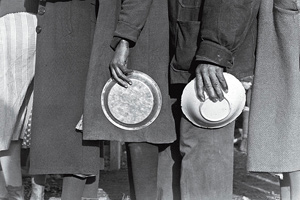
 © Walker Evans / Library of Congress
Любые другие комментарии и дополнения.
Роман Мокров: «Привет всем».
Алина Гуткина: «Рассчитывать на какую-то материальную составляющую не приходилось и не приходится. Иногда везет и можно прожить на деньги от продажи долго, если экономно. Есть резиденции как вариант поддержки. Деньги — не мотиватор. Да и мы, наверное, не за этим здесь».
От себя добавлю, что в ответах незатронутыми оказались некоторые области, добавляющие возможностей к существованию художникам, которые работают с видео. Помимо упомянутых Алиной резиденций (мой бразильский товарищ, художник-перформансист Луиза Норберга, принципиально существует в номадическом режиме, перемещаясь из резиденции в резиденцию) появляются различные гранты и фонды, поддерживающие молодых художников, — тот же грант для молодых художников от «Гаража». Понятно, что суммы и количество поддерживаемых художников несравнимы с Европой (вот у бедных голландцев недавно сократили число государственных грантов для начала карьеры всего до 86), но все же это возможность. Еще большим игольным ушком являются премии и конкурсы в области современного искусства, основные из которых — Премия Кандинского, «Инновация», Премия Курехина — довольно благосклонны к видеоработам. А незабвенный Канский видеофестиваль предоставляет возможность дерзким и смелым увидеть Сибирь и умереть.
Далее должны были быть абзацы про коллекционеров, Ольгу Свиблову, ответственность художников перед медиумом, немного оптимизма и что-то еще, но все это не вошло в рамки оплаченного объема. Засим благодарю откликнувшихся художников за ответы на столь сокровенные вопросы и целую ваши глаза.