
Translated material
From Avtozak to court
“... she <...> reckoned, the legitimate request of the police, waving his arms and legs, and was expressed by an obscene abuse of police officers,” the court decision said in the case of one of hundreds of detainees in recent weeks. Here is how Anna Margolis, who was detained on February 24, describes the process of this decision by the “disobedience” by the Zamoskvoretsky court: “Judge Cheprasova, who crumbles a blonde in a mantle, on the table - a calendar with kittens, tired (the working day has long ended), rammed at wild speed. Of course, to blame. "
Now Moscow courts are littered with similar cases. The detainees on shares are found guilty of offenses, which they did not make, write fines. Along the way, numerous violations are identified. So, the case of Anna Margolis was considered simultaneously with the case of Maria Kokovkina detained with her. Both were charged with offenses for two articles - 20.2 (violation of the established procedure for organizing or holding a meeting, rally, demonstration, procession or picket) and 19.3 (disobedience to the law to the demand of the police officer). At the same time, the Code of Administrative Offenses (Code of Administrative Offenses) does not imply the opportunity not only to combine the consideration of cases in relation to different people, but even to combine two administrative cases of one person, which in the practice of our judges is not uncommon: as the judge of the Zamoskvoretsky court Lyudmila Moskalenko said in response to the question of the lawyer Maxim Krupsky, which of the two cases of his client will obey the first, “you have one into another one into another one to another”. Often in such cases it turns out that a person was charged with two offenses for about the same thing, although the Code of Administrative Offenses prohibits the adoption of two decrees on the same facts.
True, as the lawyer of the Public Verdict Foundation Elena Pershakova indicates, since the proceedings on administrative cases are carried out, as a rule, without a protocol, during an appeal in the Moscow City Court it will be impossible to prove that different cases were considered at the same time. However, the decision of the Plenum of the Supreme Court No. 5 states that the law does not exclude the possibility of maintaining the protocol, so Pershakova recommends submitting an appropriate application. This will avoid situations when the judge verbally satisfies the request to call the witness, and then it turns out that there is a definition in the case, according to which the witness was refused.
In addition, the European Court of Human Rights not so long ago actually equated the consideration of the case of an administrative offense with the consideration of a criminal case, which means that it is necessary to comply with the principle of adversariality of the parties, therefore, the maintenance of the protocol is necessary.
Judges are extremely reluctant to call witnesses and attach photography and video to the case. Elena Pershakova believes that it is possible to convince the judge of calling the witnesses, referring to the decision of the Supreme Court , where the decision on an administrative offense was canceled and where it is clearly stated that the refusal to declare witnesses and the introduction of videos is a violation of a number of articles. Sometimes, according to a lawyer, judges may limit themselves to a challenge as witnesses of relatives of a person held accountable - “it is clear that this is done in order to then recognize their testimonies that are not worthy of trust.
There are cases when people were not able to achieve the introduction of their own written explanations. Pershakova recommends submitting a special application for the introduction of a written explanation.
According to the lawyer, there were problems with the attaching of an application for the Commissioner for Human Rights, even if there is a copy certified in the apparatus of the Commissioner. Pershakova herself managed to introduce the application together with the reports of the Commissioner for each of the two days, when the detentions took place from the Zamoskvoretsky court, on February 21 and 24, only if there is notarial assurances.
However, the refusal to call witnesses and the introduction of documents - the phenomena are already well known to those who observe the work of courts on administrative detentions in recent years. But there are new techniques, for example, the adoption of the same type, stamped decisions in which the details associated with the specific “offender” may not be taken into account. “The judge has a template for the decision, which said:“ Such and such explained that he did not take part in the rally, he didn’t shout slogans, ”Tatyana Glushkova, lawyer explains the lawyer of the lawyer for constitutional rights and freedom. - And then a person who does not deny anything comes to court. He says: “Yes, I took part in the rally, I wanted to express a protest, I shouted“ Freedom! ”“ “But when we get a decision, it still says that the person involved allegedly denied his participation in the rally. Sometimes it happens that the judge admits the defender in the process, and in the decision of him, as if there was no one in the process of the judge, and such a decision made such a decision, in the particular, in the particular, in the particular, in the present, in the present, in the particular, in the particular, in the particular Judge Irina Zubova from the Presnensky court following the consideration of the cases of detainees on March 2 at the Ministry of Defense. ”
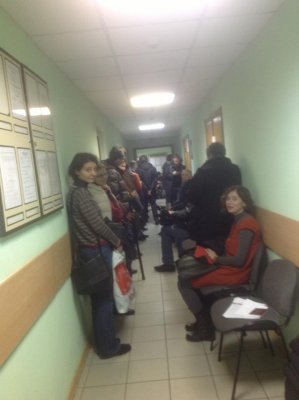
A very common problem for citizens who come to the courts, detained on shares, began to get to the meeting in his case. Tatyana Glushkova tells how on March 7, on the eve of the holiday, they came to the Tver court with the client, where at 15:10, Judge Tatyana Neverova was supposed to consider their case, and heard from the bailiffs that the court was closed at 14:00 (at the same time, the bailiffs were not presented, referring to the oral disposal of the chairman of the court). When it was still possible to penetrate the building, it turned out that the court was working, but meetings on administrative cases had not yet begun, including those appointed at 10:00. “After 14:00, they stopped letting them all out of the court,” says Glushkova. - More precisely, to release, of course, they released, but they said that if they come out, they would not go back anymore. The court continued to work, Judge Neverova considered some kind of criminal case, and people continued to sit (and some people-and lie) in the corridor. Then the meeting in the criminal case ended, a long pause followed, and as a result, the meeting on administrative cases began at 19:00. There was no question of any public access at the hearing: the bailiff launched only the person in respect of whom the case was obeyed, and his defender (if any), the rest of the people were not allowed. ” The lawyer believes that all these obstacles were created specifically so that as many people as possible did not fall into their own processes. This happened to someone: people, without waiting, left, and the court found them guilty of an offense in their absence. Glushkova notes that these people will not be able to prove that they sat in court for nine o'clock and left without waiting for the meeting: "The entry of entry to the court is recorded at the bailiffs, but the exit time is nowhere."
There are frequent cases when a person does not reach the court, and the meeting occurs without him - he is simply not notified of when the meeting will take place. The detained on February 24 at the Zamoskvoretsky court, Mikhail Uspensky says that the summons did not wait: “The court took place without me on March 3. I learned this from the call to the court. Since the decision by mail has not yet arrived, I suspect that they used the wrong address from the protocols [compiled in the ATS, despite the fact that Assumption indicated the correct address in the explanation to the protocol]. Interestingly, the court website has data on the movement of both cases. If the referee and preparation for consideration is marked by different time, then the judge made the consideration on the merits of both cases at 10:00 And together with several more cases of other detainees. ”
“Most of the judges do not make unnecessary body movements to notify people, does not send any summons: he himself did not want to come and find out the date of the meeting - your problems. And it is almost impossible to get to the courts, ”Tatyana Glushkova warns and recommends, before going to the meeting, to get acquainted with the case materials - at the same time it will be possible to find out the date of the meeting:“ In this case, either a person is immediately called the date when his case is considered, or they ask him to leave the phone number, after which they call back and reported. ” Ideally, a person who wants to get acquainted with the case file should come to the office or to a particular judge - usually things have already been painted according to the judges - to get materials, familiarize themselves, photograph, make extracts and leave. Sometimes everything happens. Sometimes this is accompanied by a long expectation in the corridor - the one who came is explained that the judge is busy and still cannot be familiarized with the documents. Sometimes they say that it will be possible to get acquainted with the materials only after the appointment of the date of the meeting - which, of course, is not true. ”
Among the innovations of the last weeks are the willingness of some judges to consider cases on the obligations of the turnout that people write to the police department. Tatyana Glushkova notes that even if the obligation indicates the specific date and time of the turnout, it fit the police officers absolutely arbitrarily, without coordination with the courts. And if earlier the dates indicated in the obligations about the turnout did not play any role, now several judges have already considered cases on the dates indicated in these documents, believing that the person brought to administrative responsibility was duly notified. Such situations, according to Glushkova, give rise to new problems: “In the police department, all the detainees, no matter how many of them are, write out obligations about the appearance at the same time, and when they come, they are told that their affairs will be considered during the day, after which people can sit all day in the court of the court, not having the opportunity to even independently form a queue, because the judge causes them at his discretion.”
Ultimately, the lack of information about meetings, and the refusal to let the public for the meeting are examples of neglect of the most important principle - the principle of publicity and the openness of legal proceedings. This also includes the refusal to announce the resolving part of the decision: for example, the judge of the Zamoskvoretsky court, Natalya ChepraSova, mentioned above, may not return to the hall after the decision, but transfer a copy of the decision to the lawyer through the assistant. “Generally speaking, this is a violation of Article 6 of the European Convention, guaranteeing the right to a fair trial,” says Glushkova. - One of the elements of a fair trial is the right to a public hearing, an integral part of which, in turn, is the obligation of the court to make its verdict public public. In a situation where the decision is not proclaimed at the hearing, but neither Tverskaya, nor Zamoskvoretsky, nor Presnensky courts post their decisions on the sites (although they should), the public is actually deprived of the opportunity to find out what decision was made. ”
However, sometimes the meeting is unexpectedly made open to the correspondents of individual television channels, with a violation of the procedure. Despite the fact that, as a rule, a video shooting of meetings is prohibited in the courts, NTV correspondents came to the meeting in the case of Sergei Parkhomenko. According to Pershakova, “we did not say that they cannot be present, but tried to ensure that the judge and the court observe some decency and the procedure. NTV representatives should have asked for permission to shoot with us, the court should have interviewed everyone, after which the judge would make a decision at his discretion. If everything was done like this, we would have no complaints about the court, since the process is open. But here they came and immediately began to shoot, and to the question on what basis, they answered that they were allowed by the press secretary of the court. They did not have a document. The spokesman said: “If you think that you are being removed incorrectly, close your piece of paper.”
Recall that the detentions themselves at the Zamoskvoretsky court on February 21 and 24 were largely caused by the fact that people who wanted to hear the verdict in the “swamp case” were not allowed into the building, which in itself is a violation of the principle of publicity. However, according to Pershakova, “judges do not want to hear the considerations that during the announcement of the sentence in the“ swamp case ”in the Zamoskvoretsky court, publicity was not provided. Moreover - in one meeting, the judge in response to this consideration said: “Do you imagine that a thousand people could fit in this office?” Thus, the wine is immediately shifted to the people who came. It does not occur to judges that there are normal ways to ensure publicity - for example, video broadcast. ”