
Translated material
Two texts about Eduard Steinberg
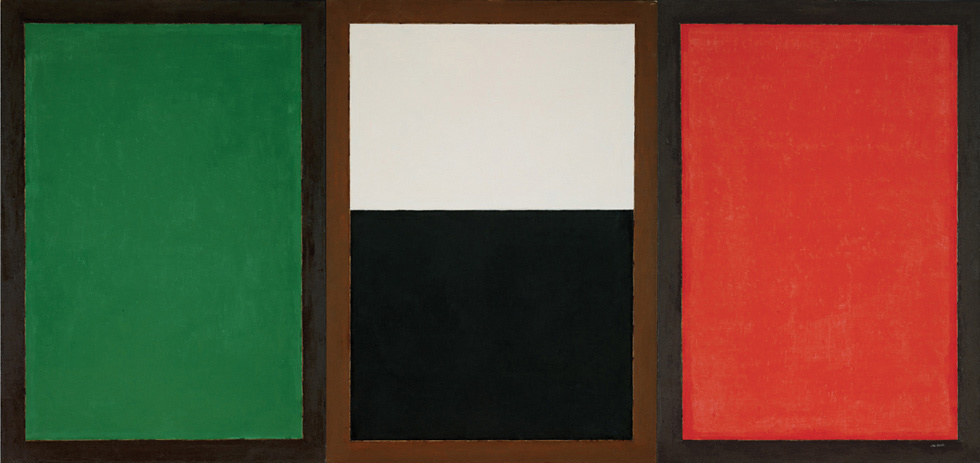
Memory of Edward Steinberg
Eduard Steinberg (Edik, as his friends called) passed away on March 28, 2012, he was 75 years old. For the past twenty years, he lived between Paris and Tarusa, the city of his childhood, where he came mainly in spring and summer.
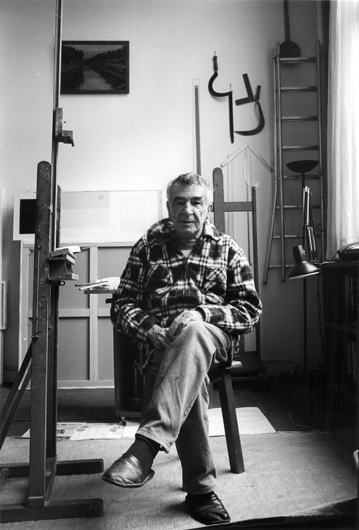 © Barbara Klemm Eduard Steinberg
Edik is one of the most significant non-conformist artists. He is often called a follower of Malevich, but his work, in which religious, spiritual motives are especially strong, actually goes far beyond the scope of Suprematism. Today, two years after the death of Edik, it is already clear: the usual epithet “Russian”, the definition of “artist of the 21st century” is too narrow for Steinberg. This is a world -famous artist. And, as it should be artists of this level, his work is outside of time.
In his primitivist, who borrowed a lot from the Suprematism of geometric paintings, the entire immenseness of Russia is revealed. He, like a surveyor, spreads the milestones, humbly outlines the contours of what is essentially unlimited. His work is aesthetically pleasing, because it is metaphysical. It is deep. Because it expresses beauty through symbols. In it, the share and mountain worlds come closer.
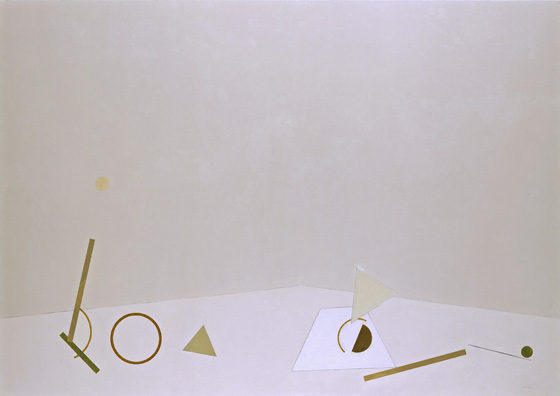 2009. "Composition". XM 114 x 162
In 1992, the Tretyakov Gallery organized a large -scale exhibition of Eduard Steinberg - it became the first dedicated to the artist. Since then, his works have been exhibited in many Russian and European museums.
In 2015, for the first time after the death of the master, a series of his personal exhibitions will be held in the Russian museums, as well as in the Wiesbaden Museum in Germany.
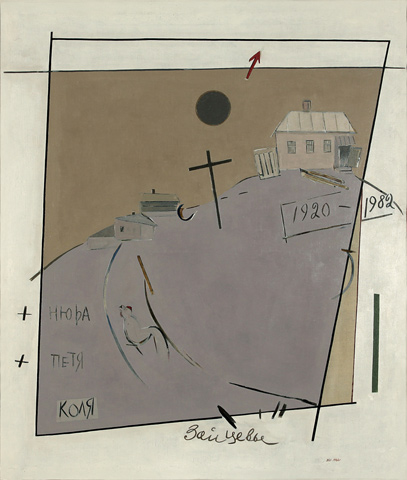 © Visbaden Museums 1986. "Zaitsevs". XM 140 x 120 CM.
The first time I ended up in the Edica studio in 2006. Then I was preparing a monograph about one French artist, famous for my period, “white on white”. I knew well and loved the lyrical abstraction of the 1950s, but, having met the works of Steinberg, I forever fell in love with geometric abstraction. I was struck by his work. Yes, and Edik himself. I liked his eccentric appearance, his voice, I liked him with Galya, his wife, I liked how and what they live. They got married in the 1960s and never parted. Quite quickly we became friends. Largely thanks to Gale Manevich. Once they invited me to visit Tarus. There I began to shoot Edik on the video. I did not speak Russian. Edik barely knew a few words in French. We understood each other, but still not enough to make full-fledged interviews. From mutual sympathy and some correspondence readiness to open to each other and the format of these videos was born: we exchanged a couple of phrases, I tuned in to him and followed where he, the artist, led me. It turned out a series of video monologues in which Edik tells about himself, his life, his work. We often shot right in the studio. And I became a witness to the process of creation, the sacrament of creativity, observed the technique of his work, his skill. All this is in these videos. In these artless shots - all Edik, his open heart and eccentric manner of moving, his views on life, how and in what rhythm he lived, how he perceived this world.
Here are a few excerpts of this video monologist.
This is the richest and fascinating autobiographical material. Fragments of these videos will be included in the program of future exhibitions of Edik Steinberg. They will also be included in the documentary and monograph (authors - Galina Manevich, Bastianelli Gilles), preparing for the publication in 2015. The introduction and main text of the monograph was written by Jean-Claude Markade, a well-known French art critic, a Russian avant-garde specialist and a researcher of creativity Eduard Steinberg. And Galina Manevich prepares the artist’s biography in Russian at the UFO publishing house, which will include the work of art historians, essays and the correspondence of Edik, his interviews, recordings of his conversations and memories of friends.
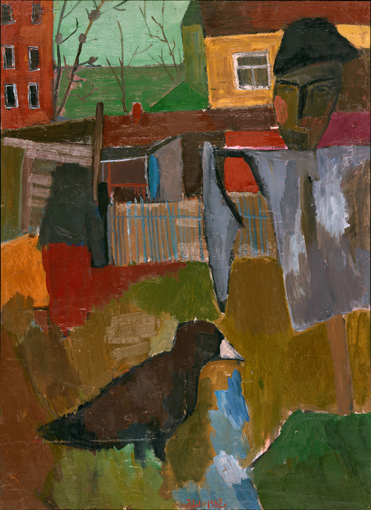 © Tretyakov Gallery 1962. "Tarusa". XM 95x70 CM
On the second anniversary of the death of Edik Steinberg, it seems important to me to note one remarkable fact: his language, which we, his admirers, seem to us beautiful, but quite abstract, suddenly became very specific for our children - adolescents of the 21st century, who did not think of life without the Internet. They do not take into mind what symbolism, primitivism, suprematism and others are. They have a fresh, uncomplicated look, and they see Edik Steinberg's work in a completely unexpected way: they see the elements of their avatars in them. All these triangles, squares, crosses and circles for them already mean something, as if they are inscribed in the context of their life and filled with this life. Welcome to the virtual world of our children. Soon they will lead me to the museum to look at Steinberg, study it and find the key to (his) to the spiritual world, in order to ultimately understand ourselves and become older.
Bastianelli Gilles
Paris, March 2014
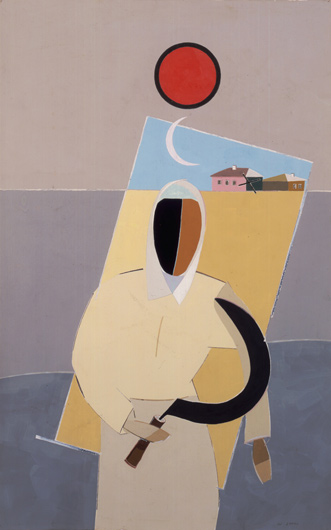 2000. Gouache. 104 x 66 cm
Eduard Steinberg - geometric splendor in Paris
"All the breath and praise the Lord"
(Psalm 150, 6)
In the late 1980s, when art first gradually, and then triumphantly made a cyclic return to attractions, socio-political denunciation, physiology, the appearance of the artist, who was exclusively painting on the European, primarily Parisian, scene, which painted only paintings, could be considered an anachronism from the point of view of dominant artistic thinking. The artist, who proclaimed himself a follower of Malevich in Paris, was exhibited in the gallery of Claude Bernard, who did not specialize exclusively in the protection and representation of abstraction, this radical revolution of the twentieth century, which broke the figure of tangible world with the centuries -old tradition. This artist, who also chose a metaphysical direction, could only be perceived as a kind of relic of the past. Moreover, in a secularized West, who was not massively accepting any transcendence, the Russian artist Edward, Edik Steinberg did not seek to like all players of the art scene on which he ended up in the last twenty years of his life. Edik Steinberg until the end remained faithful to himself, his Orthodox Christian faith - at the presentation of the film dedicated to him, he dropped as a final chord to be given to the praises: "It is not important art, but faith."
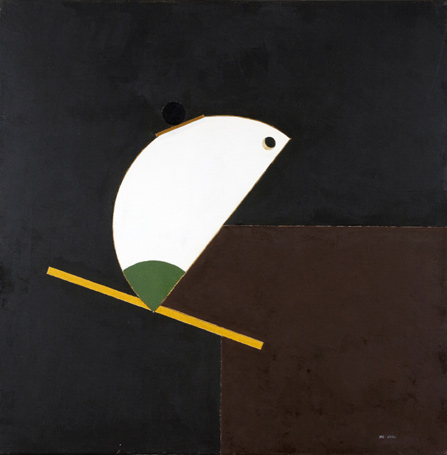 © State Hermitage 2009. "Composition". XM 71 x 71 cm
One of his friends, writer, director, critic and Orthodox Russian philosopher Evgeny Schiffer, absolutely unknown in the West and still underestimated even in Russia, back in 1970, he determined the deeply religious nature of Steinberg’s art - this is not “icon painting”, but a painting close to “catacomb paintings of the Frequency Christian communities”. Schiffer no accident compared the art of Steinberg with a catacomb, which, as you know, used biblical symbols (lamb, ark, grape vine, fish, etc.). An outstanding iconist, historian, theologian and icon painter Leonid Uspensky wrote:
“Nowhere in the catacombs we find traces of the images of documentary, domestic or psychological content <...> this art, however, was not divorced from life. It not only speaks in the language of its era, but also closely connected with this era. ”
The same can be said about the work of Steinberg.
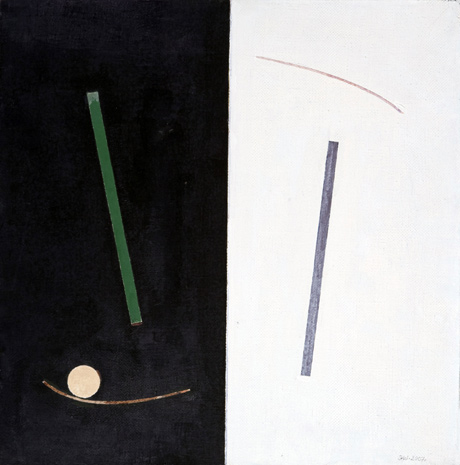 © Pushkin 2006. "Composition". XM 41 x 41
In his article, Schiffers inspiredly writes about the abstract canvases of the Russian artist as an “ideographic landscape, gloating of invisible ideas”.
Jean-Claude Markade
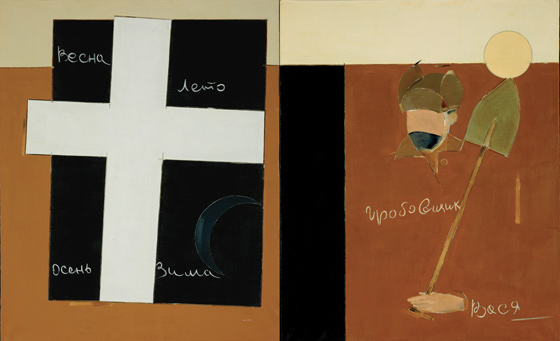 © Tretyakov Gallery 1990. Diptich “Spring Summer Autumn Winter” and “Combator Vasya”. Gouache