
Translated material
Team: "To the exit"
How the Ukrainian military left
Kyiv agrees with Moscow the details of the withdrawal of the Ukrainian armed forces from the Crimea - with equipment and flags. Most of the parts voluntarily lay down the weapon without waiting for the order. But there were those who remained faithful to the oath to the end.
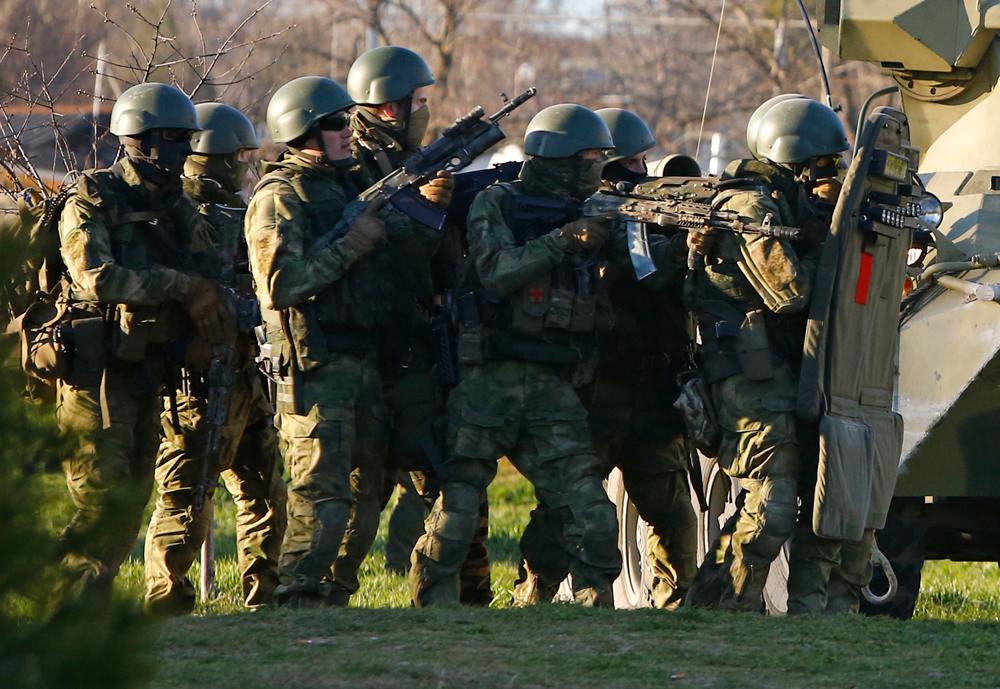
The assault on the air base at the Belbek airport Sevastopol. March 22, 2014
A separate Marine Corps battalion in Feodosia, a tactical aircraft brigade at the Sevastopol airport Belbek and the large landing ship Konstantin Olshansky in the Gulf of Donuslav near Yevpatoria were held the longest. However, on March 22–25 they were also captured.
Throughout March, whatever Crimean military unit you will go, the disposition is the same everywhere: the gates of bases are blocked either by armed people without identifying signs or Russian sailors of the Black Sea Fleet, they are behind them in sports pants and with St. George ribbons (local self -defense), and then the masses with Russian flags, and then. bicycles, children, beer and tents with food, which tirelessly chant “Russia!”. “From a military point of view, it does not represent any problems for us to remove the blockade. There is simply no order, ”said the New Times in one of the parts, an officer of the Ukrainian Marine Corps Michael, squinting from the wind blowing from the Kerch Strait. “There are two platoons of everything against our battalion.”
And he continues: “Even if they have two automatic machines, even if it is the most coolant, this is a question of fifteen minutes. Only this is not a special forces, these are Russian marines. Last year we went to the parade in Sevastopol last year. Now they were allocated to them, a room in a guardhouse, so that it was to bask where. So, right? "
The guy who listened to the conversation in camouflage without shoulder straps and chevrons turned embossed in embarrassment and moved a few steps from the gate of the unit.
Sticks against Bether
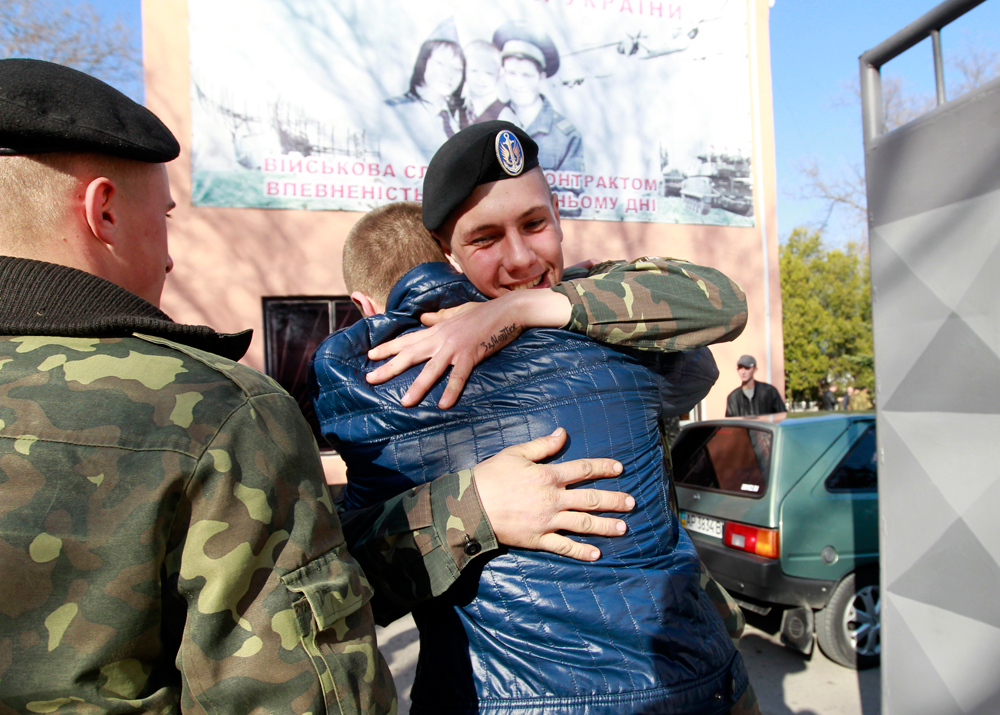 |
| Marines from part in Feodosia say goodbye before leaving for the "mainland". March 24, 2014 |
A few days later, the interlocutor of The New Times was Major Rostislav Lomtev, the political officer of the Theodosia Marines. The major was much tougher. Of course, he was restrained as best he could, but from his short remarks one could understand that he condemns the spinelessness and indecision of the Kyiv politicians: “If the power had not spit on us and there would be a concrete order, we would have been rebuffed, there would be enough cartridges for everyone. But this had to be done when the Russian troops were at the Kerch crossing. And now it’s too late: we will not fight within the city. At least because half of our soldiers have a family here. ”
On the one hand, the absence of an order to the Ukrainian military to resist gave a reason to Vladimir Putin in his speech on March 18 with a hidden mockery to thank them for a peaceful disposition. But on the other hand, they understood in Ukraine: when almost a 20-thousandth contingent of Russian troops gather on the eastern border of the country, any “green man” who died from the “Ukrainian bullets” would immediately turn into a Russian soldier, becoming Casus Belli for Russia.
The real hero of the peaceful resistance of the Ukrainian military in the Crimea was the commander of the air regiment in Belbek, Colonel Julius Mamchur - he built subordinates under the regimental banner and flag of Ukraine on March 2 and without any weapons repulsed part of his air base from the enemy.
The mamchur did not receive an order to surrender a part after the referendum on March 16, so that it was stormed on the 22nd, and the colonel himself was detained and spent 4 days in an unknown place. After the mamchura was released, he did not name the place of his imprisonment. He only said that psychological pressure measures were applied to him: they didn’t let him sleep, knocked on the doors on the door ... However, according to his wife Larisa, who managed to contact The New Times, reacted to the colonel “in Opera”, they did not use and did not insult, kept it in solitary confinement, and in the evening of March 26 took to Ukraine.
"
“If the authorities did not spit on us and there would be a specific order, we would have been rebuffed, there would be enough cartridges for everyone. But this had to be done when the Russian troops were at the Kerch crossing. And now it's too late "
"
According to Larisa, the assault on the unit entrusted to her husband on March 22 began with the performance: unfamiliar women and children were brought to the base on buses, who went out and began to scream, calling the Ukrainian military to surrender. The unit commander gathered the personnel and said: it is strictly forbidden to shoot if anyone feels that he may not restrain himself, it is better to pass the weapon: “If we even take a warning shot into the air, someone will shoot these women in the back, and they will accuse us,” Mamchur explained. Most soldiers, having handed over the machine guns, armed themselves with sticks.
“Then the women suddenly landed on buses and took away,” says Larisa. - Then the Cossacks arrived, to whom we made it clear that we would not pass the part and we will fight with sticks. Our local self -defense appeared behind the Cossacks, which could not do anything with us either. All this time I was near my husband, the entire personnel was in place. ”
And only late in the evening the Russian special forces came to the unit - already with epaulets. “They tumbled the concrete wall from the side where there were no cameras,” Larisa Mamchur continues his story. - Our fighters immediately surrounded the commander so that nothing happened to him, closed themselves. They began to shoot in the air, blow something, one guy crushed a concrete wall, called an ambulance, now everything is in order with him. In general, the Russians were quite aggressive, surrounded journalists, they took away all the memory cards from them. The husband was allegedly taken away for negotiations, he called me an hour later and said that he was arrested. ”
The worst thing, according to Larisa, began after the assault. There are no news about her husband, but from the side of neighbors and local residents there were threats to both the military and their families themselves. Many had to hide on friends, Larisa herself also hid for a long time with friends. She never saw her husband after his release, she says that now she helps him to withdraw a regiment from Crimea: only a third of the personnel are leaving for Ukraine: “Everyone is crying, saying goodbye. There are Crimeans who leave, one officer comes from the mainland, but he has a disabled parents here, whom he cannot take out. So many lives are broken, and, most importantly, there is no clarity with the future ... "
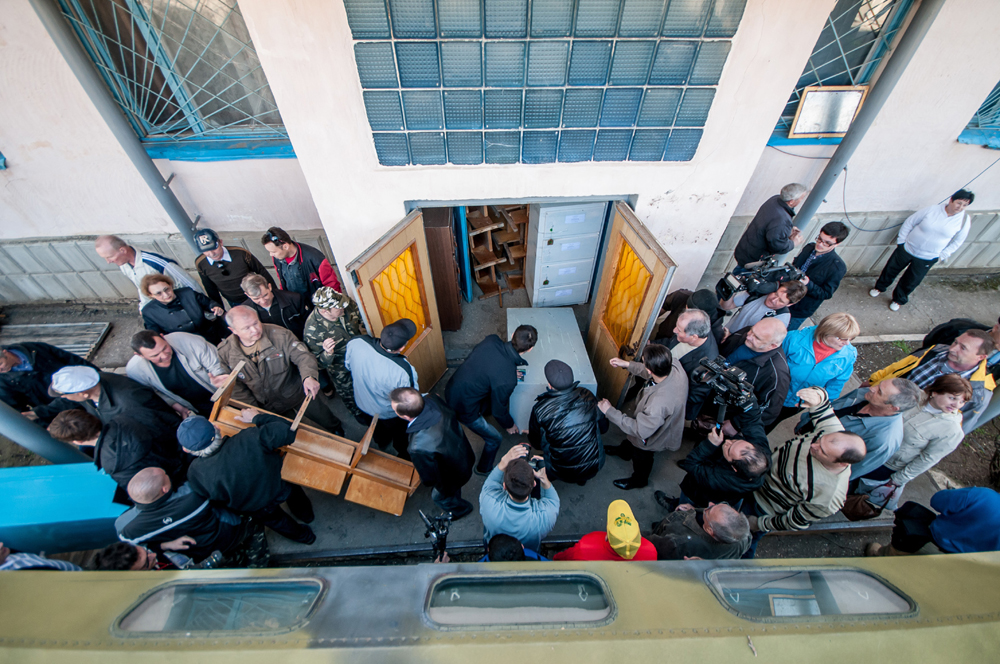
The officers of the military unit in Novofedorovka barricaded at the headquarters and threw furniture from the windows into the attackers. March 22, 2014
No galley to the enemy
Not everywhere, however, the assaults were so dramatic. The easiest way was to cope with the Autobat in Bakhchisaray: on March 10, the commander of the unit Vladimir Sadovnik, as they say, drove to Snyana on a motorcycle into the Zhiguli someone from local self-defense, at the same time demolishing a nearby campaign tent of the Russian Unity. He was immediately captured, and in the middle of the next day he returned to his native part, accompanied by Russian soldiers and ordered to open the gate.
However, the “live shield” turned out to be the most effective storming method, exactly the corresponding words of Putin: “And let one of the Ukrainian military try to shoot their people, the Russian military will stand behind people, not in front, but from behind.”
Usually a tractor or an armored personnel carrier hung a part of a part or a fence - and left. A crowd of civilians rushed in the break, in which older people and women often were. Right behind them, partially mixing with the civilians, representatives of the “self-defense of Crimea” with weapons were going on. And already followed either the same armed people without shoulder straps, or already Russian soldiers. Talking the latter was not easy: everyone was given an order to stay away from journalists. But one of them descended to the answer and, without blinking an eye, explained: “We simply maintain order here. You yourself see what is happening: the people expel the foreign army on their own. It is impossible, you must admit that weapons, equipment and documents remain unattended. ”
“If we even take a warning shot into the air, someone will shoot these women in the back, and they will accuse us of everything”
"
It was such a scenario-the military behind the women-the commander of the landing and scullet of the Theodosia battalion of Morpekhov Vasily Mikulyak was waiting for the military-but the Russians involved special forces. The assault began at half past five in the morning. Without victims, there were only because the Ukrainians decided not to use weapons, and you can’t get much with the cuttings from shovels against machine guns and grenades. A Russian landing landed on the territory of the Mi-24 helicopters, a gate broke through several betaers. Knowing that the Ukrainians closed the weapons in the warehouse, the storming used only light -school grenades and fired into the air. The whole operation lasted about an hour. The fallen battalion commander Dmitry Deleatitsky was beaten with his feet, broken several ribs, Major Rostislav Lomtev was also beaten ...
By six in the morning, about one hundred prisoners of Ukrainian marines (including numerous victims - they were not even allowed to be sent to the hospital) were taken out on trucks. The remaining 300 surrendered - in order to later accept the Russian oath or resign from the army, but to stay in the small homeland.
They resisted in the aviation part in Novofedorovka (it was here in 1944 that the aircraft of Roosevelt and Churchill settled at the Yalta Conference). The base was taken for more than an hour: the officers barricaded in the headquarters building and threw chairs and office equipment into the attackers. The crew of the large landing ship Konstantin Olshansky, who saved Georgian refugees from Abkhazia 20 years ago, was not able to go out to the sea because of the blockade, fought off from the special forces of the special forces with reinforcement. According to the information received from the sailors, before the assault, they disabled everything that they could, including the stove on the galley. ... The Ukrainian military who refused to accept the Russian oath leave the Crimea without honor and with complete unknown regarding their future. Many in civilian clothes are modestly traveling on rented buses. On the Perekop Isthmus, in the village of Chonggar, where Russia quickly arranged its border points, they after a short test fall, as they say in the Crimea, “to the mainland”. Here they are finally met by their own: local residents, civil activists, journalists-some with food, some with questions. And also - representatives of the Ministry of Defense of Ukraine ... with answers?
Photo: Shamil Zhumatov/Reuters, Ukrainian photo/Photoxpress