
Translated material
Sanctions caretaker
The State Duma was covered by a new wave of prohibitive initiatives
Which of them beat for real purposes, and where the deputies are still “shooting idle” - the New Times sorted out
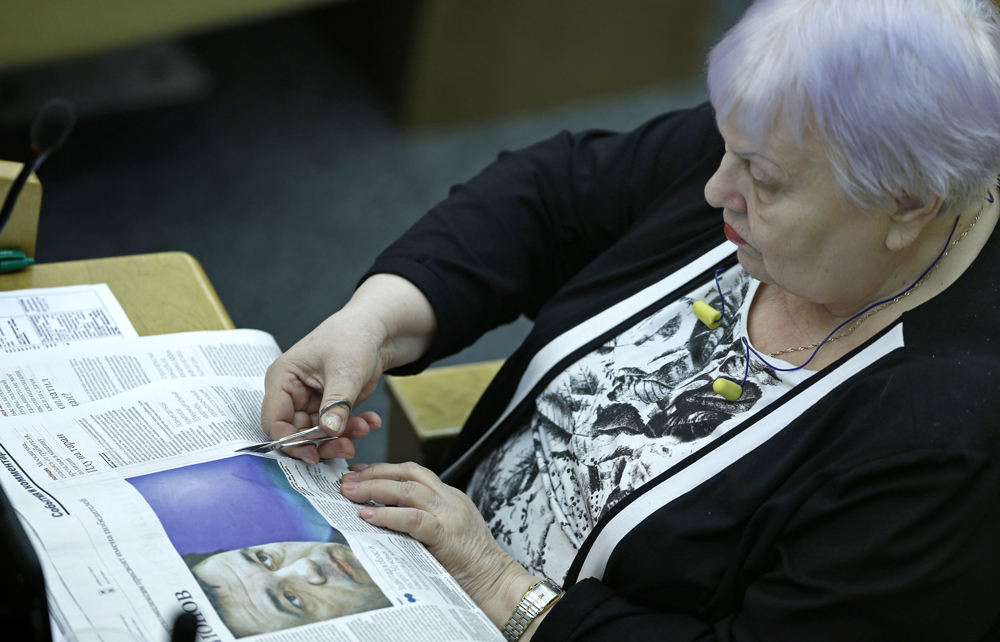
In response to the sanctions of the West, the Duma is ready to cut the rights of Russians. A deputy from United Russia Tamara Kuzminykh at a plenary meeting of the State Duma. Moscow, February 26, 2014
The New Times Forecast that this spring the State Duma will be very similar to the “furious printer” of the 2012 model (see The New Times No. 8 of March 17, 2014), comes true. There were still enough offers to tighten or prohibit something in the Okhotny series before the “Crimean campaign”. But after the referendum on March 16 and the West introducing the first sanctions against Russia, these initiatives poured a stormy stream. To expel international payment systems from the country, to ban deposits in dollars and euros in Russian banks, to attract bloggers under the article “Extremism” for “nonpatriotic” statements - these are only some of the “response measures” proposed by deputies over the past two weeks.
Meanwhile, at a meeting with members of the Security Council on March 21, President Putin, commenting on the issue of sanctions, expressed himself quite peacefully: “I think we should still refrain from returning steps.” Maybe the Kremlin and the "Okhotnoye Row simply play a good and evil investigator? And Putin is preparing for auction with “Western partners”: they say, if you do not slow down with their sanctions, then my deputies are already ready for both symmetrical and asymmetric answers ...
So the observers are wondering: what from the March forbidden stream is seriously and for a long time, but so far - so far only horror stories?
Circular defense
Of course, of course, there will be a State Duma on the sanctions of the EU and the USA. But - pointwise, as, for example, in the case of international payment systems Visa and MasterCard. They will not expel them from Russia, but they will try to force them to work according to the new rules. For this, they, as United Russia suggested by Vladislav Reznik, must create their own processing centers in Russia, which can no longer just stop servicing Russian cards as it happened on March 21 with maps of several banks related to the defendants in the sanction list.
“This is a completely realized thing,” the prospects of the creation of Russian processing centers VISA and MasterCard, co -author of the project Anatoly Aksakov (“Fair Russia”) appreciated. Why then right now? “It just never occurred to anyone that there could be some political decisions (read: sanctions.-The NEW Times), obliging private organizations, act, in my opinion, is unlawful.”
However, Maxim Osadchiy, the head of the analytical department of the Bank of Corporate Financing (BKF), does not share the optimism of the deputy. “Visa and MasterCard will have to invest in the creation of operating centers in Russia tens and hundreds of millions of dollars,” said Osadchiy. - Visa has four such centers for the whole world, and MasterCard has only one. Will they go to such investments? It is unlikely. "
But the deputy Aksakov offers a special way: “They (Visa and Mastercard) can use the Russian processing center and pay a commission. That is, they will not have to spend money on creating their own centers from scratch. ”
Osadchiy is not so optimistic: “If the Ukrainian situation begins to warm up again, up to an armed conflict, more extensive sanctions can be imposed against Russia, and then Visa and Mastercard departure from the country,” he believes.
"
Putin is preparing for auction with “Western partners”: they say, if you do not slow down with your sanctions, then my deputies are ready for answers
"
By the way, in the case of “warm -up”, the chances of accepting another sensational initiative will increase - on compensation from the federal budget of losses incurred by companies and individual citizens of the Russian Federation. Unicorn Mikhail Starshinov developed a bill in which it is proposed in response to decisions of foreign courts on the seizure of property of Russian citizens or organizations to first reimburse them losses from the federal budget, and only then demand compensation from a foreign state. If foreigners refuse to pay, you can withdraw some property located in the Russian Federation from them, Starshinov does not doubt.
It is worth, however, to recall: this decisive bill was submitted to the Duma a year ago - as it was believed, in response to sanctions within the framework of the “Law of Magnitsky” (deputy foreman himself stubbornly denied this connection). And then the document hovered - there was neither the initial discussion in the relevant committee, nor the recall of the government necessary for bills involving expenses from the federal budget.
As the New Times explained in the apparatus of the State Duma, the government is obliged to send reviews to bills within a month. If the review is not received even in a year, then this, as a rule, means that they decided to bury the initiative.
Nevertheless, Staroshinov’s project has not yet been recalled officially. Therefore, they can give him a move at any moment - unless, of course, there will be a will from above.
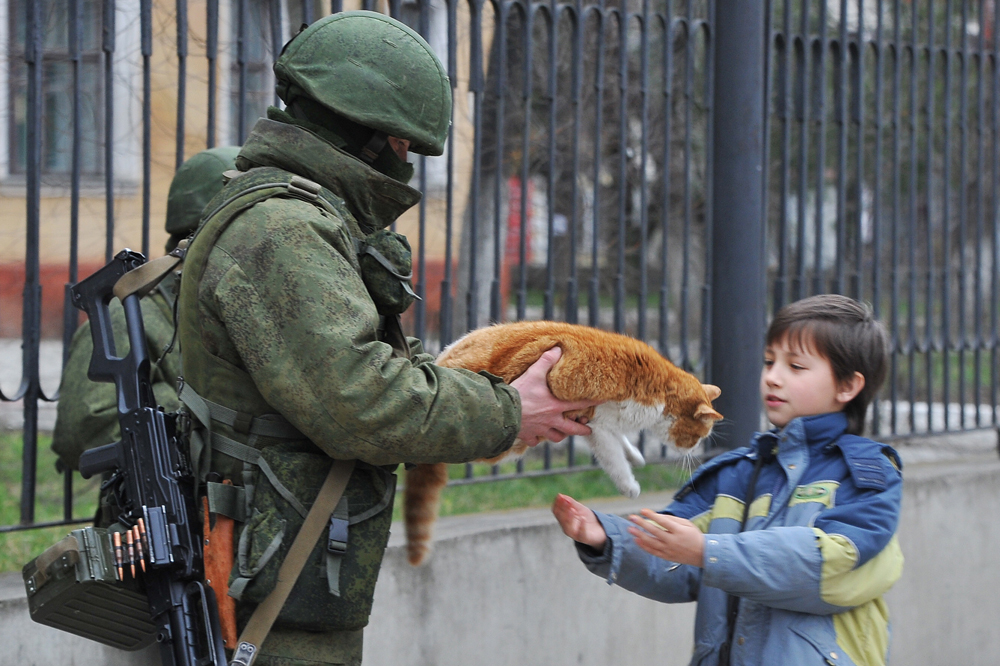
The image of a Russian warrior in the media, according to deputies, should be extremely positive. In the photo there are “polite people” on the streets of Simferopol. Crimea, March 21, 2014
Inner enemy
Another actual direction is the fight against the “fifth column” and “national traitors”. There are at least two noticeable documents, in the imminent approval of which there is no doubt.
Firstly, this is the project of the vice-speaker of Sergey Zheleznyak (United Russia) on the ban on the symbols of "organizations that collaborated with fascist organizations." As an example of such symbols, Zheleznyak cited the “Bandera flags”, which he noticed at the “march of the world” in Moscow on March 15.
True, in this case, the Andreevsky flag (the banner of the Russian Navy), and even the Russian tricolor itself, which were used as official symbols in the Russian liberation army of General Vlasov, should be proceeded. But Zheleznyak assured the journalists that nothing threatens these flags, since the Vlasovites, unlike Bandera, only borrowed symbolism that existed before them.
The second document is the amendments to the law on the guarantees of electoral rights introduced by the United Russia group and adopted in the first reading on March 19. Formally, they only introduce a system similar to the State Duma elections at the regional level: without collecting signatures for local elections, party candidates who have received more than 3% in the elections to the State Duma will be allowed. In fact, this means that, for example, in the elections to the Moscow City Duma in September 2014, only “Yabloko” will be able to put their candidates without collecting signatures from non -parliamentary opposition. And the nominees of the Party of Progress Aleksey Navalny and the RPR-Parnas, on the basis of which it was planned to create a wide opposition coalition, will have to collect signatures in the amount of 3% of the number of voters of the district. Which, of course, will lead to a wolf in the election commission of most of the disloyal authorities of candidates even at the stage of checking signature sheets.
Creativity of the masses
The remaining March prohibition initiatives are still listed in the category of “exotic”, although they can easily go into the category of “real” if necessary.
So, deputy Oleg Nilov (“Fair Russia”) proposed to introduce the State Monopoly into the production of alcohol and tobacco. More than a dozen has been introduced to the Duma in the Duma since 1993. But the new attempt is noteworthy in that the author directly substantiated it with the foreign policy situation that developed after the annexation of Crimea, and the need to replenish the budget in Western sanctions.
Deputy Yevgeny Fedorov came up with another project about “foreign agents” - only now in business. True, this time he decided to go from the other side: not to hang the stigma on the “agents” themselves, but on the contrary, to create a register of “national business”. It is proposed to include companies without foreign participation and provide them with a bunch of privileges - from tax benefits to direct subsidies from the federal budget.
In this case, the Andreevsky flag, and even the Russian tricolor itself, which were used by the Vlasovites, should be banned.
"
Another remarkable document was introduced by the refuser Oleg Mikheev, who proposed prohibiting the “dissemination of inaccurate information that diminishes the merits of the dead during the defense of the Fatherland, the authority of the Russian Empire, the USSR, the Russian Federation, their armed forces.” As the deputy explained, now the information space is “used to create a negative image of a Russian warrior, to introduce ideas into the consciousness of the masses, diametrically opposed to patriotism.” And for this you need to introduce fines: from 2-3 thousand rubles for citizens to 500 thousand - for legal entities.
Well, of course, there will not be a colleague of the Dumans from the upper house-especially in terms of the fight against the "national traitors". The package of three initiatives in this area was offered on March 27 at a meeting with Vladimir Putin, the chairman of the Constitutional Constitutional Legislation Committee Andrei Klishas (he is one of those who fell under sanctions).
The first is to give the Ministry of Justice the right to personally decide which NPOs are “foreign agents” (now NPOs should be recorded in this register). The second is to oblige Russians to notify government agencies of the presence of “other citizenship”, and not notifying them, to be prosecuted. And the third is to introduce a criminal punishment for those who have been repeatedly brought to administrative responsibility for violations at rallies.
The president in response called on the senators "not to overdo it." But he approved the proposals as a whole. This means - the sequel should be ...
Photo: Mikhail Japaridze/ITAR-TASS, Alexander Ryumin/ITAR-TASS