
Translated material
Natural obstacles
How Russia will provide two million new citizens
It is not enough to attach Crimea. More than two million people of the local population must be provided with everything necessary, and most importantly, fresh water, which is worth its weight in gold on the peninsula. Is Russia ready for this - found out The New Times
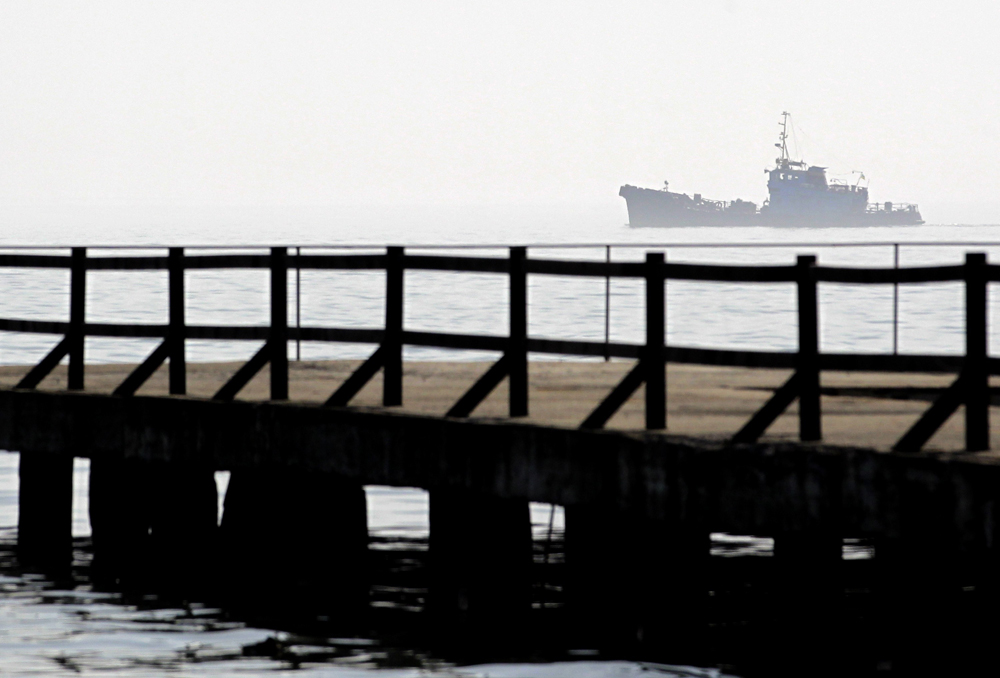
Crimean ports are technically not yet ready to become the main channel for supplying the peninsula from Russia. Kerch, March 3, 2014
On March 28, it became known: the Russian government approved additional financial assistance to Crimea and Sevastopol in the amount of 13.1 billion rubles. Money will be allocated from additional funds laid down in the budget of the Russian Federation for 2014.
“The voiced 13 billion is only the beginning,” the source of The New Times in the presidential administration explained on conditions of anonymity. “They do not laid down the solutions of problems that are still being discussed - providing water and electricity, social obligations, and so on.” In general, according to the official, the Crimea will cost Russia "at times, if not ten times more."
Moscow has no time to build up. The Crimea has already faced a number of problems requiring operational solution.
Ukrainian valve
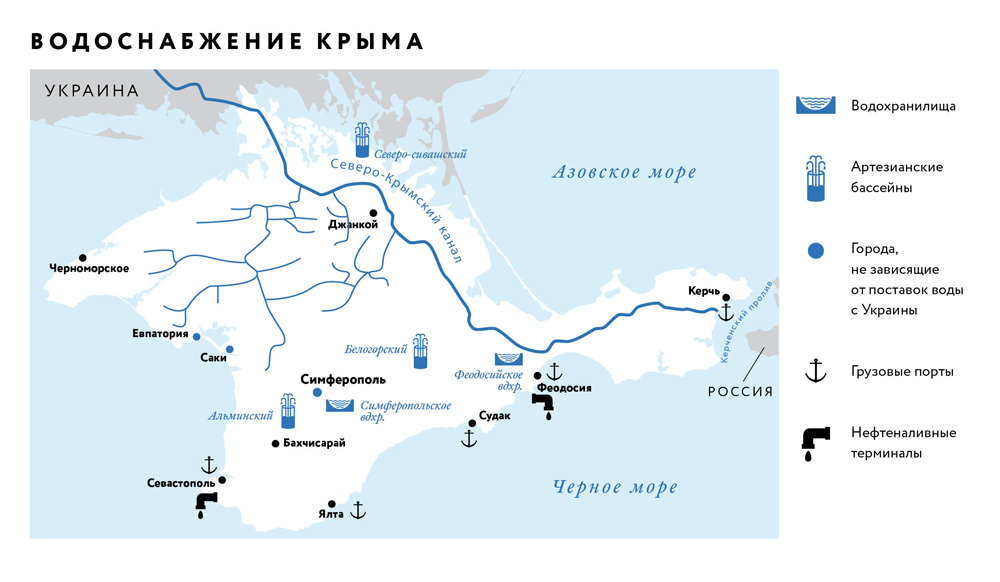
The first and main of them is water. It enters Crimea from the Dnieper through the North Crimean Canal, which is divided in several directions on the territory of the peninsula and goes into collectors. “Not without reason in Crimea, even in Soviet times, all these water arteries were guarded as the apple of an eye - there the military really was on duty with machine guns, they didn’t give anyone to arrange, nor swimming, or even just approach,” recalls Alexey Bezborodov, director of the Infranews research agency. He now works in Moscow, but he himself is from Sevastopol.
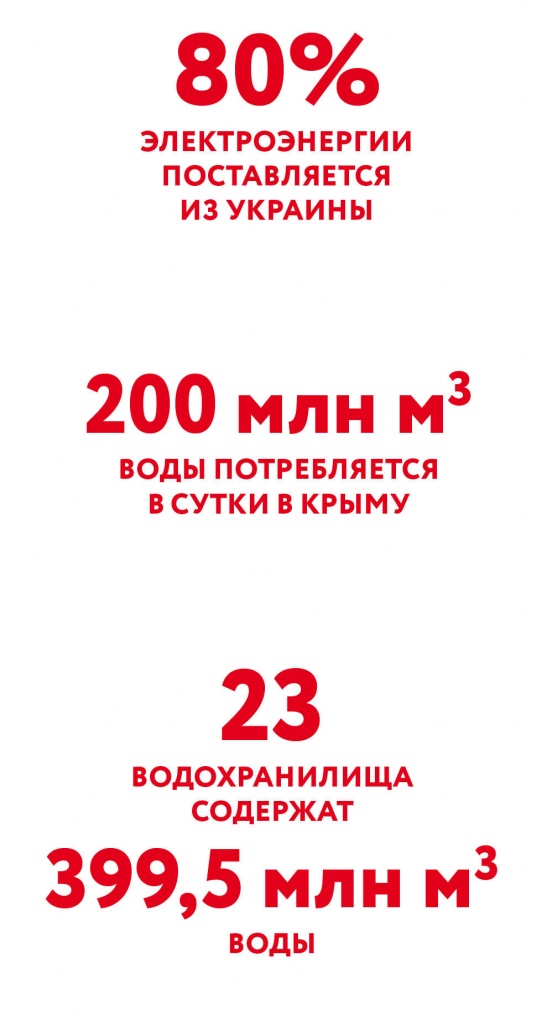
There are own water sources on the peninsula only in the mountains - this is about 20% of the required volume. The remaining 80% come from the North Crimean Canal to the Steppe areas, the North and Eastern Crimea. Koktebel, Feodosia, Kerch, Simferopol, Sevastopol - all of them are completely dependent on the Dnieper water.
What will happen if Ukraine blocks the water of the Crimea? Can Russia provide the peninsula with this resource?
“Any shutdown will lead to serious problems. In previous years, there were problems in many cities of Crimea, because the water was supplied by the hour, as in the same Sevastopol - two hours and evening. It is completely incomprehensible how to be, if the Simferopol reservoir is not filled: it nourishes Simferopol, which is almost 400 thousand inhabitants, ”says Taras Berezovets, director of the Kyiv Strategic Consulting company Berta Communications.
Alexei Skopin, head of the regional economy and the economic geography of the Higher School, told The New Times that the Crimea today has no other options, except for Dnieper water. “There are waterproof units, but this is a limited volume,” says Skopin. “It is possible to put a bunch of installations in the energy sector and thus receive more energy, but you can’t do this with water.” In principle, the issue with drinking water supply can be resolved, an expert is stipulated, but for the scale of agriculture, water supply without the participation of Ukraine will not be able to establish.
On the one hand, Ukraine receives good money for water, it is beneficial to provide Crimea with water. “Another question is how adequate people will make decisions“ from above ”. So it is likely that this year the agriculture of Crimea can be paralyzed, ”suggested Alexei Skopin.
However, the overlap of the North Crimean Canal is an extreme option that is possible only with a serious aggravation of the situation in the relationship between Kiev and Moscow. In any case, on March 28, the Deputy Prime Minister and the head of the Ministry of Regional Development of Ukraine Volodymyr Groysman said that the supply of water to Crimea would not be interrupted. True, at the same time he instructed "to work out the mechanism of mutual settlements with the Crimean enterprises-adopted users." And this means that Kyiv is likely to simply increase the water fee. Earlier, the Ukrainian government has already stated that it was considering the possibility of supplying water and electricity to Crimea at “world prices”.
According to Taras Berezovtsa, the transition to “world prices” means an increase in tariffs for these resources by 3-5 times. Now, for example, the population of Simferopol pays for a cubic meter of cold water about 12.3 rubles, in Sevastopol - 13 rubles. This is much less than the average tariff for Russia (21 rubles). If tariffs grow even twice, water for Crimeans will become more expensive than for the inhabitants of the "big land".

Power lines through the strait
With electricity, everything is about the same as with water. Ukraine supplies 80% of the electricity consumed by a network of power lines through the Perekop Isthmus and Chongar Perekop. Supplier is the Crimean electric power system, a subsidiary of the Ukrainian state company Ukrenergo. The remaining 20% provide Crimean companies.
The alignment of consumption in Crimea is as follows: the population accounts for 46% of electricity, 17.6% - in industry, 6.7% for agriculture.
Taras Berezovets from Berta Communications recalls that Ukraine supplies electricity to Hungary and Romania at market prices, and probably Crimea will now pay at the same tariffs. In terms of rubles in 2013, the cost of electricity in Hungary was 6.14 rubles per kW/hour, in Romania - 5.81. But the inhabitants of Sevastopol, for example, paid only 1.1 rubles per kW/hour.
True, unlike the story of water, there is a way out. If Russia builds a Kerch bridge and draws power lines along it, the problem of Crimea’s energy dependence from Ukraine will be resolved.
Vyacheslav Baburin, head of the economic and social geography of Russia, Moscow State University, told The New Times that it is best to build a polymagistral Strait through the Kerch Strait, where transport, electricity, and even water will go. “There is a powerful organization - Olympstroy, which completed the construction of Olympic facilities in Sochi. They have an unclaimed base now, even good - a new huge object has appeared, ”says Baburin. - It will still be quite logical if two railway crossings and two roads will operate through the strait. Just in case, it is necessary to make a high -voltage transmission line to connect Crimea to a single energy supply system of the Russian Federation. ”
The Russian government has already thought about this project: the Minister of Transport Maxim Sokolov even called the necessary investment volume - 50 billion rubles (this is a bridge, electric cables, water supply and a gas pipe). True, the implementation will take at least 3.5 years.
“So the dependence of the infrastructure on the development of political relations will remain for a few more years,” Baburin summarizes.
Banking Tsugtsvang
Another area of Crimean economy, where the influence of “big policy” will also be very felt, is a banking system.
Firstly, Russian banks that decide to work in Crimea run the risk of falling under sanctions by the USA and the EU. And secondly, on March 20, the Verkhovna Rada adopted in the first reading the bill “On ensuring the rights and freedoms of citizens in the temporarily occupied territory of Ukraine”. It provides for a sentence of up to 10 years of prison for “collaboration”: Ukrainian enterprises and organizations will prohibit any economic activity in Crimea, requiring licenses, permits or certificates.
“Ukrainian banks, if they continue to work in the Crimea, as they say,“ hit, ”explains Maxim Osadchiy, head of the analytical department of the corporate financing bank (BKF). - In Crimea, the Privatbank (the largest bank of Ukraine. - The New Times) has a huge number of departments. In what format will he work on the peninsula? Will Igor Kolomoisky want, the owner of Privatbank, sit in a Ukrainian prison? It is unlikely. "
The adoption by the Verkhovna Rada of the “frightening” bill in the first reading is more reminiscent of a political demarche in order to release steam, ”objects to Moscow expert Nikolai Prezeke, a specialist in banking operations from the Tauride National University of Crimea. In his opinion, the Rada will “change his mind and will not accept this law”: “After all, Ukrainian banks will seriously suffer from him: they have everything here (in Crimea). And so you even have to sell the premises for pennies. ”
Actually, Crimean banks, explains to Pest, on the peninsula there are only two - the Black Sea Bank of Reconstruction and Development and the Marine Bank. The rest are branches of banks from other Ukrainian cities. But most of the local population used the services of Privatbank, through which all transactions on plastic cards also went. Therefore, now, when this bank does not function in Crimea, the Crimeans cannot use cards. Russia is trying to solve the problem by importing cash: the other day pensions have already been issued by rubles, while in rubles, according to Nikolai Prezeck, the nearest salary of state institutions was also promised.
However, the issue with non -cash payments can also be resolved. “A good example was in Transnistria,” Taras Berezovets recalls. - There is its own payment system "Rainbow". These are ordinary cards, but they cannot be used abroad. ” The expert suggested that Russia may have to create a separate payment system for Crimea. True, "the residents of the peninsula will not be able to use purely Crimean cards even in Russia itself."
On your own
But the food problem - even in the absence of land communications with Russia - experts call among the least complex ones.
Crimea is a large agrarian region that produces more than a million tons of grain per year, in Ukraine it was one of the leading vegetable centers.
“Local agriculture is quite well developed - there are vegetables, fruits, and meat production,” says Alexei Bezborodov from Infranews. “In fact, you need to argue 20-30% for more advanced consumers-relatively speaking, varieties: macarons from solid varieties, some specific meat products.”
It will be problematic to supply everything necessary with large cargo courts, because, according to Bezborodov, Crimean cargo ports are used mainly for export, their capacity is weak, the equipment is ancient: “The funds have not been invested in these ports for 30 years”.
But each port is equipped with the so -called pharmacies for the approach of ferries. “To supply the peninsula, such ferries are quite enough,” the expert is sure.
As for oil products, the peninsula does not have its own production, but, according to Alexei Bezborodov, and this problem is solved: “The standard tanker in the Cabotage message with diesel and gasoline is driven, it is unloaded at Theodosian oil depot, then the contents are transported by carboards throughout the Crimea.” As a result, it will come out even cheaper than through Ukraine. “There, all fuel is more than a minimum of 20%, although excise taxes are about the same as in Russia,” Bezborodov explains. The oil terminal in Feodosia is quite modern (Yukos once worked there), and its power is sufficient to provide the whole Crimea with oil products in any form.
However, the list of household problems that the Crimeans will encounter or have already encountered and which Russia will have to solve, water, light, fuel and money are not exhausted.
Firstly, communication issues remain. In Crimea, about one and a half million subscribers of Ukrainian operators, many have relatives in Ukraine. What tariffs they will call now - a question.
Secondly, all Crimean businessmen will have to resolve issues with licenses: the permission issued by the Ukrainian side for entrepreneurial activity is now invalid. And for paperwork, after all, you need to pay. By and large, everything will have to be reissued at all, including the right to own land.
So in the foreseeable future Crimea will remain a mountain on the shoulders of Russia and its taxpayers.
Photo: Darko Vojnovic/Ap/East New