
Translated material
You can not save
Where they will put a comma in the fate of the Shukhov tower
In the fate of the Shukhov tower, the icons of the architectural avant-garde, an hour is about to come: either a security letter from the hands of the head of government personally, or, again from his sanction, “civilized dismantling”
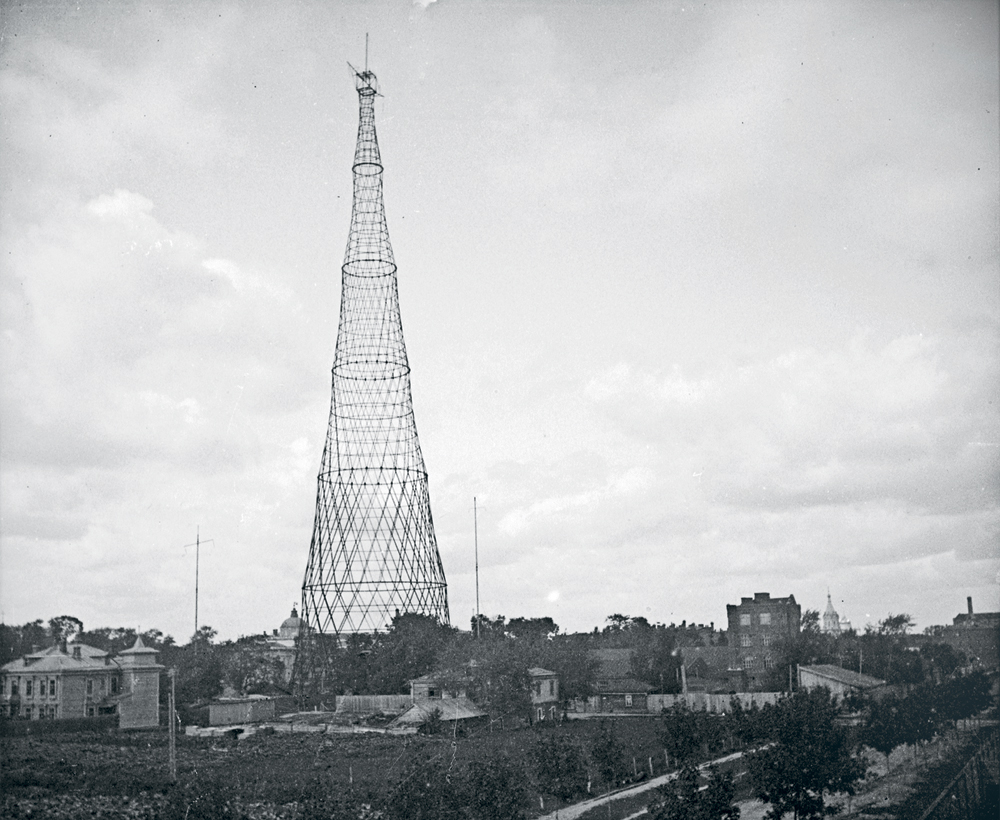
Shukhov Tower. Moscow, 1922
The radio tower, built by engineer Vladimir Shukhov in 1920-1922, is a unique hyperboloid structure, made in the form of a supporting steel mesh membrane (metal consumption per unit of height - three times less than in the efelian tower). The place was chosen as one of the highest in Moscow - 131 m above sea level. Initially, three 150-meter masts were installed here, the place of one of them was taken by the tower. The first project of 1919 assumed a 350-meter structure of nine sections (above Eiffel), but due to a lack of metal during the civil war, the project was converted into a six-section. The design had a height of 148.3 m. After the installation of two traverse and flagpole, the height reached 160 m. On March 19, 1922, the broadcast of the radio transmission began.
In 1939, the tower almost died - a single plane, most likely, the postal, crashed into the structure, touched a cable connecting the top with the base. The pilot died, but the tower survived. And in the fall of 1941, when the Germans approached Moscow, they mined the tower. Later, at the end of the Soviet government, the tower survived the barbaric restoration: in order to give the knots strength, riveted compounds were complemented by welding, violating the basic principle of Shukhov, according to which the elements should have a certain share of mobility and the possibility of self -compensation in relation to external loads.
The famous radio bank, erected by engineer Vladimir Shukhov on Shabolovka in 1922, entered all architectural textbooks as an example of innovative engineering thought. Today the masterpiece is on the balance of the Ministry of Communications of the Russian Federation. In December 2013, Nikolai Nikiforov, the head of the department, turned to Dmitry Medvedev with a proposal to make out the tower due to its dilapidated state, which is a danger to others.
It was not possible to conceal the initiative in departmental corridors: in February 2014, the fate of the Shukhov tower became the subject of acute public discussions, many famous people stood up for its defense.
Dismantling with a move
“In order to save the tower, it needs to be studied in a civilized manner” - as on February 4, Alexei Volin, Deputy Minister of Communications and Mass Communications, commented on February 4, commented on February 4.
“Since we (the Ministry of Communications of the Russian Federation. - The New Times) are responsible for this object,” the deputy minister continued, “we are ready to analyze the tower in order to maintain all the structures and restore it later. - And then he added: - We are not engaged in the restoration of cultural monuments. Therefore, the maximum that we can do today within the framework of our funds and our capabilities is to carry out it (towers) with the aim of subsequent conservation and transfer to those who then deal with its restoration. ”
The words “within the framework of your funds”, uttered by Volin, should not be perceived literally. Because back in 2011, the Ministry of Communications as the owner of the Shukhov tower, a cultural monument of regional significance, the Moscow City Combat was allocated 135 million rubles - just for its restoration, which was never carried out.
"
Some experts, on the basis of anonymity, say that the owner supposedly deliberately brought the monument to the current state
"
On the same day, February 4, the Ministry of Culture reaction followed the initiative of the Ministry of Communications. “According to Russian legislation, objects of cultural heritage, including the Shukhov tower, are not subject to dismantling,” said Vladimir Tsvenov, director of the department of control, supervision and licensing in the field of cultural heritage.
And two weeks later, when the Vice Speaker of the State Duma Lyudmila Shvetsova directly addressed the Minister of Culture Vladimir Medinsky demanding to clarify the fate of the monument, the position of his department no longer looked so categorical: the Ministry of Culture was ready to consider the transfer of the tower. And in the government they even began to discuss where to put it. They called three places: the VVC, Kaluga Square and Gorky Park. The deadlines have already been set: until May 1, finally determine the new place.
Special status
The question, as always, rests on money. It was about this problem on the air of “Echo of Moscow” that the head of the Moscow Cultural Heritage Department Alexander Kibovsky mentioned. Funds for dismantling the tower, he explained, approved in the federal budget. But there is no money for its opposite recreation. How then to be?
On February 28, at a press conference architect, a symbol of the Russian avant-garde, specially convened in the house, tried to name a spade a spade.
| *Federal Law of June 25, 2002 No. 73-ФЗ “On Cultural Heritage Service (History and Culture Monuments) of the Peoples of the Russian Federation” in the last edition of 2013 |
Indeed, according to the Federal Law “On the Protection of Monuments of History and Culture”*, the Shukhov Tower as an object of cultural heritage cannot be demolished. It is also impossible to transfer it, because in the security document the object is harshly attached to the place. Only the head of the Government of the Russian Federation can deprive the tower of security status - this is his competence and prerogative. Dmitry Medvedev was supposed to sign such an order on March 24, but still has not done it. Meanwhile, dozens of letters in defense of the Shukhov tower have already been registered in the presidential administration - from leading architects of Russia and public representatives.
The last few years have become truly decisive in the fate of the Shukhov tower. It became an object of cultural heritage only in 2011, when the city authorities approved the territory of the tower. In 2013, a “project of the object of security” was developed, which clearly states that it is the state that undertakes to protect. And at the beginning of 2014, the Moskhornovy commission, having examined the project, made additions to it and prepared a protocol, which, however, has not yet been signed. In the first paragraph of the project, it is just that the location of the object of security. “The object is determined, its location, too, so that there are no legal grounds for disassembling and transferring the tower,” Irina Krymova, the head of the Mosokhn-2 Mosokhin Mosokhin Historical Studies, was sure this workshop.
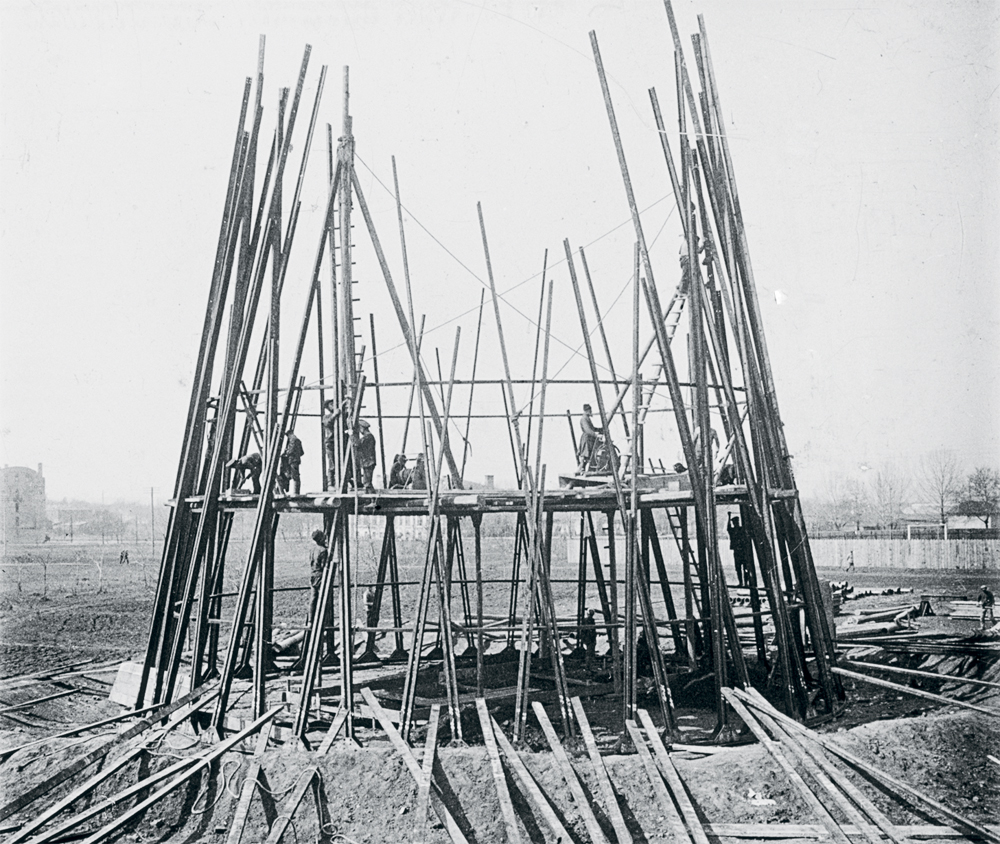
The process of assembling the first section of the tower. Moscow, March 1920
Ideas for salvation
But what about the argument of the Ministry of Communications about the “dangerous for others” of the extreme dilapidation of the creation of Shukhov? Moreover, the tower is surrounded by dense buildings.
| ** Institute, which has been observing the state of the Shukhov tower for many decades. |
“The tower cannot fall, unless there is any sabotage,” said the New Times by the factory department of the Institute of Construction Metal structures named after Melnikova ** Galina Shelepina.
Other experts interviewed by the magazine are sure: talking about the impossibility of restoration of the tower without it is dismantled. As well as the speech that she will collapse tomorrow.
Of course, attempts to solve the problem were made. For example, the idea of transferring the upper sections of the tower arose using a helicopter to another site for restoration, while the lower sections would be put in order on the spot. But it is very expensive.
Experts are sure: talking about the impossibility of restoration of the tower without her dismantling - absurd
"
There are other initiatives. Thus, Professor Markhi Yuri Volchok and the Architectural Bureau “The Fourth Dimension” offer to “cover” the tower with a casing that would take on all the loads - to calmly carry out restoration work in old structures. But this project is also super -expensive. Although is it appropriate to talk about high cost when it comes to the architectural monument of the first row?
Another concept of restoration on the spot - without any casing, but with the involvement of climbers - is supported at the Melnikov Institute. It seems obvious that restoration is in principle possible, and by 2022, when the 100th anniversary of Shukhov’s creation will be celebrated, it can be completed. There would be a desire. But, it seems, the tower is sentenced in advance.
Shame for the country
Disputes around the Shukhov tower - to disassemble not to disassemble, do not restore rest to restore - by and large it is not surprising. The impression is that constructivism in modern Russia is at least underestimated. And not only by townsfolk, but also by structures designed to protect the monuments.
| *** Pavilion No. 20, Chemical Industry, 1967, architect B.I. Vilensky. |
In general, the buildings of the Soviet era are always entered in the register of objects of cultural heritage with a great creak. A striking example is the Pavilions of the Air Force of the Building of the 1960s, none of which has yet been recognized as a monument of architecture. First of all, we are talking about Pavilion No. 20 *** - a wonderful example of Soviet modernism, which has been threatened by demolition for many years.
However, there are separate reasons for optimism. So, on March 16, the house - Master's Konstantin Melnikova in Krivoarbatsky Lane from the object of protection of regional significance was elevated to the rank of federal monument. And on March 25, the Moscow government canceled the construction of a giant shopping and entertainment center on the territory of the All-Russian Central Executive Committee-it was supposed to appear right behind the Pavilion "Worker and Collective Farmers".
But no one has yet canceled the threat of the Shukhov tower.
| **** Bauhaus - a direction in the art of the 20th century, called the German school of construction and artistic design of Bauhauc (1919–1933). At the head of the school stood the largest architects of the era - Walter Gropius, Hannes Mayer, MiS van der Roe. After the Nazis came to power, the school was closed, and many adherents of the Bauhaau went to revive this style in Palestine. Today, the Bauhaau quarters in Tel Aviv are included in the UNESCO World Heritage List. |
The Russian avant -garde is our Russian gift to the world, it is necessary to protect it with the same zeal with which futurism is guarded in Italy or Bauhauc **** in Germany or Israel. The misunderstanding of this is a shame for the country, the defenders of the tower say.
Engineer Shukhov left us many inventions, among which the first oil pipeline and oil reservoirs (not without reason the monument to the inventor stands on Sretensky Boulevard before the Lukoil building). Shukhov’s mesh hyperboloid shells formed the basis of many modern objects - it is enough to recall the London “cucumber” and the roof of the British museum, constructed by Norman Foster.
By the way, Foster himself, along with other famous architects of our time - Ram Kulhas, want Hadid - also defended the Shukhov tower. The petition of urban planners is published in the British newspaper The Guardian.
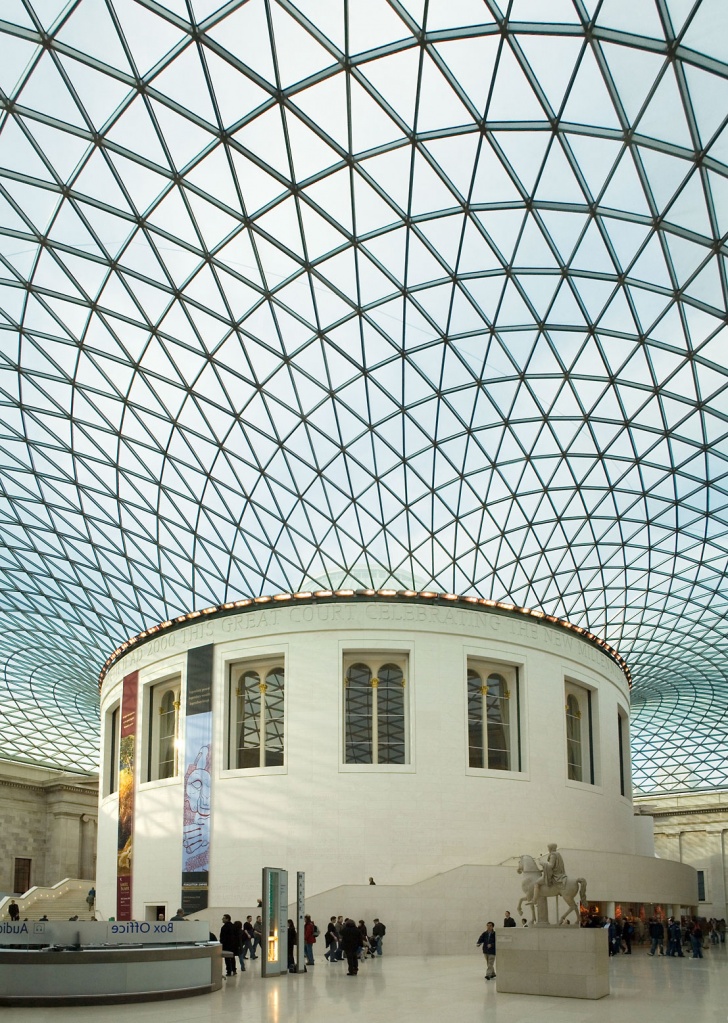
The roof of the British Museum. Architect Norman Foster was clearly inspired by the Shukhov tower. London, November 2005
Who benefits
For all the time that there was a discussion of the fate of the Shukhov tower, there was not a single professional who would say: they say that the transfer of the tower to another place was a trifle and harmless.
Why then does the Ministry of Communications insist on dismantling the tower?
On terms of anonymity, many surveyed specialists told The New Times: the owner supposedly deliberately brought the monument to the current deplorable state, then to analyze and build a skyscraper in its place. The fact is that current laws prohibit high -rise construction in Moscow within the boundaries of the third transport ring. The skyscraper is allowed to be placed only instead of another high -rise. This means that, having demolished the 160-meter tower, you can legally build a skyscraper in its place, which will instantly “repel” all costs.
Nobody has yet announced such plans for such plans. But in the circles of Moscow architects, they heard about the existing investment contract next to the tower-it is possible that neighboring buildings can be demolished for the sake of its implementation, such as a unique school No. 600, built by the architect Antonov in the early 1930s. After the recent demolition of the Don baths (they were also on Shabolovka), also constructivist, such plans do not seem so fantastic.
What next? It is likely that after the dismantling of the Shukhov tower, the residents of the district, who are advancing today for the demolition of an allegedly dangerous structure, will at best encounter a long -term construction under the windows. At the worst - they themselves are simply evicted from Shabolovka. And the historical city quarter, a miracle of architectural and engineering, will remain only in our memory and in the photographs of contemporaries.
Photo: From the Shukhov Tower Foundation, Andrew Dunn