
Translated material
Education for "blanks"
On March 24, Doctor of Historical Sciences, author of the book “History of Russia.xx Century” Professor Andrei Zubov was dismissed from MGIMO for publicly expressed disagreement with the General Line of the Party in the Crimea
| *Elya Kolesnikova submitted an application for leaving MGIMO on 03/25/2014 - the day after it became known about the dismissal of the historian Zubov, in protest against this dismissal |
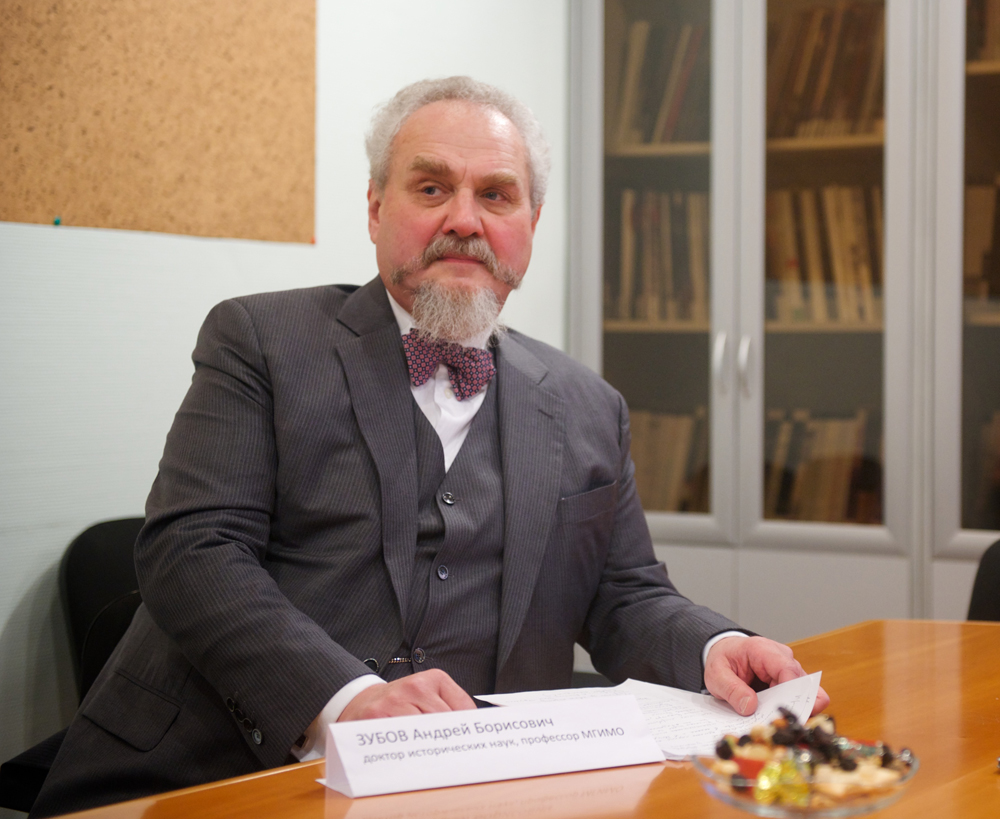
The author of the book "History of Russia. XX century "was the first" dissenting "dismissed for criticism of Russia's policy in Ukraine
After the dismissal of Professor Zubov, the leadership of MGIMO presented to its employees an ultimatum. More precisely, the first time this was done in those days when Andrei Borisovich still worked at the institute. “Events in Ukraine and Crimea fit into the general context of the confrontation of the world and good forces for the forces of chaos and evil. [...] Russia and Crimea made their choice. Now each of us must make his choice, ”wrote the head of the Department of Philosophy. For inconspicuous, a few days later they repeated in open text: “If the state, the Foreign Ministry made a foreign policy decision of the cardinal nature, and it shifts you, just do not work at the Midovo university.”
Having accepted the dismissal of the workshop colleagues for granted, teachers and professor MGIMO set themselves outside the academic community. Academic freedoms are rudely violated, and it turned out that they are not very needed. Above the university spirit, the Spirit of the Kazy-Armyskoye prevailed: everyone fulfills orders, no one dares to disobey.
I do not know who exactly initiated the dismissal of Professor Zubov, and I am not interested in understanding this. I don’t know if the rector personally wanted this or he simply followed the instructions. I saw that the head of the police department was definitely not happy and survived, it seems to me, not the best weeks in his life. But I saw something else: the silence of colleagues. Deaf, dead silence. Outgoing by reprisal with Zubov expressed in a conversation with me only one employee of the department. When I came to the institute to pick up the work book, my former students approached me. They were indignant about the actions of the leadership of MGIMO, were shocked and confused. I can’t name the name of this colleague, I can’t name the names of these boys - I will put them under attack and write them down in the “Forces of Chaos and Evil”.
"
Above the university spirit, the spirit of the Kazenno-Armysky spirit prevailed: everyone is fulfilling orders
"
The main trump card of the MGIMO administration is the jurisdiction of the Ministry of Foreign Affairs: all academic liberties that are allowed at other universities are prohibited. It seems to many that this is an argument of insurmountable strength. And he really convinces even some opponents of political reprisals. But this argument is crafty: MGIMO has not been exclusively a diplomatic school for a long time. In addition to many faculties in MGIMO there are graduate schools, there are academic councils. Last year, graduate school was opened in the specialties “Culturology” and “Philosophy of Culture”. These graduate students listened to my special course in universal grammar, and I saw in them that living desire for scientific search, which cannot be confused with anything. I’m not sure that they all came to MGIMO to learn from “culturalists in civilian clothes”.
Of course, an employee of the Foreign Ministry cannot publicly express disagreement with the policy of his country. But the Foreign Ministry goes to work after the end of MGIMO only a small percentage of graduates. But there would be several times more of them - this does not mean that university education should turn into the mass production of “blavans”. It seems that MGIMO was chosen as a prototype for testing a new educational model, in which knowledge is secondary, and loyalty, “think like everyone else” - the principle and goal. We approached this model close.
Accept my bitter congratulations.
Photo: Anton Belitsky