
Translated material
Turkish block-post
How in Turkey a ban on the use of Twitter has been a ban on
Despite the court decision in Ankara, Turkish Internet providers are in no hurry to return access to the Twitter microblog website, blocked at the request of the authorities. How the ban is valid and how the Turks are fighting with it - the New Times recognized
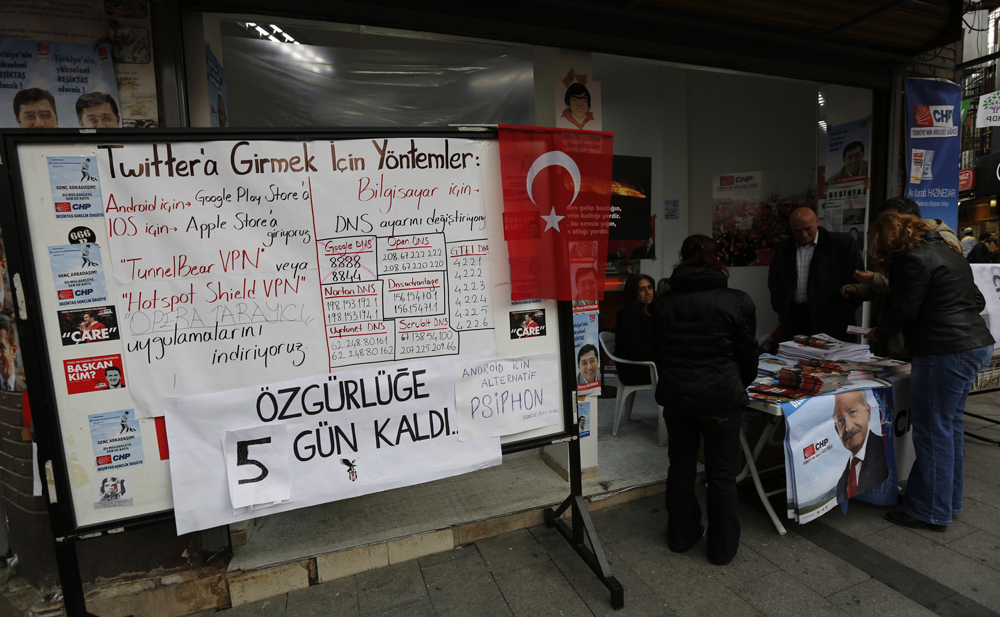
The showcase in one of the election headquarters of the opposition Republican People’s Party explains how to bypass Twitter blocking. Istanbul, March 25, 2014
In the last week of March, mysterious combinations of numbers appeared on the walls of houses in Turkish cities here and there. But the initiates - and there were hundreds of thousands - knew: these are the numbers of DNS - addresses of domain names. Changing them in the computer settings, you can successfully circumvent the Twitter site blocking, and therefore the ban on the social network installed by the authorities on March 20, 10 days before the municipal elections in the country. Prime Minister Recep Erdogan promised to “eradicate” Twitter. Starting offline the struggle against government prohibitions, the Turks showed him that “eradication” would be long and difficult.
Twitter-Vstanka
The formal reason for blocking Twitter was the non -fulfillment of three decisions of Turkish ships and one requirement of the prosecutor's office. So, in one case, a certain plaintiff demanded through the court to remove the account on the social network, where her candid photographs were posted, in another, ex-minister of Turkey’s transport, Binali Yildyrym, demanded to remove the account of corruption in the department entrusted to him. In all cases, the court satisfied the claims of the applicants, obliging Twitter to remove the indicated accounts. However, the Turkish courts ... "forgot" to send the relevant requirements to the office of the social network. And then the executive branch demanded that Twitter are banned. However, according to most experts, the authorities simply found a convenient occasion to get rid of the nursery of freedom before the municipal elections.
In Turkey, as in Russia, Internet services are provided by several providers. Each of them on March 20 received a letter from the prosecutor's office demanding to block access to Twitter. Mobile operators received the same letters. At first, the ban did not take action. According to the Turkish journalist, vice-president of the National Committee of the International Press Institute, Emre Kizilkaya, on the first day after blocking, the Twitter audience, on the contrary, even grew from 1.49 to 1.75 million: the Turks were sophisticated in Internet stitching. But after a couple of days, the number of users of the social network fell by 50%. “The authorities began to repair all new technical obstacles to those who“ deceived ”the blocking,” says Emre.
"
On the first day after blocking, the Twitter audience grew from 1.49 to 1.75 million people
"
We bypassed the ban mainly using the same DNS numbers (Domain Name System), introducing a third -party server number of the DNS DNS number of DNS in the settings of a computer or phone. The most common servers are Google DNS and Open DNS, but there are many others. However, Google DNS was quickly recognized and also blocked by the Turkish authorities.
The second most popular way to get around the ban on Twitter was the use of VPN (Virtual Private Network): The computer connects to the VPN server and changes the IP address of the IP address in another country. In Turkey, however, many VPN providers could not withstand a sharp increase in the number of subscribers and worked poorly in the early days-there were not enough capacities. However, in general, the VPN is the best way to use the Internet in restriction mode. Even in Iran, where social networks have always been outside the law, many Internet users bypass prohibitions using VPN. Another, no less effective way of “geographical” deception of providers is to use the Tor service, which sends a request to the site through several servers in different countries, thus masking the real location of the user.
“You can completely block access to Twitter only if you self -amplifying from the World Wide Web and make your own separate Internet, as in China,” the Kizilka sums up. “So the calculation of our authorities, apparently, to seriously complicate their lives to users.”
Cleaning rehearsal
On March 26, the Ankara administrative court decided to unlock Twitter. But to rejoice on the triumph of independent justice, as it turned out, early: Turkish lawyers immediately began to argue whether this decision should come into force immediately or the government has 30 days to appeal.
And on March 27, the authorities held a new offensive: the independent Kanaltürk TV television channel was disconnected and access to the YouTube video hosting, on which there was a recording of the conversation of the head of Turkish intelligence, the Minister of Foreign Affairs and the deputy head of the Turkish armed forces, discussing the possibility of a military operation in Syria. What now? “I am sure that the sources of information for users will not open“ unreliable ”information for the authorities, but in early April, perhaps Erdogan will calm down and the situation will return to the normal channel,” Emre believes. And then he adds: “In August in Turkey, the presidential election. So in March, the authorities most likely conduct a rehearsal to clean up the information space. ”
However, other “conditionally democratic” countries may well use the results of the Turkish “rehearsals”. And Russia, judging by the current attitude of all branches of power, are among them.
Photo: Murad Sezer/Reuters