
Translated material
Robomzika non-stop
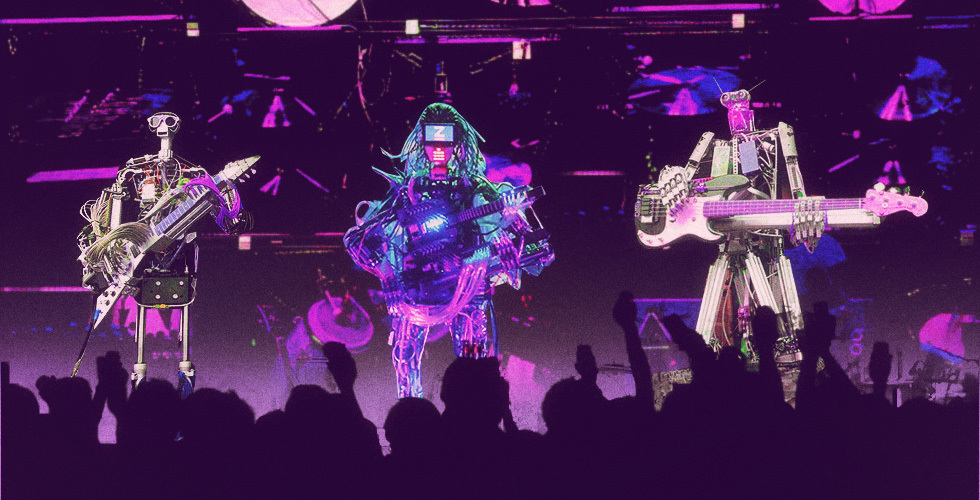
You probably remember the episode from the film “Guest from the Future”, where the Robot Werther invites Kolya to “Competitions of Robots-Hitarists”. And if there is no need to count on passenger transport for uranium or devices, reading thoughts, then everything is in perfect order with robotics. Today, robots can not only collect smartphones or check tickets, but also show themselves well in music. Although before the situation described in William Gibson’s novel “Idor” (a creature with an artificial mind and a way-head, created according to the model of Japanese singer-idols, becomes a real pop star), the movements in this direction are noticeable to the naked eye. What are at least Japanese pop groups, where instead of a pretty singer, the voice of the Vocaloid synthesizer sounds, which is no longer so simple to distinguish from human singing.
The robots themselves compose, they play themselves, only there are not enough listeners robots.
Another wave of conversations about musician robots began after Tom Jenkinson, aka Squarepusher (eccentric British electrician with a jazz past), published the video clip “Sad Robot Goes Funny” , where the trio of robots (naturally, also in Japan) performs a sort of progressive jazz. Under this project, Jenkinson summed up the ideological base - to create this trio, it was inspired by the modern classic composers of Conlon Nankerrow and Dierge Ligeti, who often used the unusual manner of playing traditional instruments. Though robots, although they are not distinguished by a subtle sense of articulation, play much faster than a person and are not connected by the absurd restrictions of the human body, which has only two hands and only ten fingers. Japanese inventors tried to personify their wards, giving them names: they say, these are not just cars, but real musicians. The 78-paltz superhitarist is the name Mach , a drummer who easily copes simultaneously with 22 drums- Ashura , and a virtuoso-coat-clavicure- Cosmo .
The idea to give tools in the hands of robots, or rather, to entrust the role of the performer with a mechanical device, to put it mildly, is not new. One of the first “automatic orchestras” was invented at the beginning of the 19th century by Johann Melcerem, a friend of Beethoven. The first musical robots were intended for two goals: on the one hand, they helped the composers (it was easier to drive the score into the machine, even if it was difficult, than rehearsing the work with capricious orchestras), on the other hand, they served as the players, which were simply not there then.
With the advent of sound recording, and then sequences and computers, mechanical tools have forgotten the mechanical tools (any laptop is now doing well with the performance of a complex orchestra) and remembered them only in the 21st century, when everything slowly began to be disappointed in computers. Nevertheless, it is one thing to collect music as an application from already recorded sounds, another - to pull real strings and blow in real pipes, even if a person does not do this. The idea of a “work for a mechanical orchestra” was most accurately implemented by a jazz guitarist-virtuoso Pat Metron on the album “ Orchestrion ” (2010). Its guitar solo is accompanied by an automatic orchestra of piano, marimba, vibrophone, guitars, shock and other exotic, like water bottles, in which, of course, robots also blow. And Patu helped in creating this orchestra not only traditional tools of tools like Yamaha , but also Brooklyn inventors from Lemur ( League of Electronic Musical Urban Robots ) , whose developments willingly use advanced electronic workers.
The American composer and percussionist Patrick Flenegan went even further. Its drummers robots do not just perform parties written for them, but improvise on the go. Flenegan, a graduate of the composition of the Columbia University, studied artificial intelligence methods for a long time to create music, and eventually collected his Jazari robots ensemble, named after the Arabic scientist al-Jazari and outwardly reminiscent of cars from the cartoon about Wallace and Thunder. The main achievement of Flenegan was the algorithms by which robots can interact, in different ways to respond to a person’s game (Patrick himself plays with his whole machinery) or another robot. Thus, Flenegan robots are quite capable of “jams” as real jazzmen, but it is not yet known how much they will succeed without the participation of a person. It turns out that Patrick and his team have a cunning percussion music of the Afro-Asian sense, and the Jazari album, which Patrick “Samizdat” released at the Bandcamp site, has already managed to praise the FACT magazine.
The next degree of freedom - transfers into robots, or rather, to the artificial mind of the functions of the writer - is also well mastered. Many avant -garde artists of the twentieth century experimented with “algorithmic music”, from Janis Ksenakis to Brian Ino, but the algorithms were mostly auxiliary instrument. Two thousandth showed us independent "robocrosers." The German company Fest O , for example, developed a string quartet that composes and performs baroque music. The algorithm of the work of this “composer” is based on a cell assault rifle that is very similar to the game “Life” by Mathematics John Convei. Here, however, there is a certain trick - the robot still needs “input material”, the composition, in the image and likeness of which he creates his own. At the same time, it looks extremely impressive-the robots themselves compose, they play themselves, only the list of listeners are not enough.
But the most outstanding success in the algorithmic composition was achieved by the American scientist and composer David Cope, professor at the University of Santa Cruz, California. At first, Cope developed a program called EMI (“Experiments with the Musical Mind”), which composed works in the image and likeness of the works of famous composers - Bach, Vivaldi, etc. The principle of its functioning is complicated in implementation, but is easy to understand: EMI analyzed the “input data”, i.e. The works of an experimental composer, and revealed in them dominant musical moves - harmony, melodic solutions, etc. Then, having these rules in the arsenal, EMI created new works that sound and really very similar to unrelated works of classics. Here, for example, how the Copovsky "Beethoven" sounds:
The BBC 3 radio station once even arranged a “blind test” among the listeners, proposing to compare the work of Bach, the player of the composer Rachel Scott (also written in the aesthetics of Bach), as well as one of the “bug -like” records of the Copov program. Correctly determine which of these plays a person wrote, few were able to.
David Cope did not stop there and in the 1990s he created a virtual composer, echoing her Emily Hauwell: she not only composes her own music, no longer focusing on the classics, but also self-study, reacting to reviews like “good-bad”. According to Coop himself, his virtual daughter, unlike most living composers, is susceptible to criticism. The first album of Emily Hauwell saw the light in 2010 on the respectable “classic” Centaur Records label.
"Jazz and classics are good, but how is the rock?" - You ask. It turns out that the Robot’s iron leg has already stepped here. In Germany, for several years now there has been a metal group of Compressorhead - a quartet of robots playing on the most ordinary rocker musical instruments. Robots also distinguish unusual anatomy. For example, the guitarist, nicknamed Fingers , is like a Snarpusher Mach , 78 fingers, for the Stickboy drummer - four hands. The bassist Bones even knows how to ride a stage on the caterpillars. That's just the essay of their own rock-slogans has not yet reached, the current Compressorhead repertoire consists of imperishable Mot ö Rhead and AC / DC . But there is a feeling that this is a fixable thing and the emergence of a full-fledged autonomous “robot”, which DAFT pretended to be pretended Punk , just around the corner.