
Translated material
Ghosts Marx
In connection with the events in the Crimea and gaining new turns, twisting the nuts increasingly in the media, social networks and blogs talk about the return of the “scoop”. The Olympiad in Sochi is compared with Moscow-1980, the processes in the case of May 6 and over Pussy R Iot -with Soviet indicative courts, and the entry of troops into the Crimea-with tanks in Prague in 1968. Like any other metaphors, these analogies are a political judgment, behind which there is usually a liberal idea of the USSR as a kingdom of lack of freedom and violence over history compared to the “normal” “Western” through development. In turn, the authorities use fragments of the Soviet past (for example, the myth of World War II) for its own purposes, as an instrument of great -power conservatism, skillfully manipulating the older generation, including the same Crimeans. If you look closely, it is easy to notice that the liberal and Putin-conservative understanding of the analogy of “Modern Russia-USSR” are shifting each other. I would like to problematize this analogy without completely abandoning it, but having come out of the obsessive binary opposition “USSR - West”, “Ours”.
For starters - several evidence. There is no economically and politically universal return to the Soviet one, which hints, for example, Irina Prokhorova. Yes, there is a spinning of power and capital, there are difficulties for conducting a business independent of the authorities, but at the same time Russia joins the WTO, social expenses are cut, free medicine and education are destroyed. The similarity of the Putin's vertical of power with the party nomenclature hierarchy, many members of which were included in the new system, also deceptive: a powerful change in the basis entailed the mutation of the superstructure. The Soviet vertical of power was completely built into society and the economy and, for all its dispatrability, nevertheless built a different system of values for its members than, for example, United Russia, less oriented towards personal luxury and more responsible . Most often, indications of the return of the “scoop” are not concerned with the economy and the political system, but of culture, ideology, identity policy. Indeed, the Russian state uses the Soviet experience of suppress freedom of speech and manipulating facts with might and main. But the designs of the state propaganda itself in the USSR and in the modern Russian Federation are very different.
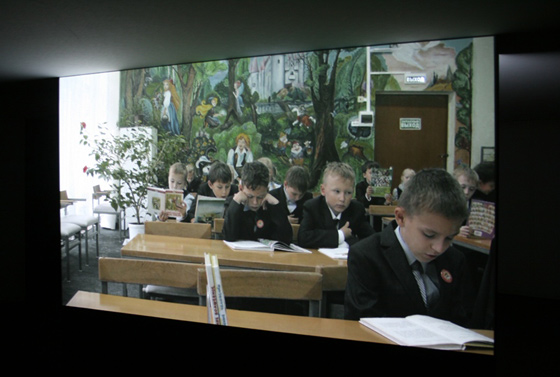 At the exhibition of Dina Karaman "Cinema to Romance." 2014
The Soviet media and other cultural institutions up to museums with a huge amount of silence and lies kept didactic educational ideals - albeit turning into a shell and dusty, but the ideals of universal, public knowledge. Huge circulations of thick magazines or no one read scientific books with tables still fill in any village library - next to the recently published detectives of Daria Dontsova. In the form, Soviet propaganda inertia inertia stored faith in the possibility of universal knowledge, universal truth, although the true tip of its content could be completely different and addressed to a narrow circle of interested parties, such as reports of statistics in provincial newspapers, where we could read hints of which head of the collective farm will be sometimes given a bon For purely corruption considerations. This wrong side of the Soviet bureaucracy is opened by films according to the scenarios of Alexander Gelman - but it is opened precisely from the standpoint of Soviet ideals, from the standpoint of hope of the possibility of returning meaning.
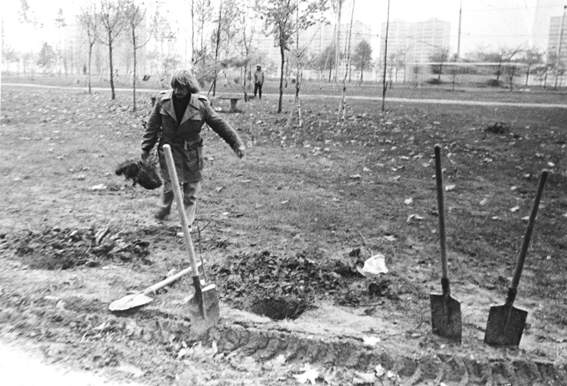 Totart group. "Subbotnik on the laying of the Avangard alley." 1982
Today's propaganda is devoid of measuring universal, universal truth-the measurement that is due to which Alain in “ethics” indicates the truth of the October Revolution as an event addressed to the whole world, and contrasts it with the national-socialist coup addressed to only one nation. Meanwhile, modern Russian propaganda manipulates with nationalist rhetoric - and is borrined by the rhetoric of the Cold War precisely as an instrument of nationalism. Moreover, the nationalism in Soviet propaganda since Stalin's times was more than enough - but he always coexisted with the ghosts of universal, global thinking, with the ghosts of Marx. Russian propaganda is built not on the Soviet principle of “propaganda and education”, but by the capitalist “propaganda and entertainment”. Like any product, such entertaining propaganda is heterogeneous and focused on different target audiences of consumers - but no longer manufacturers, like provincial Soviet newspapers with semi -excommunicated statistics on collective farms.
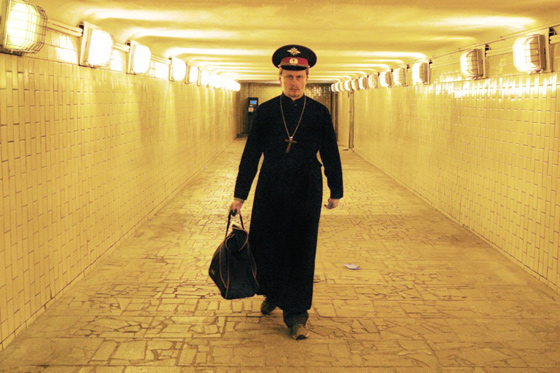 Group "War". "Mentopop." 2008
I’ll clarify in order to avoid misunderstanding: there is no talk about whether more or less freedom was in the USSR than today; Obviously, now there are much more opportunities for the statement that we willingly use, although these opportunities are open and relevant far from all segments of the population. It is only about the dominant state ideology - that in comparison with the flat and increasingly frankly nationalist ideology of Putin's Russia in Soviet ideology there was another surplus, dimension - a ghost of universal utopia, not actualized, but, by the contrary, ultimately buried by history, although hopes for its actualization flashed again both in the thaw and in the thaw and in Perestroika. This problem was already raised by Viktor Misiano in his exhibition project “Progressive Nostalgia” and the relevant releases of the “Art Journal” . I will leave aside the question of nostalgia and its overcoming, and try to indicate the difference in relation to Soviet and Russian artists to the prevailing ideology.
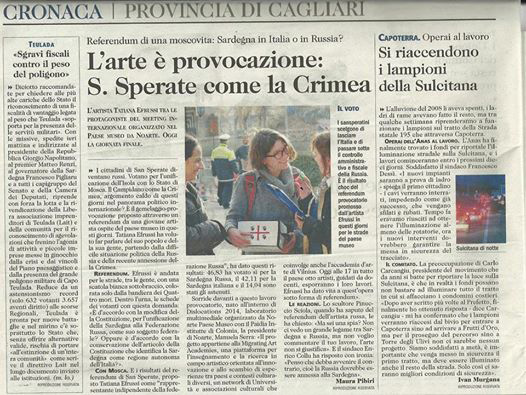 The Italian newspaper with an article dedicated to the referendum on the accession of Sardinia to Russia. The work of Tatyana Efrussi. 2014
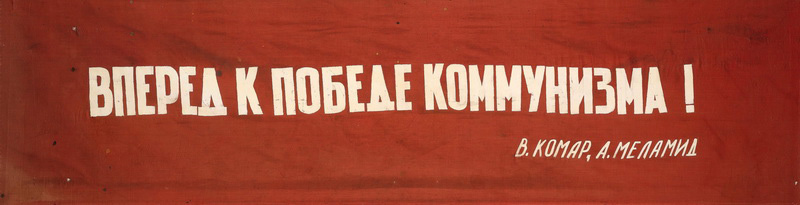
In the social art, the symbols of Soviet ideology were assigned to the artist so that they found a paradoxical significance of emptiness-the significance, which is not only the effect of appropriation of repressive symbols of power, but also a sense of lost meaning-the meaning, for example, Marxist statements. The ghost of this lost meaning is especially tangible against the backdrop of the absurd “privatization” of its shell, as in the “slogans” of Komar and Melamid, where artists sign with their surnames “glory to work” or “our goal is communism” and so actualize the problems of the universal/private. The famous banner of the “Collective Action” group “I don’t complain about anything, and I like everything, despite the fact that I have never been here and I don’t know anything about these places” also switches the statement of the statement from the slogan addressed to everyone to a purely personal recognition, and a top-up, which is addressed to a paradoxo described by a paradoxical, internally conflicting text. This internal inconsistency characterizing the void also indicates the loss of meaning in addressing to everyone, to a universal person underlying the Soviet project. But the artists are fascinated by this emptiness, it serves for them aesthetic resource, and the empty shells of utopia retain the ability to indicate some other, transcendental dimension.
Maria is one -year -old, "Feast during the plague." 2014
The similar ambiguity of the gesture of Soviet artists, which is also caused by censorship considerations, is unprotected in relation to Russian symbols of power: although Soviet authors (not only artists, but also filmmakers, writers, composers) faced this ambiguity, without a more direct path to speak out, the similar one, working with modern ideology, cannot be stumbled up. No wonder artists are entering today with power into horizontal buffoon dialogue, such as, for example, the “war” group with its “mentopop” or “x ** in captivity at the FSB, duplicate the logic of domination in today's Russia. The mockery of the “War” are built as the mirroring of the camp principle of gross force, which is in accordance with which the power thinks and acts. In the video of Mary of the one -year -old, dedicated to the adoption of the State Duma “On the Propaganda of Hymosexuality among Minors” and Putin’s speech about the accession of Crimea , the Russian authorities also have no hidden dimension, its differentness is the differentness of stupid, but dangerous monsters that can be horrified and which can be ridiculed without any respect. The speeches made by Putin or deputies in the video of the one -year -old is initially inhuman sound products: Mizulina speaks monstrously stretched bass, Zhirinovsky chattering and squeaks. The Tanya Efrussi project, a referendum on Sardinia, according to which the island was supposed to join Russia as Crimea, or the action of the Administration group, who has stirred an announcement of the search for “persons practicing non -traditional sexual relations,” these modern gestures of subversive affirmation indicate the horror of the possibilities to identify with the logic of power. But they do not find any semantic territories that are forgotten by her, no unconscious, which often reached a subversive affirmation of social block artists forgotten. The difference between the approach of social art or “cd” to the Soviet and approach of contemporary artists to Putinism can be read as the difference between the study of the devastated, which has lost the truth of rhetoric and rhetoric initially false.
Maria is one -year -old, "non -traditional." 2013
The above comparison of the Soviet and Putinsky is arranged primitively, on the principle of searching for similarities and differences between two data to comparison objective and independent entities, as in the children's assignment “Compare pictures”. Walter Benjamin with his “theses about the concept of history” , and he was not alone, would condemn such an approach. The past is not given to us separately from the present, and the operation of their segregation is always the operation of segregation of traces in the present: coexisting scars of the past, the recent past and what is happening right now. And ideology - both in the positive and in the negative sense of the word - acts through these traces. Many photographers, including amateurs, are busy recognizing the Soviet rudiments in today - from recent examples, one can recall the student of the student of the School of Rodchenko Dmitry Lukyanov, dedicated to the life of provincial Soviet cultural houses. This series shows that the lower -scale public impetus, the impulse of amateur performances, the impulse of the life of local communities, not without violence assigned by Soviet ideology, today does not find a new shell, reproducing the fragments of the past and the unsuccessfully jamming of the fifty ghost of universality.
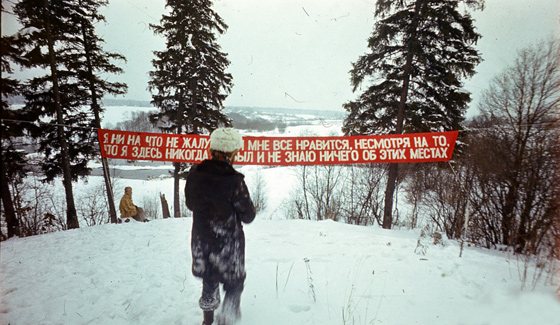 Group "Collective Actions". "Slogan". 1977
A difficult political statement about the interweaving of the Sovetsky’s traces with the present, raising a question not only about the continuation, but also about the loss of the Soviet, was the exhibition “Cinema to Romantic” by Dina Karaman, who recently held in the arena and was accompanied by a censorship scandal - but not with the exhibition, but with the text of Minaev’s novel. In each of the three parts of the exhibition (a format specified by the arena), romanticism appears in two inseparable hypostases: as a living impulse to another, to the truth - and as a repressive mechanism of interpretation and the official unification of this truth. For example, against the backdrop of an old slide, a modernist library in Ulyanovsk, pioneers and Zavolzhsky walking in front of it - gave an enthusiastic voice a modern guide tells the children about the importance of family values. The interweaving of romanticism as a impulse and romanticism as obligations refers to the Soviet cultural paradigm, in which the pathos of speaking on behalf of the people, speaking from below was petrified in bureaucracy and state apparatus. However, with all the inconsistency of the “romantic” at the exhibition, the core of genuine lyricalness is found in it, but the core that exists only being called into question, refuted in itself. The exhibition, as Dina said, began with a video shot in the mountains: the moon, lit by the dull light of the branches, the clouds smoke over the ridge. Dina shot this video purely for herself and thought that she could never show him publicly, since otherwise it would turn into a shameless vulgarity and lose its meaning. But the exhibition became an indulgence of a romantic impulse, included it in a system of doubt and irony, thanks to which it became possible to convey this impulse. And this dialecticity of the romantic becomes a challenge to the flat ideology of the modern Russian state, trying to include public impulses and aspirations, thus reproducing the Soviet scheme. The work of Dina indicates that the universal truth and truth is purely personal, the truth lurking from direct representation is mutually necessary, but their meeting, a meeting of the universal and intimate, entails an insoluble conflict as a sign of the presence of truth.
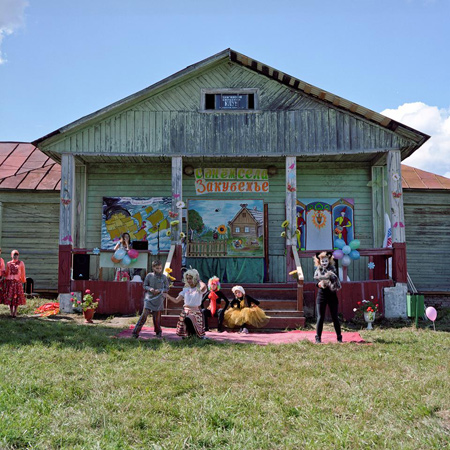 Dmitry Lukyanov, from the series "Dkdanism". 2013
In this context, you can return to the "slogans" of a mosquito and a Melamide or a transparence "KD". At first glance, by the absurd intimination of fragments of collectivist ideology, they indicate a flaw in the very design of total knowledge and universal truth that underlies the Soviet utopia - that this utopia, which is addressed to everyone, cannot work, being separate from social relations of the personal level itself, not being related to the truth of each individual subject. In their works, mosquitoes and melamide or “cd” restore this lost connection of the truth of the subject and the truth of the universal - and such a restoration of the connection is a provocative act for ideology, indicating the crowded out.
The current Russian authoritarianism does not appeal to any measurement of truth - neither as a universal message, nor as a secret engine of the subject - and works in the all kinds of horizon of the castle of castle. The loss of a monopoly on the truth is a fact that is unlikely to be grieved about. But he is a challenge to society, which should reflect a system of social ties, where truth could live. While the place of the source of aspirations for a different is empty, the ghosts of the Soviet one, which will try to master the state, will also go to it, will every now and then. But it is uncritically to repeat myths about the eternal return of totalitarianism in Russia that means distorting the situation, and therefore, confuse possible ways of withdrawal from it.