
Translated material
At the border of a nervous breakdown
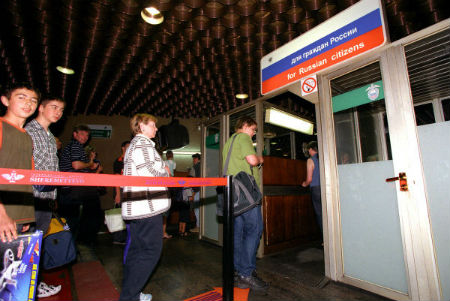
Passport control in Sheremetyevo. Photo:% B. Babanov/RIA "Novosti"
Participants in the protest movement are increasingly experiencing difficulties when crossing the Russian border.
On April 2, the FSB officer at the Domodedovo Airport detained the historian Irina Karatsuba and held a conversation similar to interrogation with her.
Earlier, similar situations were faced with, in particular, deputies, Natalya Polevina, activist Artem Chapaev, journalist Alexander Sotnik, the Executive Director of the Voilia Shibanova, the participant of the Solidarity movement, Olga Faleeva and the chairman of the soldier’s committee, Ella Polyakova.
Irina Karatsuba :

Domodedovo airport. I just returned from Sharm El Sheikh. An employee of the border service looks puzzled and says that my passport does not break through the base. I am taken to the side. Another employee invites you to go to a certain room. I refuse - he is sincerely surprised. Questions begin. Are you detained by the internal affairs bodies? Do you live at the address of registration? Where do you work? When I said that I was working on the radio, he was surprised the second time. Where were you? What did you do? Then he said that the case was in the Olympics, and when I noticed that she was over, he again significantly added: after the Olympics, the situation will develop and intensify. ” It sounded like a threat.
There were seven or eight people like me, near the mysterious room: a grandmother with a child, young women, a young man, Tajik citizens ... I don’t understand what united us. Some were taken to the room and closed outside.
The main question: why did this happen to me? The degree of my social activity can not be compared with the activity of Pelevina or hundred. In general, now you have to go abroad and return from there with instructions from a lawyer - so some people go to rallies, armed with the law on the police and the constitution.
Olga Faleeva :

The case was March 11 and 18 at Vnukovo Airport. I also went to Egypt. And the beginning was the same: the employee of the border service widened his eyes. Then another employee approached me, apparently the head of the shift, and asked to wait - they say, it was necessary to conduct a certain additional check. I waited more than half an hour. I was asked who I am, where I live, where and for what purpose are going, whether they were holding me at rallies and whether I support Pussy Riot. Then my fingerprints were removed. All my attempts to find out, in connection with which such attention, had no success. The most intelligible thing I heard: "You understand what the situation is." They also mentioned the Olympics.
All this happened at four in the morning and an hour before departure, so I had no one to call with a request for legal assistance. Upon arrival in Russia, the situation was repeated, but I had to wait less. After the employee of the border service waited, I waited only a few minutes. I was told that the reason for waiting for me to lose my passport. I never lost it.
Ella Polyakova :

This has happened to me already eight times: on the train, and on an airplane, and not leaving, and at the entrance. The scheme is about the same. An employee of the border service takes a passport, changes in his face, grabs the phone’s phone, begins to confer with someone and tells me that there are no problems, but I need to move away and wait. Sometimes they rewrite the data of passports of those who are traveling with me. Once I had to deal with a young border guard who, apparently, was faced with the need for additional verification for the first time and nervous - and I, already having such an experience, reassured him. He told me that everything finally understood when it turned out that I was working in the Committee of Soldiers' Mother.
We wrote complaints to the prosecutor’s office and the FSB. The departments sent them to each other, but in the end they still answered us. There were two typical answers. First: Sorry, our employees are loaded. Second: Sorry, your data is similar to a certain criminal. The worst that we are brought into some lists, and make you be excluded from these lists is even more difficult than understanding why you were brought there. It is important to respond to these situations. I do not really believe in court, but complaints sometimes help to reconfigure a system of lawlessness. I succeeded, and recently I have been going calmly.
On December 3, 2011, on the eve of the scandalous elections to the State Duma, Lilia Shibanova , a laptop was taken at Sheremetyevo Airport. She was able to return it only in March 2012, when the Khimkinsky city court recognized his seizure illegal. It was because of success in court that incidents in the border zone were no longer repeated, says Shibanova:

In my case, it was not only about psychological pressure. What was happening looked like an attempt to upload unlicensed programs to my laptop and initiate business. A similar case was in our Samara. I think that detention and interrogations at passport control points are a way of intimidation and, possibly, an obstacle, because of which civil activists may not go to international events. Be sure to punish the perpetrators in illegal detentions - first of all with the help of appeals to the prosecutor's office and courts. This, of course, is very troublesome, and the result will not necessarily be in your favor. But at least to some extent, arbitrariness will be limited.
Irina Borogan , editor of the AGentura.ru site:

Practice to detain people on the road or entry into the country has become familiar over the past five years. Andrei Soldatov and I had similar situations after our book was published about the Russian special services "New Nobility": during the year every time we left the country, our passports scanned completely, although they usually scan only the first page to make sure that the passport is not fake. This took time and fluttered the nerves.
Detention at the border is an effective method of pressure, especially since it is difficult to resist a half -hour or one and a half hour delay by legal methods, but the plane, if you are delayed when you fly out, can be skipped. Employees of the border services can always refer to the fact that when reconciling with databases, they "lit up" a signal and they need extra time to install something. Often, people are being made in some rooms, sometimes they ask banal questions there. All this makes you understand that your movements are tracked.
There is a special mechanism - the so -called guard control, which makes it possible to track the movement of people. As it became known, it was used in the case of Nizhny Novgorod human rights activist Sergei Shimovolos. Through the Russian courts, Shimovolos found that it was entered into the database and all its movements were tracked. The European Court of Human Rights went over to his side. But he was controlled by the Ministry of Internal Affairs, not the FSB. The Ministry of Internal Affairs, unlike the FSB, publicly admitted that the Center "E" keeps records of all people whom it considers extremists or prone to perform extremist actions. The FSB never stated that she has the same databases. It can be assumed that there is still. And the court will allow you to understand how the system works.
Yuri Gervis , lawyer:
Any verification measures can be carried out differently. You can correctly explain the actions that are carried out, but you can speak with a stone face and a meaningful look, thus exerting moral pressure on a person. There are a number of counting parameters that are checked when crossing the border: is there a person’s wanted list, are there any restrictions related to court decisions, including alimony debt, whether a person with him has objects withdrawn from civilian turnover, such as weapons and drugs ... questions that employees of the border service can ask to clarify these general issues, they may not be many. However, it is worth remembering that the questions about where the person was, in connection with which he traveled, with whom he stopped, is not within the competence of the Russian border service, since they are in no way related to the legal crossing of the border.
A citizen in respect of whom controversial actions take place in the border zone, has the right to know in connection with which they occur and who conducts them. They must introduce themselves to a person. People perceive their official powers in different ways and can abuse them. In order to be able to appeal these actions, you need to know the name and position (or the number of the token, if any) of the employee of the bodies. You can also photograph it on the phone, turn on the recorder. Then, probably, there will be no problems with proving his actions in court.
These actions can be appealed both to the court and to the bodies of the transport prosecutor's office. For example, complain about rudeness, inadequacy of behavior, infringement of rights. And the court may well take the side of the victim. I think that such situations can be related to extra-budgetary factors: say, with someone’s request to annoy a person, forcing him to be nervous. If the victims of the Tagus appeal are more often applied to the court and the prosecutor's office, the border service will be forced to adjust their actions and will no longer be able to easily satisfy someone's strange requests to lead people out of balance. And it should not be lost in such situations. Otherwise, consider that your ill -wishers have reached their goal.
Alexander Podrabinek , human rights activist and journalist:

The difficulties that have recently arisen in some Russian citizens when leaving and entering Russia can hardly be explained by law enforcement reasons. Most likely, border guards and customs officers create a nervous atmosphere at the border, obeying the instructions from above to strengthen vigilance and identify unreliable elements.
There is no operational meaning in this. Talks about political addictions and personal topics do not fit into the legislation and cannot be used even to initiate administrative cases. Attempts in this way to intimidate the opposition or people who sympathize with the opposition will hardly lead to success.
In such situations, I would recommend to stay with representatives of the authorities strictly within the framework of the law - this is given to them the most difficult. When detained, demand the preparation of the protocol with an explanation of the causes. There are no conversations on any topics without the interrogation protocol and in the absence of a lawyer. At the first appeal, to demand the name of the surname, position and name of the unit in which your interlocutor serves.
If all the requirements of the law are fulfilled by them, ignore their questions on the merits, taking advantage of their constitutional right not to testify against oneself. And the most important thing is not to be afraid. A dog that yelps usually does not bite. If you have something serious, you will be imprisoned without any preliminary conversations.