
Translated material
France: Olland's overthrow
The Spanish Party of the New Prime Minister
About why the ruling party suffered a crushing defeat in the municipal elections and why the “authoritarian sanguine” was appointed prime minister
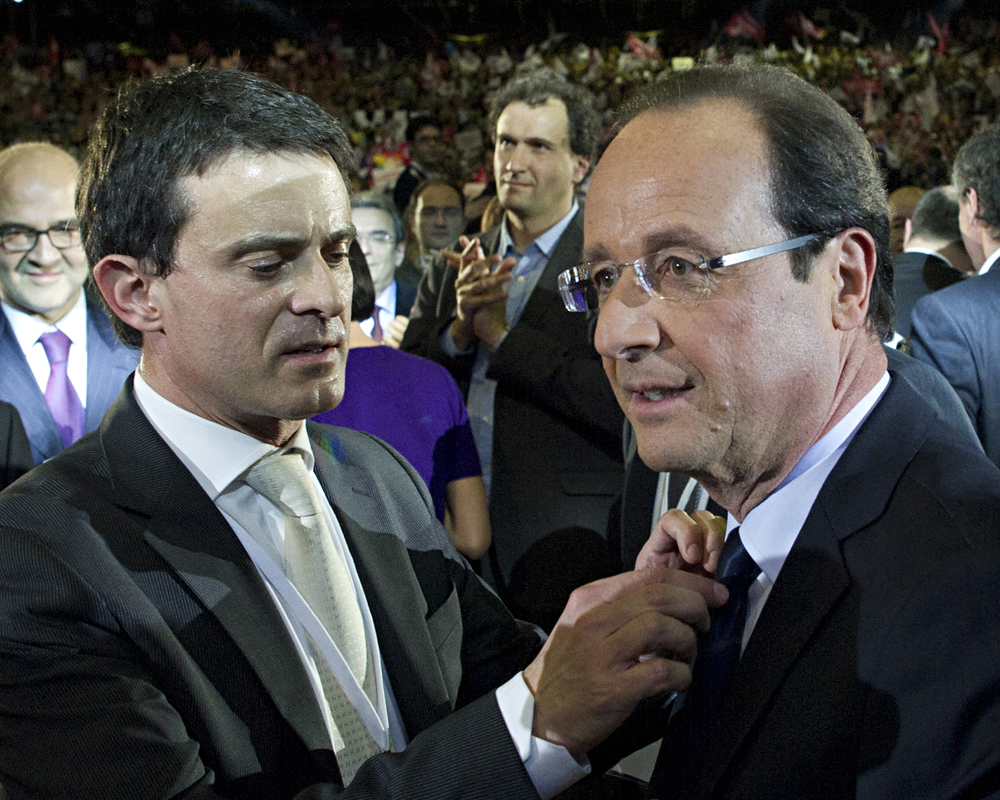
New Prime Minister Manuel Waltz (left) is designed to correct the mistakes of President Hollande
Socialist President Francois Hollande and his environment hardly come to their senses after a storm destructive for the party called “Municipal Elections”: the former cabinet is swept away, competitors took control of 58 large cities. According to the results of the vote on March 30, the socialists received about 40.5% of the vote. Their main rivals, liberal conservatives from the Union for the People’s Movement (UMP) party, supported about 46% of voters.
Francois Hollande was defeated less than two years after his election to the presidential post in May 2012. He failed his first exam - and these were the first elections after his arrival in the Champs Elysees - an exam that, as he tried to inspire his environment, “real trifle”, “pure formality”. Just think, the elections of mayors of 36 thousand cities and communes are a purely local event, it should not be reflected in the atmosphere of the Palace of the Republican Monarch. However, everything happened exactly the opposite.
The main loser
The result was unprecedented, defeat was the most difficult. Socialists, together with their partners in the ruling coalition, have lost control of 150 cities with a population of more than 10 thousand inhabitants. There was no such shame yet. Moreover, in 12 cities the ultra -right National Front Marine Le Pen won: now in his asset of 1,200 won places of municipal advisers against 80 according to the results of the 2008 elections. The growth of the influence of the Lepenovites and the expansion of the circle of their voters is undeniable.
But the main defeat personally suffered Hollande. “It is necessary to change everything,” he said to his environment, learning about the results. Who would doubt ... “I heard your voice, I understand everything,” he turned to the electorate on television the day after the announcement of official results. The electorate remained in doubt.
A few hours after the television, Hollande removed Jean-Mark Airo from the post of prime minister of his close friend, appointing his always opponent (inside the party), Manuel Waltz, the energetic head of the Ministry of Internal Affairs with the reputation of the “right among the left”.
In fact, these elections became a nationwide referendum against the policy of the president and his government. The main complaint of the voter: the socialists did not keep the pre -election promises.
"
Socialists, together with the "green" have lost control of 150 cities with a population of more than 10 thousand inhabitants
"
"Change - now!" - So sounded the main election slogan of Hollande, which was picked up even by companies engaged in private air transportation.
The main points of the election program also looked like a tidbine piece. “We will redistribute the tax load between the rich and the poor,” Holland promised. Yes, yes, this is about the 75 percent tax on the superpathies, against which he voted-already in Russia! - Multimillioner Gerard Depardieu. Bottom line: everything hung in the air. Hollande did not dare to butt with the Constitutional Court, which questioned the initiative of the Elisean Palace, which gives rise to populism, although he gives the President the opportunity to insist on his Constitution of the Fifth Republic. In addition, Hollande promised to “overturn the unemployment shaft”, from which young people suffer most, and even initiated the innovation - long -term “youth contracts”. The goal is to stimulate stable employment among young people.
But here the successes are more than modest. 5.5 million Frenchmen - 11.5% of the able -bodied population - without work. More than 10 million live behind the poverty line. Obviously, it has not yet been possible to overturn the shaft.
The son of the artist
Francois Hollande, no matter how much it hurts him to listen to it, is an unpopular president who had flushed in power in vain in power. Its unpopularity beats records - only 20% of the French, according to the latest surveys, are satisfied with his stay in the Champs Elysees. His new Prime Minister is twice as popular with him. At least in the social party. They say that the 52-year-old waltz anticipated the appointment of the prime minister, prepared in advance for this, too clearly interfering in questions that were not formally the sphere of his competence, up to sharp polemic attacks on colleagues.
Many call the waltz "Sarkozy from the left." However, again, whether he is actually the left is a big question. It is undoubted that the waltz infects many with its frantic activity and vivid performances. But his pronounced authoritarianism, and his exorbitant ambitions, which he never hid, are striking are striking.
The Spaniard by origin, the son of the artist from Catalonia, who received French citizenship only in the early 80s, Manuel Waltz from a young age was engaged in social activities and politics. A quarter of a century ago, he was an adviser to Michel Rocar, the Prime Minister and the brightest person among the French left. In 1997, the waltz was already working with Lionel Jospen, another prime minister-socialist under the right President Jacques Shirake.
Waltz's entourage is the most venerable public relations in France. It was they who handed him the skill optimal for his career and authority to use the media, with their help, he launched strong connections among the bosses of the media and publishing market. The waltz is not one of those who are trying to spend public opinion. He creates it himself. “This is a real PR machine, which is not equal to the power in today's France,” one of his trusted people said about him. It is in this, perhaps, the main difference between Waltz and Hollande and Airo, whose manner of communicating with voters is concentrated in one word - confusion.
On a strange field
The paradox is that Hollande, severely punished by the left electorate for failure to fulfill the main election promises, made a man who, being one of the most recognizable politicians and an official in France, was initially unpopular in his native social party. Mostly for the excessive, as many people believe, the rule. For example, in 2011, the party organized the primaries to decide on its candidate in the presidential election. Among the supporters of the left forces, Manuel Waltz took the penultimate place, barely gaining 6% of the vote! But after that he managed to turn the situation into his favor. Now his support rating, according to polls, has been held a 30 percent barrier.
And here something hitherto unheard of is discovered: the waltz today earns glasses in rhetoric, which in previous years would be risky for the leftist.
So, he exploits the topic of strengthening the authorities, tirelessly supports the internal affairs bodies entrusted to him, if there are conflicts and disputes with justice, and is beating illegal immigration. Even at the time of the presidency of Sarkozy, the waltz was one of those few socialists who supported the steps (and rhetoric) of the then owner of the Champs Elysees against illegal immigrants, primarily against the gypsies arriving from Romania and Central Europe and settle the slums on the outskirts of French cities. “These people do not want and are not able to integrate,” said the waltz on French radio, justifying the demolition of slums and mass deportation of 20 thousand gypsies. (By the way, officially the number of gypsies in the country did not exceed 17 thousand, which means that many were deported a second time or even sent several times.) State pressing against immigrants is sharply criticized by part of the left -wing establishment, including the top of the social party, as well as human rights associations and movements in protecting the rights of immigrants. But the waltz did not embarrass.
On the contrary, having headed the Ministry of Internal Affairs, he only activated this pressure. And in the eyes of the general masses of the population - including supporters of left -wing ideas - has turned into a person who can stop underground immigration. The waltz feels the mood of the layman well, and the dogmas of the social party party is not a hindrance for him. He is a new type of leftist. For example, he does not hesitate to talk about the “internal enemies”, referring to the young Frenchmen who left for Syria to fight with the regime of Bashar al -Assad. The object of his attacks was the Salafites and supporters of jihad, in a word - fundamentalists, but public opinion accepted them to the expense of Muslims in the broadest sense.
Until now, the Muslims and immigrants consistently turned into a repulsion goat the far -right National Front. Now one of the most promising figures of the social party party is playing the same field, and now the head of government.
Intrigue-2014
After the municipal elections, the French policy enters the intriguing phase. On the one hand, Hollande, who, according to one of his advisers, “was used to the prescription with the help of Sesamez and negotiations alone” - that is, directly with members of the government, bypassing his friend Airo. On the other hand, a waltz. After the party’s defeat in the municipal elections, Hollande puts in the prime minister’s chair actually his main competitor in the party (but popular in the country), the “authoritarian sanguine”, as one of the officials of the Champs Elysees called Valsa. A person to whom part of the party members is still not ready to forgive the idea of removing the word “socialist” from the name of the party.
There is no doubt, the waltz will be happy to take a podium. And even more: in his sight you can already see the presidential election of 2017. In the updated government, where the portfolio of the Minister of Ecology received the ex-satellite of the president and the ex-candidate for the President Rulen Ruayal, everyone understands this. In the last days, the body movements of the executive branch are indecisive and clumsy. (Two "green" ministers from the former government Airo refused to become members of the team of the new prime minister, believing that the political line of the waltz "leads to the disaster.")
The tension at the top is growing, which is very inappropriate for France in its current state. The social crisis, which began in the five -year plan of the reign of Nikol Sarkozy, continues to worsen, increasing the budget deficit of the French state. The economy is not growing (growth of 0.3% in 2013). Brussels more persistently requires Paris to reduce deficiency, cutting social expenses and launching cardinal reforms. Meanwhile, it was this neoliberal policy that caused a social shock, which, in turn, was reflected in the results of the municipal elections. “We must act faster and stronger,” said the waltz, barely settling in the Matignon palace, the residence of the prime minister. He said so convinced, as if the disappointed French left electorate had already completely lost his memory.
Photo: Fred Dufour/AFP/East News
France is a unitary state with the Presidential and Parliamentary system. This means that the ratio of the powers of the president and the head of the government (Prime Minister) depends on the balance of power in the National Assembly (one of the two chambers of the parliament). If in the National Assembly the majority of places belong to the Sopartians of the president, he appoints the Prime Minister at his discretion, remaining the sole head of the executive branch. The Prime Minister is responsible primarily to the president who has the right to resign the government at any time.
If, according to the results of the parliamentary elections, the ruling party is losing, the president is forced to proceed from the real alignment of forces and entrust the Cabinet to the representative of the competing party. In this case, the Prime Minister enjoys certain independence from the president, and key decisions are made by parliament. There were three such periods in the history of the Fifth Republic (in France it is called “coexistence”): 1986–1988-President Francois Mitteran (Socialist) and Prime Minister Jacques Shirak (Gollyst). 1993-1995-President Francois Mitteran (Socialist) and Prime Minister Eduar Bullian (Hollyst). 1997-2002-President Jacques Shirak (Hollyst) and Prime Minister Lionel Zhospen (socialist).