
Translated material
Nobody saw anything
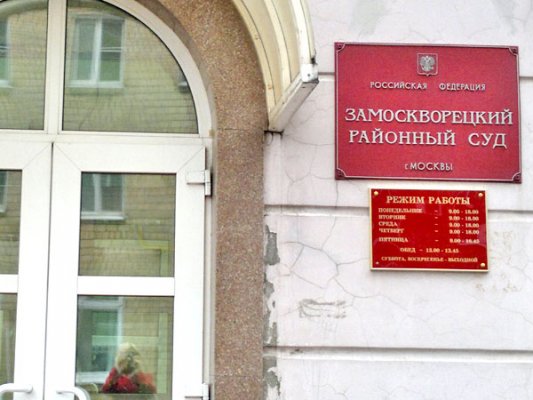
“Still and strange,” was read on the face of the judge of Chepraova, who falls into the rabbit hole of the administrative process ...
April 2. So, today the next meeting was held on our general general client with Tatyana Glushkova. The situation is similar to the one that Tatyana recently described - in the protocol on an administrative offense is a address that does not exist, and at which our client, according to the prosecution, made an offense, - Bolshaya Tatar Lane, 10. But even this, as it turned out, is not the most interesting. Yes ...
Briefly about the factology of the case.
The charge is actually based on two documents - a report and a protocol on an administrative offense.
The report was drawn up by a polycussion, who did not detain our client and did not see how he was detained, because he first saw him in a car carrier. But at the same time, apparently, just in case, he pointed out in the report that our client “with his actions made a violation of the public event of the established procedure for holding a rally” (if you did not understand anything, know - this is normal ...).
The protocol was drawn up by a polycres, who could not see anything at all, because at the time of the detention he was bored in the police station in the south-west of Moscow in anticipation when he would be brought by several car carriers with detainees.
We summarize. Nobody saw anything.
Therefore, they decided to transfer the case to court.
(Until April 2 there were several court hearings that were postponed for various reasons. The last time before the interrogation of the police officer was postponed due to the fact that my colleague Tatyana Glushkova filed a motion to introduce a notification from the cadastre that the address that appears in the protocol does not exist.)
Today I had the honor to interrogate a police officer born in 1992, who began with confidence by the fact that the detention was carried out by the Zamoskvoretsky court, and our client chanted "Freedom to the Prisoners of Bolotnaya!" To my question why in a report he wrote that the detention was taking place on Tverskaya Street, he thought, smiled and asked to see the report. Having studied the document, he said: “Yes, everything is correct. So, on Tverskaya. " It turned out that on February 24, a man managed to visit both events and “didn’t remember exactly” where and what exactly happened. For the same reason, he showed that the approximate number of participants in the action was “about 200”, while the protocol indicates “about 1000”, and the clarifying question regarding the slogans replied that “one of the people chanted slogans,” and whether our client was not known among them.
As a result, having received comprehensive information about the detention from the polythe, who did not see anything and did not accept his own detention, Judge Cheprasov decided to postpone the meeting in order to call another important witness - a police officer from the police department, who made a protocol on an administrative offense and which also did not see anything. The judge explained her decision by the fact that he wants to find out “who made it such a wonderful protocol.” “After all, it turns out,” she said reasonably, “that the question is at all, whether there was a client at the place of the offense.” I wanted to add “at the address that does not exist”, but resisted.
Now you will see you with Judge Chepraova on Friday, at 9:00 in order to interrogate another witness who did not see anything.
(On Friday, the meeting was postponed to Monday, since the witness did not appear.)
April 7. The proceedings in the case of an administrative offense under Part 5 of Art. 20.2. The Code of Administrative Offenses is stopped!
So, today Tatyana Glushkova and I still managed to interrogate in court another one, this time the last, witness who did not see anything.
Today, the district commissioner, a middle -aged peasant, suspiciously unlike his colleagues of an invisible front, acted as a witness. If I were in their place, as if I would suspect him of "unreliability." “Unreliability” proved to be almost immediately-as soon as the district authorized person asked the question of whether someone from the prosecution would participate in the process. The unexpected adequacy of the question, I was probably surprised even more than the district police officer.
The interrogation was predictably - a witness who did not see anything, explained to the court that he had not seen anything, that the protocol was on the basis of a police officer, who also saw anything, and about the mismatch of the addresses suggested that it was made in connection with a “technical error”. To the question of my colleague, regarding where the mention came from the protocol about the number of participants in the action, slogans that our client allegedly chanted, as well as his actions during the detention, if in the report, on the basis of which the protocol was drawn up, these data are not in principle, the district police officer expressed a seditious assumption that not all documents and part of the documents were simply lost.
Judge Cheprasov already listened to the explanations of the defense without much enthusiasm - all possible witnesses who did not see anything were questioned, the circumstances set forth in the case file, not only did they contradict each other, but did not coincide with the circumstances contained in the testimony of witnesses of the protection that saw everything, the address of the place of committing the offense in reality was not in reality. In a word, Judge ChepraSova did everything that she could to maintain the prosecution, and her conscience was clean - one could safely make a decision on the termination of the proceedings.
Thus, this is already the 7th termination of the proceedings in the case of an administrative offense in a series of detentions on February 21 and 24, 2014.
PS Ah Yes, the proceedings were terminated in connection with the release of the place of administrative offense.
Original :
Comment by lawyer Yuriks * Tatyana Glushkova * :
The meeting in the case of Andrei Yashin was marked immediately by three amazing events.
Firstly, for the first time in my practice, a district police officer was called to the court, drawing a protocol on an administrative offense. Alas, not as a representative of the prosecution, but only as a witness.
Secondly-again, for the first time in my practice-the words “The representative of the prosecution” in the administrative process did not sound from the defender (but from the same precinct authorized, interested, whether the representative will be in the process). Having received clarifications that if anyone can be a representative of the prosecution in this process, then only he, the district police officer, was retreated with the phrase: "And what ... I am not the prosecutor, but only the designer ..."
Thirdly, Judge ChepraSova announced the resolution of the decision!
The revolutionary, in general, was a court session.