
Translated material
There are no contradictions
The Constitutional Court of the Russian Federation did not see violations in the Law on NPOs
On April 8, the Constitutional Court of the Russian Federation ruled that the Law on NPO - foreign agents does not contradict the Constitution, but the fines for it should be changed, since they do not allow the punishment below the lower limit. What losses suffered NGOs and what citizens lost as a result of a one and a half years of war with the "agents" - the New Times sorted out 
“Of course, we continue to work, announced the creation of a new organization - the Kostroma school of public policy. Last week, Boris Nemtsov spoke with us, talked about the growth of housing and communal services tariffs, ”says Nikolai Sorokin, chairman of the Board of the Kostroma Support for Public Initiatives. Rather, already a former chairman: after the center in the spring of 2013 was fined 300 thousand rubles. For refusing to register with a “foreign agent”, the founders were forced to start the process of its liquidation.
“Now we work without the formation of a legal entity,” Sorokin continues. “Of course, this is difficult, we don’t have an account, we cannot receive donations, write applications for grants ... But to rent a hall, put mineral water and glasses - this is a small amount, so we have developed with friends and supporters and still held this round table.”
Statistics
In total, for the period from November 2012, when amendments to the Law on NPOs entered into force, by the end of February 2014, the prosecutor’s office on the need to register as “agents” received almost 60 organizations. 11 of them achieved the abolition of prosecutors through the court, four more continue to sue (the processes were suspended before the decision of the Constitutional Court) and only two were forced to self -destruct. At the same time, none of the “attacked” NPOs in the register of “foreign agents” has never been signed: it is now the only unknown organization in it-“promoting the development of competition in the CIS countries”. "
The courts over the past year did not receive a clear signal from the Kremlin to unambiguous support of the prosecutor's office
"
It is also easy to notice that the “foreign agents” identified by prosecutors are distributed unevenly (see map on page 22). Along with Moscow and St. Petersburg, there are several more points of their increased concentration-for example, Perm, Chelyabinsk, Murmansk and Novosibirsk. “In different regions, there are different activity of non -governmental organizations: in Perm or Novosibirsk, for example, it is higher than in many other regions,” explains Pavel Chikov, head of the Agora Association. “The degree of aggressiveness of local prosecutors is also distinguished, therefore, say, the Far East has practically not noted by some serious raids at NGOs.” 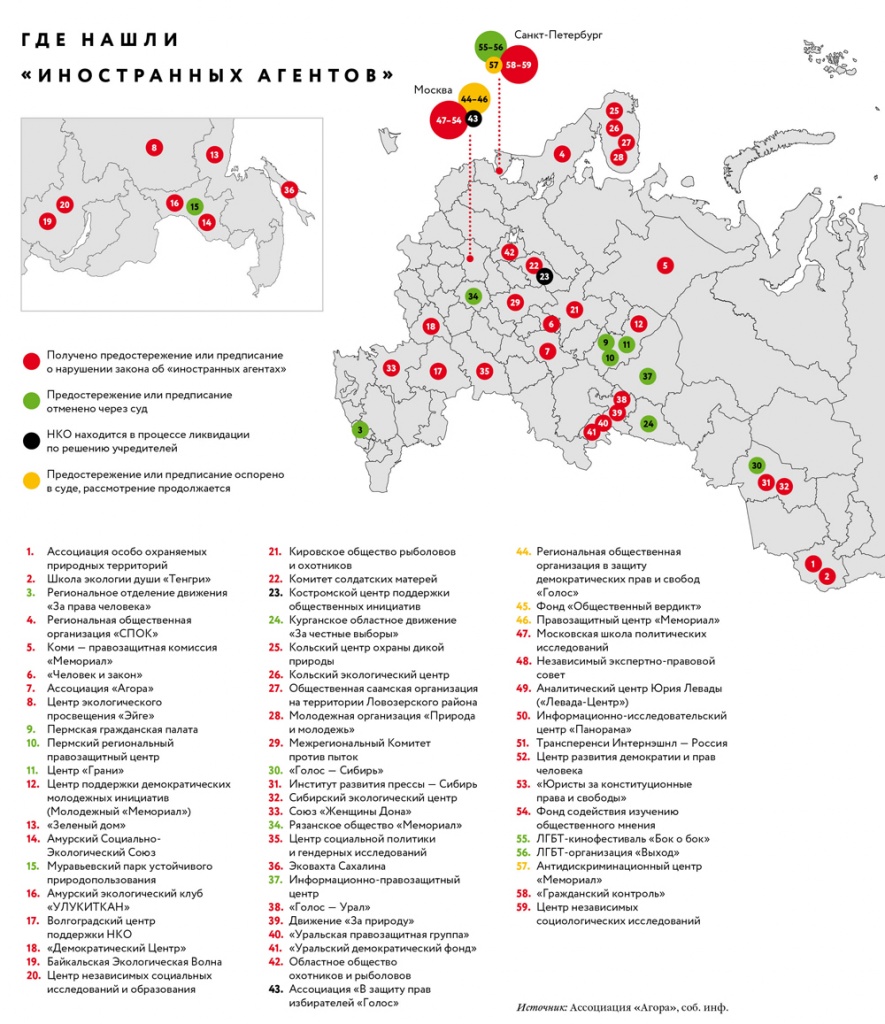
Losses
However, without losses for social activists and ordinary citizens in this war were not done.
For example, the Kostroma center, according to Nikolai Sorokin, was not only the only site in the city where there were discussions on all -Russian and local problems, but also provided free methodological and legal assistance to other public organizations that often have neither an office, nor their own lawyers, nor accountants. The newspaper and the site that informed the townspeople about the activities of NPOs and civilian activists were also closed.
Those who retained his organizations had to spend a lot of effort and means to beat off the attacks of prosecutors. “The inconvenience and hassle related to inspections and subsequent courts were universal: thousands of organizations were forced to engage in all this nonsense for a month or two, and those who later went to the courts have been doing this for almost a year,” the head of Agora explains.
At the same time, the largest human rights organizations, according to their representatives, managed to minimize losses.
So, the Voice association, which, after paying the 300,000th fine, also had to go to self-destruction, now exists in the form of the same public movement. “Our main task is to observe the elections, and we continued it, no matter what,” the co -chair of the Voice Movement Grigory Melkonants told The New Times. “The scale of our work, of course, decreased, but we worked both on the autumn regional campaigns of 2013 and in an extraordinary election.” All traditional projects acted-a hot line, a “map of violations”, an SMS-cyc: “All this worked and in no way turned off for a single day from the moment the pursuit of the“ voice ”began.
“Last year, it was something harder than the previous one, but something better,” agrees the head of the Memorial human rights center Alexander Cherkasov. -We did not close, did not specifically reduce some projects. Moreover, we had another front of the work-our lawyers assisted many NPOs in cases of “foreign agents”, and some of these cases were successfully won. ” 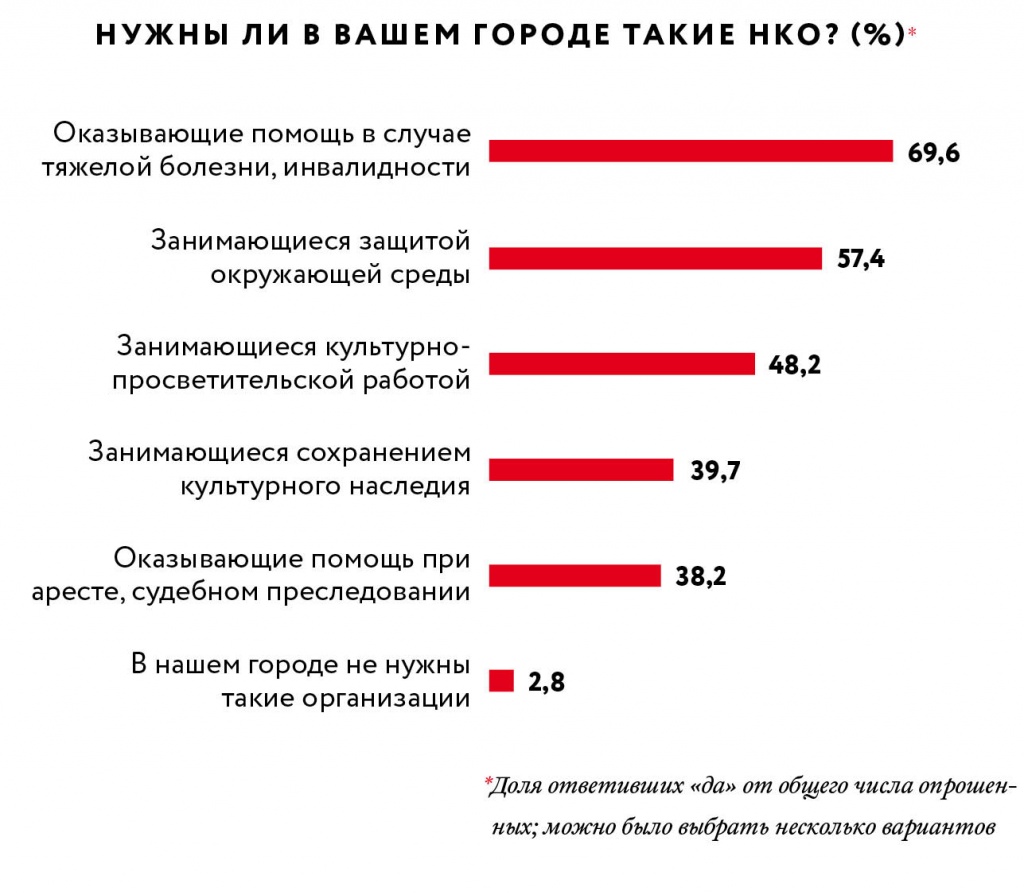
At the same time, all social activists agree that the war of the state with the "agents" caused NPOs a huge reputation damage. “Citizens more prone to state propaganda have established themselves in the opinion that“ someone sometimes with us, ”complains Pavel Chikov. “Our citizens generally know little about public organizations, and if you know little about something, and you are facing a powerful propaganda wave that it is bad, foreign, it is very easy to form such a negative attitude,” adds Boris Makarenko, chairman of the Board of the Center for Political Technology (CPT).
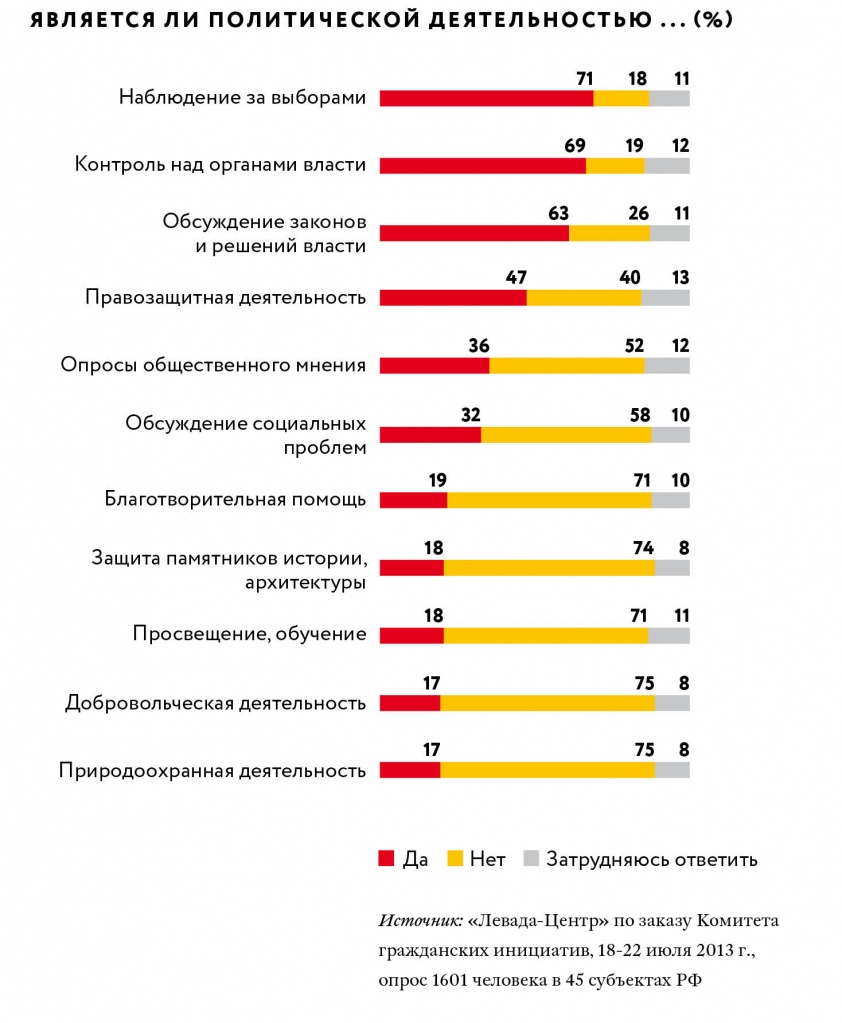
Last fall, by order of the Civil Initiatives Committee, Alexei Kudrin, the Central Department Store prepared a report on the state of the Russian Civil Society of Russia. It stated that Russians really do not experience special needs at NPOs - with the exception of those that provide specific benefits (for example, social), and not abstract protection of rights and freedoms. And in the understanding of the term “political activity”, our citizens, as it turned out, are very close to the prosecutors, who also consider “control over the authorities” or “discussion of laws” by a pure policy (see graphics).
And it is from this point of view, Makarenko believes that the intermediate results of the “hunting for agents” should be evaluated. “According to formal criteria, it can be said that prosecutorial inspections were terribly ineffective: almost 1 thousand NPOs were checked, about 200 were found signs of political activity, and the prosecutor's office aroused a little more than 20 and even not everything won,” the political scientist summarizes. - But in fact, the effectiveness of this struggle is very high. Because its main goal was to change the climate in relation to NGOs and intimidate them. Which was done. "

Photo: Gennady Gulyaev/Kommersant