
Translated material
- breeze - sulfur or chlorine?
Norilsk Nickel against the film "Combine" Nadezhda "
A film about a city that is considered one of the most environmentally unfavorable points in Europe - travels to international festivals, but may not go out in Russia
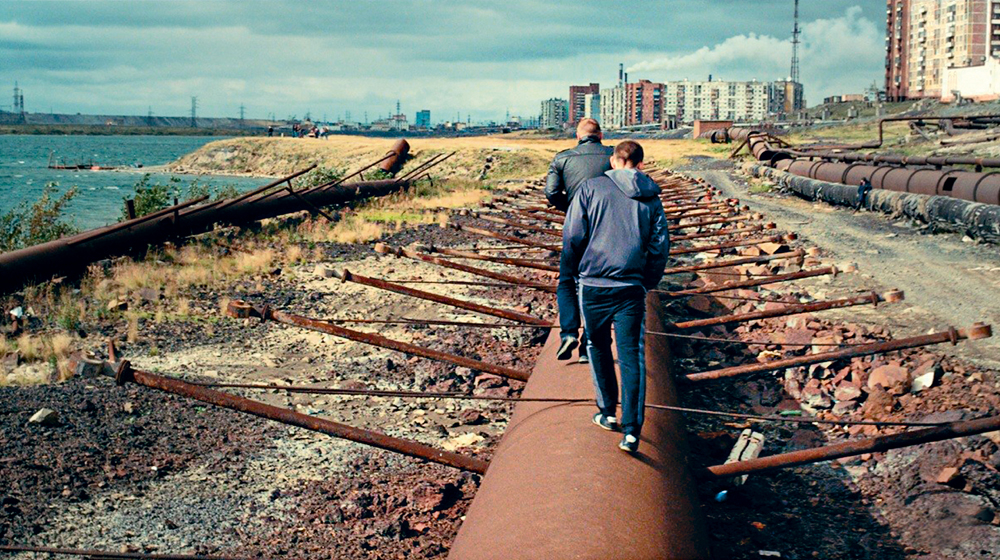
Hopelessness in the landscape and heads. Frame from the film "Combine" Nadezhda " /Photo: The press service of the director
| *Natalya Meshchaninova-documentary director, student of the workshop of Marina Razbuzhkina. ** On April 1, Minister of Culture Vladimir Medinsky said that the Ministry of Culture of the Russian Federation will support the bill on the ban on non -normative vocabulary in cinema and theatrical productions. He said that films containing obscene vocabulary will not be given rental certificates. Nevertheless, the show of such a film at festivals will be possible. |
Director Natalia Meshchaninova dullly crazy about a narrow Vilnius street: on April 1, Minister Medinsky was not jokingly stated that he was preparing a bill on the ban on the film in the cinema, and Natalia was seriously worried about the fate of her first game painting “Hope”.* The film - about teenagers from the Far North, who, discussing the topics far from the motives of philosophy Kierkegaard, the work of Hoffmann or the use of cadenations in Baroque music, especially do not select words. Anticipating the rapidly tightening of cultural nuts, Meshchaninov shot all scenes in two takes - with non -normative vocabulary and without and, if desired, can mount a special, dietary version. But on installation, rewriting sound and other things called post -production film industry, you need at least six months. Before the Festival "Kinotavr" - he in June - no longer in time. It seems that the author’s version of the film will only be seen by the audience behind the hill. **
"National Distributors"
In winter, the picture participated in the Rotterdam competition, where Sokurov and Parajanov were once awarded, is now demonstrated in Vilnius, then he will go to Wiesbaden. So far, the Russian community in Lithuania was most aggressively accepted: on a conversation after the show of Meshschaninova and actress Daria Savelyeva, who played the main role, was bombarded with questions where the words “denigration” and “lack of culture” appeared. People who were unlikely to be behind the polar circle were interested in what purpose the Meshchaninov was discredited by the city and the friendly extractors of precious metals living there. Leaving the audience, one of the Russian -speaking audience shouted to the girls: "What, glory to Ukraine?" Obviously, in this way he made it clear that the picture, where the Russians drink vodka and swear obscenities automatically classify the authors of the subsets of national traitors who support the disgusting Maidan.
Cineman growing up
The funny thing is that the hard Norilsk texture-the factory workshops, where they had long waved a hand to compliance with safety rules, streets without any signs of greenery, poisonous-ssvintos palate-in the film about the city, which is considered one of the most environmentally dysfunctional points in Europe, is practically no. Unless at the request of the father to open the window, the heroine boldly aware: “And what is our, interesting, today the breeze is sulfur or with chlorochka? What do you like more? " Otherwise, this is a classic film-romance of growing up, Coming-off-Age Story, whose conflicts are the same in Norilsk, Honolulu and Moscow: whatever the nest in which you grew up-idyllically green or with air, overwhelmed by chlorochka, you painfully want to escape from there as soon as possible. Just because it is vital to break away from the roots at a certain age. Meshchaninova admits: she chose such an exotic point for filming on the map precisely because she wanted to show: people rejoice and sadden in similar proportions, wherever they are.
"
It was impossible to shoot on the street: the police demanded for approval the dialogs in printed form
"
Norilsk Nickel against
But the local philistine did not believe. The main opponent of the filming was the Norilsk Nickel. As soon as the group arrived in Norilsk, the plots dedicated to television people who arrived to denigrate Norilchanes began to twist on urban television. "The film begins with the scene of drinking strong alcoholic beverages in nature!" - the authors of television ties were horrified. "Do you never drink kebabs with vodka?" - the director of Meshchaninova was helplessly. “Uh, we drink it,” the Norilsk residents answered and disappeared, refusing to continue the conversation. It was impossible not only to get to the factory workshops, but also to really shoot on the street: the police demanded the approval of the dialogs in printed form. Problems with the extras and episodes began: local artists refused to act. That is why the microscopic role of the saleswoman of the souvenir store is played by the screenwriter Lyubov Klumen, the visitor to the factory medical room is portrayed by the operator Denis Klebleev, and in the mass scenes the film group can be seen almost entirely.
The picture “Hope Combine” was shot without a penny of state money: this is the fundamental position of the 26-year-old producer Elena Stepanishcheva, who believes that the state should not take money for a movie. Behind Stepanishcheva’s back is Boris Khlebnikov’s comedy “until the night is separated”, shot for $ 100 thousand, collected on the Internet. The line of crowdfunding and private financing Elena is going to bend from now on: I would like to make a movie, the inappropriate ministry. Stepanishcheva is one of the authors of the manifesto of independent producers published in the journal "Session": it was de facto and was the general producer of the Hope Combine, although five producers are five. Films like this appear in Russia more and more often. It seems that our movie was overwhelmed by a new wave, and its authors make films so passionately that it is not important whether they are expressively expressed or not.