
Translated material
Violence and worldly
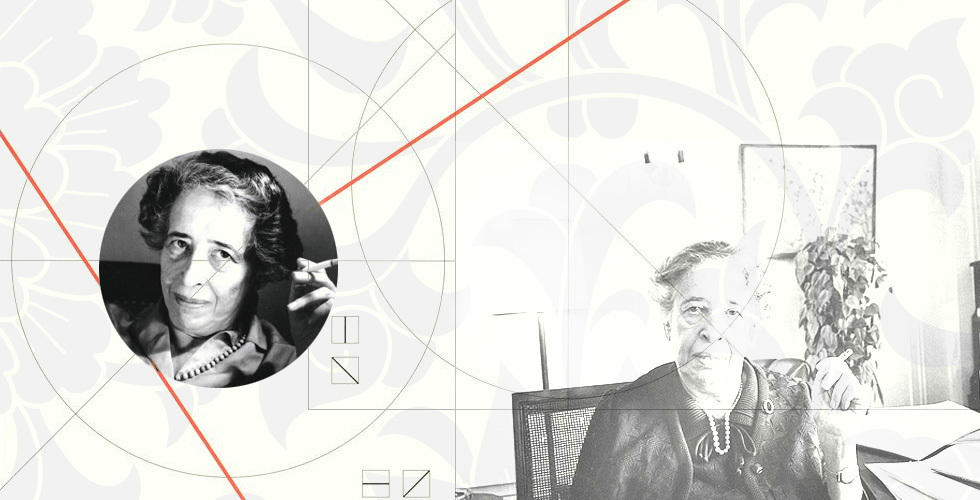
The book of Hannah Arendt is divided into three parts - it is reasonable to divide into these parts and a review.
False windows of power
False windows are a well -known architectural element that does not violate the harmony of the palace, but only shows that genuine power with its mercy even turns into a substantial element of the composition. False windows “in the sky of black” require a certain pretense from the viewer - he must take them for the true ones, while recognizing them false. Then they will no longer be accepted for the true ones, but will become a true aesthetic fact, the same heritage as any other element. Power for Hannah Arenidt is a complex baroque or ampir composition, it is not a nomenclature, not a system of subordination and management, but rather a collection of all kinds of architectural elements, each of which is absurd, but together they form the composition that does not tolerate voids.
If in ancient metaphysics nature has not suffered emptiness, then in the metaphysics of Hannah Arendt does not tolerate the emptiness of the politician; And does not forgive that emptiness, that frustration, which leads to violence. Lessee was skeptical of the youth violence of 1968 - it was it that served as the background of the book. For her, this youth violence was simply an indicator of the frustration of those people who learned to list all architectural elements, put parliament, court and local self -government on the shelves of their mind, but which at the same time annoyed by this curiosity.
 © New Publishing House
Hannah Arendt is more likely to act as an enlightening naturalist, for whom the systematization of curioses and pathologies in nature proved not the strangeness of natural life, but on the contrary, delighted with the classical harmony of childbirth and species of organisms. Systematization, accompanied by great work on explaining individual phenomena, created the ideal of classical harmony as a single principle of “spiritual being” - the distance between enlightenment and chanting the spirit is not as great as it seems at first glance. The parliament as a bearer of the spirit of democracy, with signs with the names of each speaker, is arranged in the same way as the botanical garden, zoo or a collection of minerals: as each phenomenon should speak, being included in the catalog, so each parliamentar must perform, creating the draft law. Arendt shows that it is possible to get rid of violence in modern politics if the enlightenment is not returned to it as an ideology, but as the transformation of the “botanical garden” into a “nursery of seedlings”.
Hannah Arendt immediately shares power and violence, proving with the help of numerous calculations that strong power does not turn to violence. Violence is always a temporary measure, always revenge or rage, which is not compatible with the dignity of power. The authorities cannot rely on any fierce adherents, subordinate to the orders of the commander or the beings of the heart: no matter how strong the effects of these orders and internal motives are, Goliath is doomed to fall under the weight of the architecture of its volumes. “The volume of violence is at the disposal of a particular country soon, perhaps, will no longer be a reliable indicator of the power of this country or a reliable guarantee against destruction from the side of a substantially smaller and weaker power. And here there is an ominous resemblance to one of the oldest intuitions of political science - that power ( Power ) cannot be measured in the categories of wealth, that an abundance of wealth can weaken power, that the rich are especially dangerous for the power and well -being of the republics ”(p. 16). The authorities, understood as wealth, requires to cut real windows in the place of all false windows, but this is what turns out to be a fatal solution: the building becomes unsuitable for life, uncomplicated to incompatibility with life. And then, not violence, but a living life, rebelled against her.
Seduction: leading and erecting
For tenant, the world of people living in democracy is the world of people seduced by a correctly built speech. Remembering how small the asset was in student rebellions, Lessidte remarks: “The most inactively observing the majority entertained by the resolving between the professor and the student, in fact, has already become a secret ally of the minority. (You just need to try to imagine what would happen if one or more unarmed Jews in Germany on the eve of Hitler tried to disrupt the lecture of the anti-Semita professor ...) ”(p. 50). On a superficial glance, it may seem that tenant is distrustful of the rebellious minority, although it endlessly exalts it over the universal agreement in the Nazi state. But in fact, the unity of the thoughts of Aryan students in Germany and the unity of the thoughts of democratic students in America are different things.
Aryan students considered themselves philosophers who would never be seduced by anyone’s living speech: they know better how it should. Whereas American students are ritors who understand that life defeats life in a dispute with the idea. On the side of life there is not only the scope of opportunities, but also the fact that the plan of life about itself is immediately clear. So the sage of Gorgia, justifying Elena Trojanskaya, said that she was seduced not only by the compliments of Paris, but also by Eros’s fire, forcing all people and not leaving anyone indifferent to someone else's happiness and trouble. Totalitarianism requires to be indifferent, but here we can recall not only gorgic, but also Cicero, who, arguing about the nature of the gods, noticed that the gods cannot be considered indifferent - because if they have sufficient invisible eloquence to convince even skeptics of their existence, then they are a bit to the world, a bit to the slightest change in the mood of the audience. For Cicero, the world, and not just a person and society, has a mood; And therefore, politics for Cicero is not the realization of “interests” and moods, but the ability to live in the world so that he does not get you and does not talk to you, does not confuse you.
Thanks to Rede, the world learned that hatred of those who are not like you - this is a hatred of life, no more and no less. Now many Russian readers will learn about this.
Hannah Arendt does not refer to grogi or Cicero - such links to ancient rhetoric will become ordinary only in modern thoughts, Barbara Kassen and her school. But she continues the topic that another great philosopher, Simon Weil, who called the Iliad “Poem of the Force, opened. By force here it was not called violence, but an effort to be along with another, to endure the cross of another, as a wounded on his shoulders. For Weil, the Iliad was a real prologue to the new Testament, a real explanation of what it means to take a cross: it is to take another as a wounded, to take on the severity of his biography.
The merit of Hannah Arendt is that she connected this carrying of a cross with a temptation, with the ability to be seduced by someone else's speech and seduce the beauty of her own life. The institution of the political order in her is a temptation: the ability of the people to perceive the Constitution as what leads to all into awe, to the sacred expectation of a better life, and thereby become a political people seduced by Eros of order. This is the opposite of the temptation of authoritarianism and totalitarianism - the rejection of the cross. “Ideology” is a way to contemplate order, faithfully to serve and commit crimes on this path, bypassing the cross that can only give the right to contemplate order.
Being non-living
The most important part of European culture was a fable attitude to animals as the images of human passions. But they were not at all psychological insight at all, but simply the spirit of exaggeration, characteristic of the myth: the myth is ready to make any fury of cosmic fury. Then, as is the tenant, the war will simply be the materialization of the image of animal rage, indigenous in the deepest antiquity of mankind. But it is with such a simple transition from size to magnitude that is the Rede. She insists that no explanation, no tricks of speech will turn animal passion into military rage. “None of the properties of creative ability can be adequately expressed in metaphors borrowed from the life process” (p. 96). Metaphors, which are simply and unpretentiously borrowed, are a grave philological sin for tenant.
She contrasts this philological sin with philological virtue. Without saying anything about the plots of ancient literature, it follows in its image of the social world not the oldest, but an enlightened classical mythology, suitable for the moral education of schoolchildren. The animal is not a character of the fables, but by the character of the “metamorphosis” of Ovid: if the poet glorifies the transformation of forms, then the animal body can hide behind the human face and vice versa. If in the fable the correspondence turns exactly the same, and not another behavior, then the “metamorphoses”, on the contrary, mean complex masking of behavior, unexpected write -off from the accounts of rage and other instincts, which are then reproduced as a simple imitation. It is no longer a person carries animal rage in himself, but society, masking the animal beginning in himself, suddenly turns out to be covered by collective rage. The need for a massage when accepting a new form, exemption from old habits then requires reproduce past habits in order to identify yourself already in a transformed body - in the body of social life.
Hannah Arendt unexpectedly turns out to be a critic of the common “personalist” ideas that a meeting with another arouses in a person his deep thought of himself, carries out a spark of true self -knowledge and true humanity in him. This romantic myth was no longer working. On the contrary, for tenant, a meeting with another allows a person not to pretend, not to discipline himself and arouses truly inexplicable cruelty in people. Any judgment in social life disappears when a person forgets that he should be able to turn into a “political animal”, according to Aristotle.
“Political animal” is not just a designation of certain skills, the habits of life in society, but the designation of a person’s ability to renounce his own given, racial or class, and to perceive politics as a new life for himself. Racism, totalitarianism and various forms of rationalized violence for tenant are forms of evasion of metamorphosis, evasion of life, this is reducing reality exclusively to quantitative dimensions and comparisons: whether the team is enough for everyone to destroy the resisting individuals. And only a living life becomes a genuine policy, the way of life that is unpredictable enough so that a person can find his place, and is predictable enough so that he does not abuse violence once again. Of course, such a genuine policy is so far from utopia, but thanks to Lessee, as thanks to Derrida or Habermas, the world learned that hatred of those who are not like you are not like life, no more and no less. Now many Russian readers will learn about this.
The edition of the book itself is the offer of memory to the translator, Grigory Dashevsky. The classical education of the subtlest expert of ancient poetry and rhetoric turned the translation into a real panorama of the political life of various centuries: if Dashevsky translated “behind this is a firm conviction”, then the conviction really turned out to be a monument, like monuments to commanders and crows - beliefs, like kings, once ruled the world; And if it is said “verbal shades play at best a secondary role”, then this means not just the insignificance of semantic overtones, but the significance of the game principle in politics, which occurs where the words become too ambiguous. The text of the book Arenidt is literally played by virtuoso-translator; We can say that we see not only the game of virtuoso, but also a change in draperies, a change of scenery, and we come to a better understanding of entire eras in the history of European culture. We would not have gained in such a new revival, enlightenment and century of totalitarian utopias, if not for these imaginary scenery created by thoughtful and classically measured use in the translation of each word.
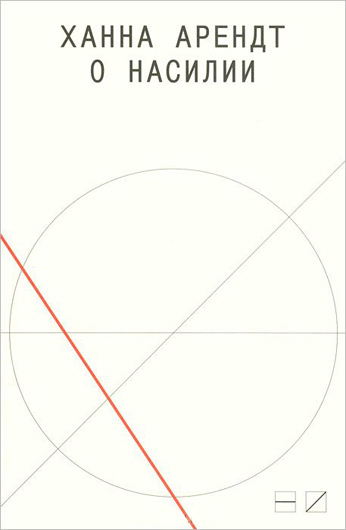
Hannah Arendt. About violence / per. from English. Grigory Dashevsky. - M.: New Publishing House, 2014. - 148 p.