
Translated material
I am the Crimean Tatar
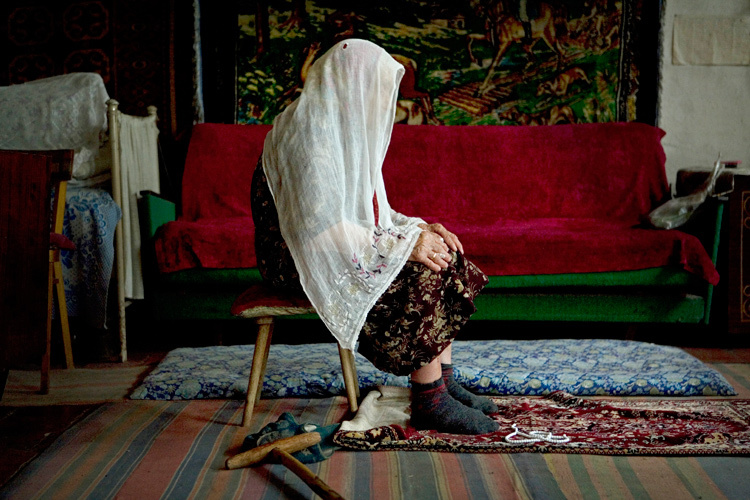
We continue our project “Cinema Believe” - and we expand its geography: the next two shows with discussions will be held in Yekaterinburg. On April 13 at 17:30 we will show the wonderful German documentary film "Traitors of the Motherland" - about the writer Paul Gracik, who worked at the Stasi. And on April 14 at 19:00 - material for the future film about Ukrainian events from the Maidan to Crimea under the conditional name “Ukraine. Reality " .
The discussion of the films will be attended by one of the authors of the Ukrainian documentary project by Beatan, director Oleg Loevsky, playwright Yaroslav Pulinovich and director of the Center for Modern Drama Natalya Sannikova, political scientists Fedor Krasheninnikov and Konstantin Kiselev. Discussion moderator - deputy chief editor of COLTA . Ru Mikhail Ratgauz. Both shows will be held in the House of Cinema. Dear Yekaterinburgers! Come to watch a movie, discuss it and get acquainted!
Bread
I don’t remember my childhood. I remember how my uncle married in Sudak, my sister Indjifa danced at a wedding with our father, and my grandmother gave me a delicious pies and my brother. I also remember how we collected almonds. We had large gardens with walnut trees.
My father had five brothers. Two with him took to the war, and two were shot by the Germans. The older brother was called Ibrahim. He was the first secretary of the executive committee. The second brother was called Rishid. He was the chairman of the collective farm.
The wife of Ibrahim, Aishet, baked bread every day at home, and then he was sent to the partisans with a body. Once with a television, they sent another of my uncle - Ismail. He had to tell them that pike perch would be surrounded, that he had to retreat.
Ismail came to the partisans, but for some reason he could not leave them and he himself was surrounded. He defeated the grass and hid in some pond under this grass. He slept on the trees at night, and hid in the water for days. Ate one bark. And no matter how much we saw with him later - but he went through the war, he lived in Uzbekistan - he was very thin all the time.
And Ibrahim and Rishid were shot. Someone betrayed them and said that they were communists. So at six in the morning they gathered the village, arranged a court, and then executed. All villagers were told that they shot Russian communists.
They did not figure out who the Crimean Tatar is there, and who is not.
I was 4 years old when we were deported. In 15 minutes they ordered to gather. That the mother managed to put in the nodes - they took away. We had no mattresses or pillows. They loaded us into a small on -board ZIL and took us to the station. When the car moved, our cow came running to her. Beautiful, black and white. I am 74 years old, and I still remember how this cow mumbled while running after the car.
As we brought us to Uzbekistan, I do not remember. They settled in a hut in the Begovatsky district, not far from Tashkent. This was called DVZ - a distant evidence zone. The hut was so long. Four families lived in four corners.
And then the wife of Ibrahim, she was called, like me, Aeshet, died. When she was dying, she asked for grapes. Crimean Tatars before death they want something. And now my mother and my brother Memet went to some distance, 18 kilometers to fulfill her desire.
And my father worked in Tula after the war. When I found out that the family in Uzbekistan is tormented, he sent us the parcel. Two pots and sieve. I still remember them. And then he fled from Tula and left for us. I just got a job for a construction site - two policemen came for him and put him in prison for a year.
And my brother Memet went to work. He was 11 years old when he got a job as a master at the factory - to repair motors for tractors. The tractors constantly broke. He repaired the motors very well. He made a special bench - the growth was not enough for such work.
Cotton
From the third grade we collected cotton. A day, 40 kilograms were necessary per day. My older brother and sister gathered at 60. From September to November, the school did not work. And then, when the cotton ended, they collected the “dried apricots”. This is a cotton that has not opened. On the "kuraga" the norm was 120 kilograms. These "boxes" brought us home. Each family is 5-10 bags. We sat and picked this cotton at night.
Then our children collected cotton too. True, my daughter Elvir could not at all, she was constantly hung at school on the board of shame.
From the fourth grade in Uzbekistan, I fought constantly. Because we, the Tatars, were called traitors. Mostly the Russians were offended. The Uzbeks never offended us, they are also Muslims.
I am 74 years old, and I still remember how this cow mumbled while running after the car.
Once, our history teacher Yuri Danilovich detached a fight.
- Aishet! Do not be fighting! You will never prove it. It’s not you to blame, it was simply necessary to give Crimea to others, - so he said. Then I read somewhere that Stalin wanted to relocate all the Jews to the Crimea, but could not and therefore set them in Birobidzhan, I don’t know if this is so.
And we had fights there - horror. Oh, how our Tatars fought when the men began to return from the war. I would try to call someone a traitor - they did not allow the mouth to reveal. In the city of Begovat, a man lived, Tatar. He worked as a truck driver, and all his children knew how to drive this truck. So there was some kind of fight, the seven-year-old kid got on his father’s truck, hijacked her and came to help the Tatars.
Here we had a friendly people.
Radish
There was constantly not enough food, while I was small, so my mother and meme went at night on the field behind the radish. They selected the one that remained after the tractor passes. We ate this radish instead of bread.
Once my mother slept and was late for work. A few days later she was summoned to court. They threatened that they would give two years. Mother sobbed at home - what will the children do?
When my mother came to court, she immediately burst into tears. The woman was alone on the presidium, to calm her down. I asked everything - why my mother was late for work. She began to tell that she lives in the hut, that children have no blankets and pillows - everyone is sleeping on straw, that there are nothing for children. She said that she went to collect a radish. This woman told her that now the whole court would check her words, and took her to the barrack. We, as many people and police officers saw, for some reason immediately thought that they would shoot mom.
The aunt was horrified, because my mother told the whole truth. She and other people from the court left and returned in an hour or two. They brought us all mattresses, pillows, blankets.
We are rich.
Ismail
I well remember that everyone around was given vouchers in the sanatorium as participants in the war, but only by our Crimean Tatars, they did not give anything like that. Because we, even if we fought for the Soviet Union, were still traitors. Even the children, although they had nothing to do with it, did not give vouchers to the pioneer camps. Only Uncle Ismail, who helped the partisans, gave a ticket to the 30th anniversary of Victory. To the Crimea. For memories.
He, after he was hiding from the Germans, managed to stay at the front. I went to the Crimea to the war, and returned to Samarkand. There he met his wife, four children were born in them.
He came to the Crimea with joy. But when he looked, he realized that he could not just take and leave. Then Ismail transported his entire family to Crimea. I bought a house, broke the garden, began to somehow live.
Ismail was not taken to work, they didn’t take his wife, they didn’t even take children to school. His neighbors, Russians and Ukrainians, went even indignant at officials-why didn’t you take children to school? But one of them took and brought it to him that they were living from them, the Crimean Tatar, who bought the house, and put all kinds of vegetables on the site. A tractor arrived, demolished the house and plowed a garden.
Ismail and the family went to another village, bought a second house. Well, the second house was demolished in the same way. I bought the third house then. And again everything was demolished. After the third house, his wife had a heart break. She died. When his wife died, Ismail met some of his relatives in the Crimea, they called to settle next to them.
They lived in Lenin, there is generally one steppe.
Factory
After school, I went to study in Namangan on an accountant. There I was introduced to my future husband. He just returned from the army, then he served for three years, and lived in Miley-Say (a city in Kyrgyzstan on the border with Uzbekistan.- Ed. ). We had a modest wedding, there was almost no vodka. I had a white worshiping dress, and I danced in it so! From my husband I gave birth to three children - Elvira, Gul and the server.
With my husband, we moved to Tashkent. I remember once all the Elvir’s tears came home and says that she will not be taken to school because she is the Crimean Tatar. So the children on the street told her. This means that parents for children said something about us. Everything was good in the end with Elvira. She went to school near the house, in the third grade her director ordered to transfer to a physical and mathematical school. She later received the medal, she wrote the work best, despite the fact that she was not Russian.
After I gave birth to children, I got a job at the factory that I made CTP (complete transformer substations. - Ed. ), Such things for power plants. This plant was very famous, 800 people worked there, and my husband worked on it by the designer. And then the head of the plant Gisersky, a Jew, took me there without documents. Then I had documents at my last work, because they still did not pay for the decree with me. Gisersky knew that I was the Crimean Tatar, that they were doing well to work, so I decided to help. I got there as a senior accountant of the settlement department. And, it happened, until two or until three in the morning, she sat down with calculations. There were no calculators then, and I worked on an arithmometer.
The Tatars generally die early, so much they survived everything.
With me in one office was still a senior accountant of the material department. So thin, evil. So he climbed me from the first day. "How are you - the Crimean Tatar - can you work in the calculation department?" Constantly find fault with me. And the girl Lyuba worked with me, I took her from the workshop to my assistant. She was smart, and beautiful, only limped: one leg is shorter than the other. And then Lyuba once, when this thin began to insult me, picked up a heavy glass for pencils from the table and swung on this man.
He was scared and wrote a statement. Just not for any, but on me. The police arrived at the factory. But the police, before going to my department, first asked the men in the workshop. Everyone told me what kind of mother I am, what an employee. We stood up for me. And the police told me: "Calm down, we all understood."
Then this thin could not enter the workshop and quit.
Marlene
In the 80s each month, the Tatars collected money and sent a delegation from the national movement to Moscow. I remember that Marlene Nebiev (the famous figure of the national movement of the Crimean Tatars. - Ed. ) Constantly traveled from us. His father Poster was the first secretary of the executive committee in Simferopol. Relatives of Osan told him during the war: "You rename your Marlene, otherwise he can be shot." It was impossible the traitor in honor of Marx and Lenin to be called.
Marlene graduated from 10 classes with a medal, was a member of the CPSU, worked as a teacher in Tashkent. Behind him constantly three or four Kagbashniks were monitored. Even when he comes to the tatars for the wake, they still arranged surveillance behind him. Marlene did not decide anything in Moscow. Then he was fired from the school where he worked to the capital. They kicked out of the party. In Crimea, Marlene also achieved something. I organized rallies. And on the nervous ground, apparently, the esophagus cancer fell ill and died.
The Tatars generally die early, so much they survived everything.
Self -seizure
We decided to return with my husband to Crimea in 1988. The husband sold the house, the apartment, put all the money on the book. We went by train, loaded the 20-ton container. We drove three bags of sugar, two bags of flour. We knew that we were going to the Crimea that it would not be smooth there. Elvira and her family moved behind us. Built somehow. They bought rams, bought a cow, planted a garden.
As we arrived, we were robbed immediately. We stole a gas stove with us. Then the money on the book burned. So we arrived: there is no money, they don’t take anyone to work. There are no benefits either. Even to go to the clinic - and it’s hard. Elvira once led her children to the clinic in Crimea. While sitting in line - they began to run along the corridor. And the Russian woman says: “Here, these black -haired Tatars have arrived! Now it will be necessary to sit on the doctor longer! " Elvira grabbed her hair, began to fight. Doctors raised from the offices to separate.
It was hard to live in this house, and three kilometers had to go to the station. And the children grow, everyone needs housing! Then I went to self -selection (the practice of launching land plots widespread among the Crimean Tatars. - Ed. ). At first we arranged rallies in Simferopol. I remember that somehow they stood on Lenin Square, stood and demanded a solution to our question: where to live, how to work. I could not stand already - the chair took with me. A month later, ours sent us to Kamenka (the village of Kamenka, who later became part of Simferopol. - Ed. ). We lived there in tents for the first time.
Now in Ukraine everyone is fighting, planting each other, sharing something, changing flags change.
On the self -capture, Aider looked after us, we called him pinochet, he was so strict. He taught us Molotov cocktails so that we burned wheat sheaves with them. In Kamenka, the wheat was waist -deep, we collected it, and left sheaves without cereals so that they could be set fire to. Auder said that if there is smoke, they will not be able to photograph and plant us.
We had 13 women on self -selection - we prepared food, and the boys of the “shells” - the dump trucks unloaded. Several cars a day. Young guys in the Crimea moved at all with packages: two shirts, two pairs of panties - and that’s all. They were constantly raised by Sinavever Kadyrov (one of the leaders of the Crimean Tatars, a member of the Mejlis. - Ed. ) And Mustafa Dzhemilev (one of the leaders of the Crimean Tatars, People's Deputy of the Verkhovna Rada. - Ed. ). They told them how to behave, so as not to swear. We looked so that there was no drunkenness and fights. I remembered well what kind of Jemilev was then - small and thin, like death! Because he grew up in hunger and in the cold.
Then there was a self -capture in Sofievka. There were already fights! Our guys went there, and there are already tractors - we arrived to demolish houses. Russians or Ukrainians drove them, I don’t know who for sure. When at home they demolished, they began to pick up dishes from women, they went to fight. Then, after all, no one had anything - we threw ourselves together. And so our men scolded women that they climbed into a fight. They said: Do not be fighting for the dishes, do not! Tomorrow will still be dropped.
Own land
Then we settled down, and my husband began to drink. I left him. I just got into the train, went somewhere. I went out on the final one and sobbed. I don't know where to go. I don't know what to do. One girl sheltered at night. He says - do not cry, woman. Come with me, I live nearby. You will be spent with me, and tomorrow you will figure it out. In the morning I went by bus to the Arabat Strelka, in the village of Genica Gorka. I found housing and work there - I got a housekeeper. Then she worked as a watchman in some boarding house. And the times were dashing. I remember that the owner of the boarding house told me: if someone climbs into the boarding house at night, do not lean out. Let them take out at least the entire boarding house, if only you are not killed.
At that time, some politics went. The Tatars began to come. The authorities began to distribute land plots. And now all the areas were distributed. Four children? For all four they will be designed. Small children, big, no matter! But me, despite the fact that I am a Tatar, I also got a site. The owners of the boarding house rewrote the land of their son -in -law. I began to build there. But there was no money anyway - I began to sell my things, then I started driving in Dzhanka - I’ll buy five kilos of bow there and sell it in a piece. In Odessa, I will buy a thousand hryvnias. How some money appeared, ran after building materials. The house raised a small one, started a goat. Due to goat milk and lived. Then I returned to Kamenka, and the children moved there. So we have changed.
I had a story on the Arabat Strelka. A girl approaches my tray and asks in Ukrainian: "Skiles are koshtu?"
“Girl, I don't understand Ukrainian,” I tell her.
“Well, since you live in Ukraine, they should understand,” she replies to me.
Then I told her everything about the Tatars, about the village of Tatar, about deportation. She told her why the place is called the Arabat Strelka. That all the blood of the Tatars is politically. She was very ashamed.
Although I only know my tongue. Here, Meydan is going on (Crimean Tatar radio.- Ed. ) Or ATR (Crimean Tatar TV channel.- Ed. ) Shows-if they say Tatar, I do not understand. "Bun" (the final news program on Atr . - Ed. ) I do not look. And my children do not understand Tatar at all. But they translate the instructions of drugs to me.
I have not learned Ukrainian.
At home
Yesterday they turned off the light, so the Tatar neighbor went and bought a diesel generator so that the TV could be watched. And who turns off, I do not know. I can’t watch TV for recent months without tears. That because of the dead one hundred people on the Maidan I sob. Then the Russians killed Tatar (the body of the Crimean Tatar, the decisions of Ametov found on March 15 with traces of torture. - Ed. ), He had three children. Then the officer was killed in the topographic part (on March 18, a Ukrainian ensign and a veteran of the Second Chechen War, who fought on the side of the Self -Defense Forces of Crimea, died from a sniper bullet. - Ed. ). A pregnant wife is crying. After all, everything lived fine before that! What's happened? What right did they have to kill them?
I am "Meydan" listen and worry everything. This was recently killed, like him, Muzychko. Terrible. He is someone's son! How can you like that? Сейчас в Украине все дерутся, сажают друг друга, делят что-то, флаги-млаги меняют. Стыд и позор! Во время войны тоже флаги меняли, а мне все равно, какой флаг. Лишь бы нас уважали, начали замечать.
Вот, говорят, заметят нас теперь из-за этой истории с присоединением. Но я что-то не верю. Ни от прошлой власти никакого внимания к нам не было, ни от нынешней не будет. Мы на референдум не ходили. Нас, татар, во-первых, никто не звал. Во-вторых, мы бы все равно не пошли. Первый раз нас обманывают, что ли? Вот не верю я, что кто-то к нам постучится, что-нибудь доброе скажет и будет за людей считать.
Вы думаете, татарам нашим что-то будет с этого? Вы думаете, земли нам дадут? Ничего не дадут. Мы никому не верим. Мы ошпаренные уже. Теперь вот сидим и ждем у моря погоды. Что с самозахватом будет моим — не ясно. У меня дочка в Украине прописана. Как мы ездить будем друг к другу — непонятно. Тревожно все это, и что с детьми будет?
Наши мальчики тоже очень пострадали от этой истории. Они со всего Крыма приехали на митинг в Симферополе 26 февраля (митинги крымских татар и пророссийского населения проходили у стен Верховного совета Крыма параллельно и закончились столкновениями. — Ред. ). Их там так избили! Там такая давка была. Они потом отлеживались неделями дома. Родителям ничего не говорят, а встать не могут: все болит.
Может, русские снова выселить нас захотят. Грозят же все друг другу. Вот недавно ехала в троллейбусе, а там женщины русские про нас говорили. Что нас в Турции несколько миллионов живет. «Не дай бог понаедут все», — говорит. Куда понаедут? К себе домой понаедут?!
Когда татар реабилитировали — радости у нас не было. До того мы были измотаны всем. Вот как русские ликовали: в Россию, в Россию! Домой вернулись! А мы куда вернулись?
Мы тоже здесь дома и побольше русских тут живем.