
Translated material
Woe from ultimatum
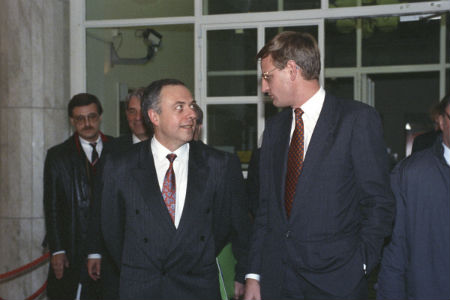
Andrey Kozyrev and Karl Bildt at the SBSU session in Stockholm. Photo: Yu. Abramochkin/RIA "Novosti"
In December 1992, I and some of my colleagues witnessed the event, which then made a lot of noise, and today is almost forgotten. Together with the Minister of Foreign Affairs of Russia Andrei Kozyrev, we flew to Stockholm for the next SBSU session, as the OSCE was called then. Russia was not yet a member of the Council of Europe, and the meeting on security and cooperation was for her the main European forum, to which she sought to give the status of the "European UN".
According to the rules of organization, the meeting is held without the participation of the press. We learned about all the vicissitudes of the discussion, grabbing the sleeve of a member of the official delegation, which went out to ventilate. I met in the cafeteria of the Swedish Prime Minister Karl Bildt, introduced myself and asked him the most acute question of the current policy-about the withdrawal of Russian troops from the Baltic countries. Bildt said that the Sweden government refuses to link the withdrawal of the rights of the Russian population, as Russia insists. I decided that I already have something to write about.
But, returning to the lobby of the conference room, I saw something amiss. A large, fat, fat, fat, overwhelming apoplectic man was coming from the hall - it was Lawrence Igelberger, who acted as a US Secretary of State. He held on to his heart. Following Igelberger proceeded Kozyrev in the same direction.
None of the colleagues really knew anything except that our minister was amazed at everyone. Finally, adviser to Minister Galina Sidorova came out of the meeting room. In her hands, she held the text of Kozyrev’s speech, but did not give it to us, but dictated it. As we read, our jaws dangled.
I have to amend the concept of Russian foreign policy ... The space of the former Soviet Union cannot be considered as a zone of full application of the norms of SBS. This is essentially post -Persian space, where Russia will have to defend its interests using all available funds, including military and economic ones. We will firmly insist that the former republics of the USSR immediately join the new federation or confederation, and this will be a tough conversation ...
After reading, Galya was silent in anticipation of questions. The question was one: "Well, what does all this mean?" All that Galya was capable of at that moment is to make it clear to us that she herself had not seen this text before, and recommend not to rush to Moscow. Meanwhile, Bildt has already commented on Kozyrev’s performance in the most sharp expressions.
Having hidden in the far corner, I admired the marvelous Kozyrevsky text and thought. Kozyrev was one of the most hated parliamentary opposition members of the government. He was charged with "infantile pro -Americanism", "unilateral disarmament" and the betrayal of national interests in general. The requirements of his resignation were distributed in the walls of the Supreme Council with non -consulting regularity and perseverance. The critics were especially infuriated that Kozyrev did not remain silent and did not make excuses, and now and then he got involved in Swara. What are at least the "party of war" and "red -brown" - political nicknames, the authorship of which belongs to Kozyrev. In an interview that I took from him in March 1992, he first warned of the threat of a "nomenclature revenge." In the central apparatus of the Foreign Ministry, he said, 60 percent of employees are people, "either completely demoralized by the system or in direct political opposition to the regime."
On December 1, the VII Congress of People's Deputies opened in Moscow, which became the highest point of the constitutional crisis. Deputies demanded "adjustments to reforms". They refused to approve the acting Prime Minister Yegor Gaidar. In turn, Yeltsin, turning forward to Russian citizens, regarded the actions of the parliament as a “creeping coup” and an attempt to restore the “totalitarian Soviet-communist system”. By the time Kozyrev went to the rostrum of the session in Stockholm, Yeltsin, slamming the door, left the congress and called on his supporters to follow him. However, it was not possible to deprive the congress of the quorum.
Ipadov and smartphones did not exist then, and I could not find out what was happening in Moscow at this moment. But it was clear to me that events were developing according to the worst scenario. Almost no one doubted that Kozyrev was just "voiced" someone else's text on duty. But it was already unimportant. According to my information, some delegations of the CIS states hastily began preparing appeals to the West, including NATO.
Substituting and having shot down the meeting from the agenda, Kozyrev returned to the hall and asked for words for a second performance, from which it turned out that it was a hoax - the minister spent, as he later put it, a session of shock therapy.
I perfectly remember the funeral mood that reigned on board a ministerial aircraft on a reverse flight to Moscow, when it became known that Chernomyrdin was appointed prime minister. Kozyrev did not see himself in the office of Chernomyrdin and was almost sure that he would not only not be approved, but they would not appoint him either.
Sitting on an airplane, the minister said that the “ultimatum of Kozyrev” is the quintessence of the views of far from the extreme opposition. To my question, why, in this case, he limited himself to a temperate option, the minister replied that "to use the extreme theses is dishonest" and that he wanted to preserve "the purity of the experiment." He believed that he had achieved his goal, the shake was useful. The ghost of the right coup in Russia now wanders around Europe. It is now clear to everyone that without democratic Russia, the whole world order will collapse. The minister outlined this gloomy perspective as follows: "A full -scale confrontation with the whole world, including neighbors in the CIS. We will remain in isolation and for many decades will exclude the possibility of any integration in the political space of the former Union."
A little more than twenty years have passed - and today the ultimatum of Moscow is no longer surprising anyone. The nightmare of Europe has become a reality.