
Translated material
Dmitriev leaves the "Center for Strategic Development"
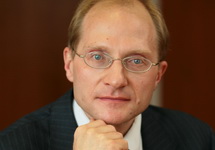
Ex-president of the Center for Strategic Development Foundation Economist Mikhail Dmitriev was finally dismissed from the CSR. This was announced in his LiveJournal by the director of the research fund Sergey Belanovsky. Dmitriev’s team leaves with him, "so far to nowhere, just to the street."
According to Belanovsky, the director of the SSSR North-West, Vladimir Knyaginin, was appointed to the place of Dmitriev. "The organizer of this reassignment was Dmitry Fedorovich Mezentsev, the former governor of the Irkutsk region, and now the Secretary General of the Shanghai Cooperation Organization. He fought for this for almost a year and ultimately achieved his own," Blanovsky wrote.
Dmitriev lost the post of President of the CSR, who has been occupied since 2005, in January of this year. His resignation was then explained the expiration of the term of office. At the same time, he did not consider the candidates for the vacant post of the President of the CSR, and the Council of the Fund, which must appoint the President, in 2013 did not manage to collect the quorum twice. Dmitriev remained the supervisor of the CSR, as well as the chairman of his subsidiary - "TsSR -Region".
Then one of the employees of the Fund told Vedomosti that Dmitriev was refused to reassign to reassign, as he criticized the pension reform. The economist was one of the authors of the 2002 pension reform, which introduced the funded component of the pension. He resisted the actual elimination of the funded part during the new reform and this caused discontent in the social block of the government.
The interlocutor of the newspaper noted that the first signals of such discontent began to come in the summer. Then the deputy chairman of the Council of the Fund, the ex-governor of the Irkutsk region, Dmitry Mezentsev, tore off the attempts to re-election Dmitriev in absentia, insisting on the personal presence of all members of the Council, which was difficult to ensure.
Over the past few years, the CSR has prepared a series of expert reports in which there have been an increase in the discontent of citizens and the request of the company to change. These studies caused a negative reaction of power.
The first report, which appeared in March 2011, predicted mass street protests following the results of the Duma and presidential elections. In the second study, released in May 2012, there was an increase in fatigue from the ruling elite and new protest performances were predicted, despite the dispersal of the rally on Bolotnaya Square. In the third report, published in October 2012, an increase in the number of citizens who considered the revolution not only possible, but also desirable, and as a probable scenario, mass civil disobedience was called the revolution.
In July 2013, another report appeared. It stated that protest moods in the regions are stronger than in Moscow. Particularly high protest potential was recorded in provincial million-plus cities. The CSR also noted that now the electoral equilibrium is much more dependent on the economic situation than in 2006-2010.